
Buying your first home in Boulder usually comes down to two questions: What can I realistically afford here, and how do I avoid an expensive mistake on the property I choose? Boulder makes those questions more complicated than a generic national homebuyer guide suggests. Purchase prices vary considerably by property type and location, attached homes may involve substantial HOA obligations, and individual properties can raise questions about flood exposure, wildfire risk, radon, permits, older building systems, or septic infrastructure.
There are also unusually relevant local assistance options, including City of Boulder programs and Colorado Housing and Finance Authority financing.
This guide explains the Boulder market as of August 2026, how to build a realistic budget, which assistance programs deserve a closer look, how to compare properties and locations, and what to investigate before your contractual deadlines.
What first-time buyers should expect from the Boulder market in 2026
The main takeaway is that a citywide Boulder price statistic is useful for context, but it should not become your shopping budget.** Property type, exact location, condition, HOA structure, and jurisdiction can produce very different purchase and ownership costs.
For context, Zillow reported a typical Boulder home value of $957,377 as of July 31, 2026. Its latest median sale price on the same market page was $897,450 for June 2026. Those figures use different methodologies, which is a useful reminder that “the Boulder home price” is not a single number.

A first-time buyer may be looking at a condo, townhome, smaller detached house, deed-restricted property, or a home farther from central Boulder. Each creates a different financial equation.
Jurisdiction also matters. Do not assume that a “Boulder” mailing address means every City of Boulder rule or housing program applies. Before relying on an assistance program, zoning provision, flood regulation, or permit record, confirm whether the property is actually within Boulder city limits or governed by Boulder County or another municipality.
Your first decision, therefore, should not be “What is the maximum price the lender will approve?” It should be: What combination of purchase price, monthly ownership cost, property condition, and location leaves enough financial room after closing?
Before choosing a price range, compare the true monthly cost of owning a home in Boulder—not just the mortgage payment.
Build a Boulder-specific budget before you start touring homes
A useful Boulder budget includes the entire cost of ownership, not simply principal and interest. Two properties with similar prices can have materially different monthly and long-term costs.
Start with the recurring expenses that may apply:
- Mortgage principal and interest
- Property taxes
- Homeowners insurance
- Mortgage insurance, if applicable
- HOA dues
- Utilities
- Routine maintenance
- Expected near-term repairs
- Property-specific flood insurance or other coverage
- Parking, private road, water, septic, or other location-specific costs where applicable

Property taxes are particularly easy to oversimplify. Boulder County does not apply one universal residential tax percentage to every property. Taxes depend on actual value, state-set assessment rules, and the mill levies of the specific taxing districts serving the property. The county’s published 2026 calculation guidance uses separate residential assessment treatment for school districts and other local governments. Buyers should review the actual tax history and taxing districts for the property rather than relying on a generic online percentage.
Insurance deserves similar treatment. Obtain a property-specific quote early enough to evaluate it before your contractual insurance or due-diligence deadline. Roof age and condition, construction characteristics, prior claims, wildfire exposure, and the insurer’s underwriting standards can all matter. The Colorado Division of Insurance maintains consumer resources specifically addressing homeowners insurance and disaster-related coverage issues.
Compare financing by total cost, not rate alone
Down-payment requirements vary by loan program, and putting 20% down is not a universal requirement. Ask lenders to compare the same loan scenario so you can evaluate the interest rate, APR, mortgage insurance, lender fees, points, monthly payment, and estimated cash needed to close.
Federal mortgage rules generally require a lender to provide a Loan Estimate within three business days after receiving a complete application containing the required information. That standardized form is designed to make competing loan offers easier to compare.
Keep a separate reserve for repairs and ownership surprises rather than using every available dollar for the down payment and closing.
First-time buyer and down-payment programs can change the cash equation
Boulder buyers should investigate assistance before they shop seriously because some programs require education, certification, specific financing, income qualification, or a property inside defined boundaries.
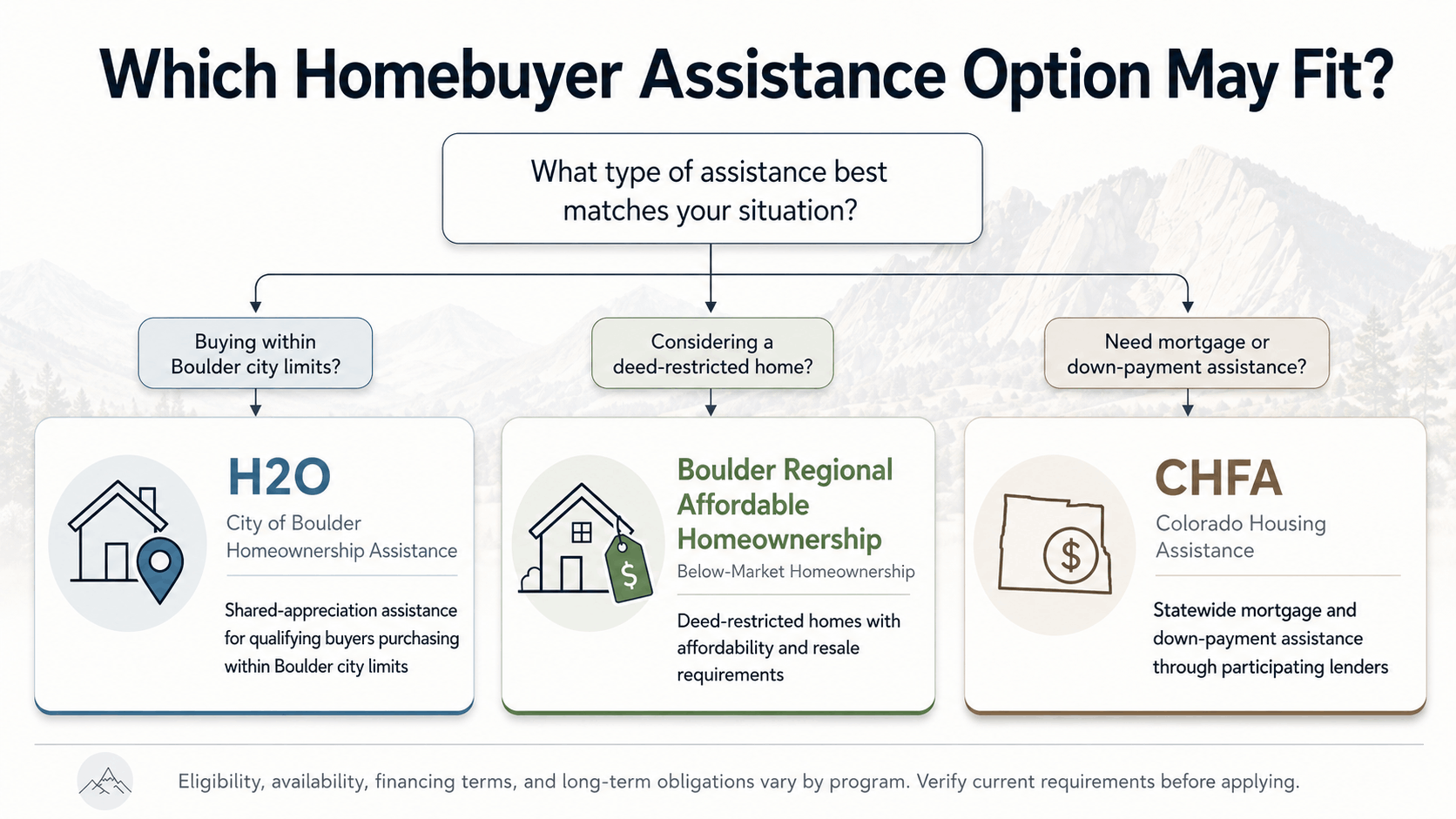
City of Boulder H2O program
As of August 2026, the City of Boulder’s House to Homeownership, or H2O, program provides qualifying first-time buyers with a shared-appreciation second loan of up to $100,000 toward a market-rate home inside Boulder city limits.
The city currently defines an eligible first-time buyer for this program as someone who has not owned a home during the previous three years, with a stated exception for someone divorced during that period. H2O also includes employment, income, asset, owner-occupancy, education, mortgage-qualification, and debt-to-income requirements. Funds are limited and distributed on a first-come, first-served basis.
For 2026, the published H2O income maximum is $126,000 for a one-person household and $144,000 for a two-person household, with separate limits for larger households. Those numbers and program availability should always be rechecked before a buyer relies on them.
The H2O loan does not operate like a simple cash grant. No regular payments are due for 30 years unless a triggering event occurs, but repayment includes the original amount plus a proportional share of the home’s appreciation. Buyers should model that future obligation before choosing the program.
Boulder Regional Affordable Homeownership Program
The Boulder Regional Affordable Homeownership Program, historically known as the Permanently Affordable Homes Program, offers below-market-price homes to qualifying owner-occupants. These properties carry an affordability covenant that restricts future resale pricing and imposes other ownership requirements. Unlike H2O, the regional program is not limited to first-time buyers.
That distinction matters. A lower acquisition price can help with affordability, but the resale formula and covenant affect how equity and future sale proceeds work. Read the specific covenant for the property rather than treating a deed-restricted home like an unrestricted market-rate property.
CHFA assistance
The Colorado Housing and Finance Authority also offers statewide mortgage and down-payment programs through participating lenders. As of August 2026, CHFA advertises a down-payment assistance grant of up to the lesser of $25,000 or 3% of the first mortgage, or a deferred second-mortgage option of up to the lesser of $25,000 or 4% of the first mortgage. These options must be paired with eligible CHFA first-mortgage financing, and program restrictions apply.
CHFA-approved homebuyer education is required for CHFA borrowers, and its current education certificates are valid for 12 months.
Do not choose assistance based only on the amount offered. Compare the mortgage rate, repayment provisions, resale or shared-appreciation restrictions, occupancy requirements, income limits, and total long-term cost with a participating lender and the program administrator.
Choose the property and location by trade-offs, not labels
The practical first-home question is not which Boulder neighborhood is “best.” It is which property gives you the right combination of cost, condition, transportation, housing type, and ownership obligations.

A condo or townhome can reduce the individual owner’s responsibility for certain exterior or common-area maintenance, but the HOA becomes part of the financial analysis. Review current dues, budgets, reserves, master insurance, deductibles, pending or recent special assessments, litigation, maintenance history, parking rules, renovation restrictions, and any rental limitations that matter to your plans.
Colorado’s Division of Real Estate maintains the state HOA Information and Resource Center, and Colorado common-interest communities may be governed by the Colorado Common Interest Ownership Act and their recorded governing documents.
Detached homes usually place more maintenance responsibility directly on the owner. In established Boulder neighborhoods, that can mean budgeting for older roofing, electrical, sewer, drainage, foundation, heating, or remodeling work. Boulder County reports that just over 40% of county housing units were constructed before 1978, reinforcing the value of reviewing age-specific building and environmental issues.
If Boulder proper does not produce the right combination of property type and monthly cost, compare current inventory in nearby communities such as Louisville, Lafayette, Superior, Longmont, Erie, or other relevant areas. Do not assume the neighboring municipality is automatically less expensive. Compare current purchase prices, taxes, HOA obligations, commute routes, insurance, and property condition using the same criteria.
If school assignment is important to your decision, use the Boulder Valley School District K-12 School Finder for the exact address. BVSD specifically advises users to verify addresses near attendance boundaries with the district rather than relying on third-party representations.
For transportation, RTD’s current Flatiron Flyer service connects Boulder with stops along the US 36 corridor and Denver. Service and schedules change, so evaluate the actual route you would use rather than relying on a generic commute estimate.
Boulder buyers need property-specific flood, wildfire, radon, permit, and system checks
A normal home inspection is only the starting point in Boulder. The next step is matching the investigation to the exact property.
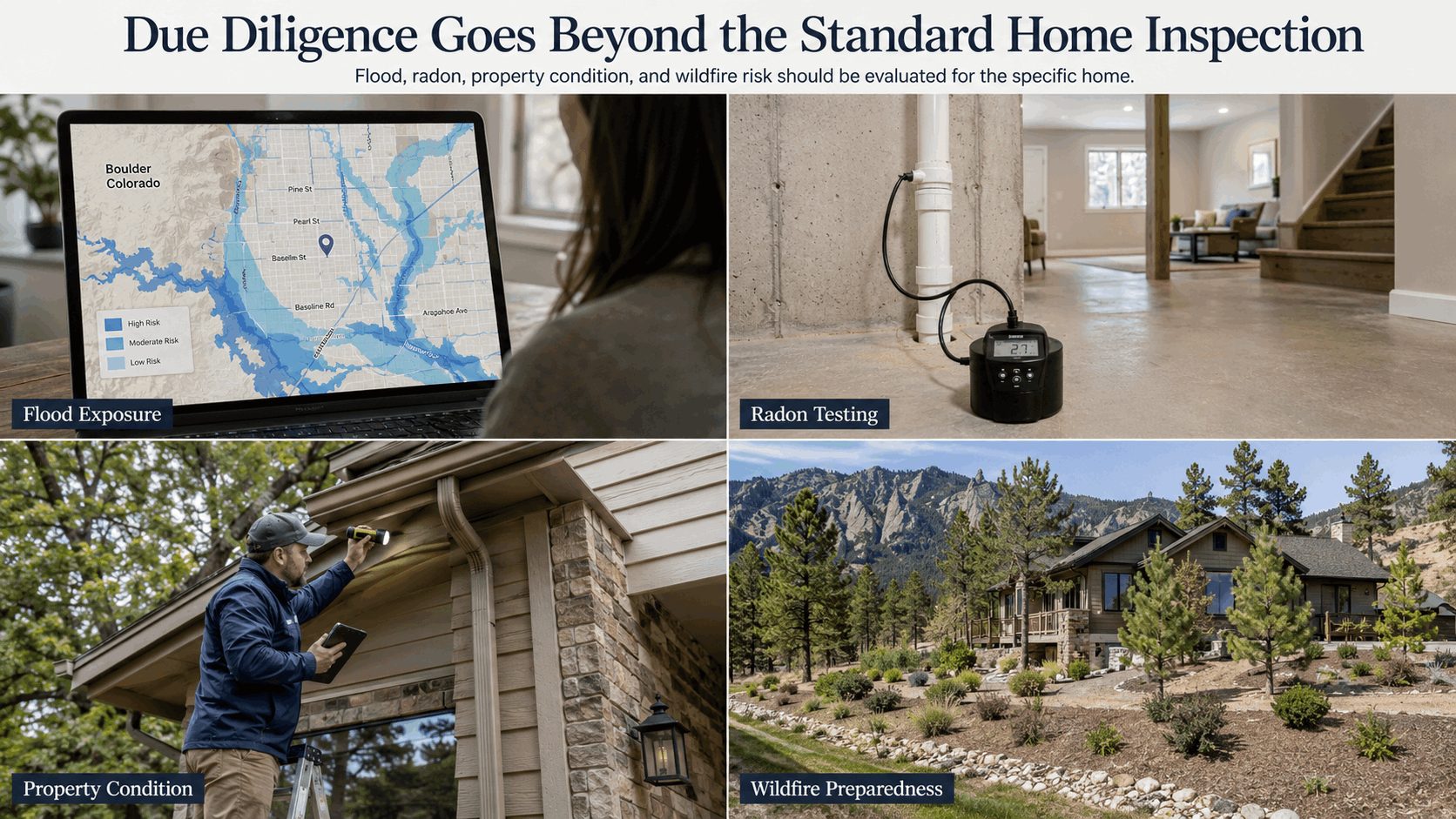
Flood exposure
The City of Boulder maintains an interactive floodplain map, and FEMA flood maps are used for federal insurance and regulatory purposes. The city notes that a FEMA Special Flood Hazard Area generally represents land with a 1% or greater annual chance of flooding. Flood maps can also be revised, so check the current address rather than making assumptions from distance to Boulder Creek or another drainageway.
If a property appears in or near a mapped flood area, investigate applicable insurance requirements, elevation information, development restrictions, prior mitigation, and any available elevation certificate.
Wildfire and homeowners insurance
Wildfire diligence is not limited to remote mountain houses. Boulder County maintains wildfire-zone and historical-fire resources and provides mitigation guidance through Wildfire Partners. The applicable risk, construction features, vegetation, access, and available insurance should be evaluated for the individual property.
Obtain the insurance quote before your contract deadline, not after inspection negotiations have ended.
Radon
Boulder County Public Health reports that approximately one in two Boulder County homes has elevated radon levels and identifies the county as EPA Zone 1. Testing is the way to determine a particular home’s result.
A mitigation system, where needed, is different from evidence that a current system is operating correctly. If a home already has mitigation equipment, confirm its condition and testing history.
Permits, zoning, historic status, and improvements
For homes in the City of Boulder, the city’s property-information resources provide access to zoning, flood information, historic-district and landmark maps, permit information, rental-property information, and other property records.
Compare records with what you physically see. Finished basements, additions, decks, converted garages, major electrical work, and other alterations deserve follow-up when permit history is incomplete or unclear.
Sewer, septic, and rural systems
A sewer scope can reveal conditions that a general inspection cannot see. For properties using an onsite wastewater treatment system, Boulder County has a specific property-transfer process. Subject to listed exemptions and alternative compliance paths, county rules require qualifying septic systems to satisfy inspection and property-transfer requirements when ownership changes.
Rural and mountain properties can require additional investigation of wells, septic capacity, private roads, access, wildfire mitigation, drainage, and utility service.
No map, disclosure, or inspection should be treated as a guarantee. Buyers should independently verify school boundaries, zoning, insurance availability, property condition, HOA obligations, permits, flood status, wildfire information, septic or well records, and other property-specific facts with the appropriate agency or qualified professional.
A practical first-time buyer process from preapproval to closing
The most reliable way to make a first Boulder purchase manageable is to put financing, assistance eligibility, property research, and contract deadlines in the correct order.
A practical sequence looks like this:
- Set your ownership budget. Decide what total monthly payment and post-closing reserve work for your finances before using the lender’s maximum approval as a shopping target.
- Interview lenders and obtain financing scenarios. If CHFA, H2O, or another assistance program might matter, raise it before making offers.
- Complete required education or program certification early. Some assistance programs require steps that cannot be solved at the closing table.
- Define property criteria objectively. Compare housing type, HOA obligations, condition, location, transportation, jurisdiction, and likely repair exposure.
- Review the offer before signing. Understand price, earnest money, financing terms, inspection provisions, appraisal terms, title matters, HOA-document deadlines, insurance deadlines, and every date that could affect your rights. Colorado’s Division of Real Estate publishes the current Commission-approved residential contract and related forms for 2026.
- Perform property-specific diligence. Coordinate the general inspection with appropriate radon, sewer, roof, structural, flood, wildfire, septic, well, HOA, permit, title, insurance, or specialist investigations.
- Complete financing and appraisal requirements. Avoid making major financial changes or taking on new debt without discussing the impact with your lender.
- Review final loan documents. For covered mortgage transactions, the lender must generally provide the Closing Disclosure at least three business days before closing, giving you time to compare it with the Loan Estimate and question unexpected changes.
- Complete the final walkthrough and closing. Verify agreed property conditions and review the final documents before signing.
The goal is not to find a property with zero risk. Every home has maintenance obligations and trade-offs. The goal is to understand the material risks, quantify what you reasonably can, and decide whether the specific home still fits your finances and plans.
If you are preparing to buy your first home in Boulder, Eric can help you compare properties, local programs, HOA considerations, inspection priorities, and offer strategy based on the specific home you are considering. Online guides are a useful starting point, but they cannot replace reviewing the actual contract, HOA documents, permit history, insurance quote, inspection findings, lender terms, or your individual financial situation.
FROM OUR BLOG


Boulder Homeowners Insurance 2026: Wildfire, Hail & What Buyers Need to Know
Buying a home in Boulder involves more than finding the right neighborhood, negotiating a purchase price, and qualifying for a mortgage. There is another important consideration that can affect both the monthly cost of ownership and the ability to complete a purchase: homeowners insurance. In Boulde

Boulder Down Payment Assistance 2026: How First-Time Buyers Can Get Up to $100,000
For many Boulder buyers, the challenge is not simply qualifying for a monthly mortgage payment. It is getting enough cash together for the down payment, closing costs, reserves, and everything else that comes with buying a home in one of Colorado's more expensive housing markets. What many buyers do
Boulder ADU Rules 2026: Can You Build, Rent, or Add an ADU to Your Property?
Accessory dwelling units have become one of the most useful—and frequently misunderstood—housing options in Boulder. An ADU can create a separate place for an aging parent, an adult child, a long-term tenant, a home office setup with living space, or even a future downsizing option for the homeowner