
Renting out a home in Boulder involves more than finding a tenant, setting a monthly rent, and signing a lease.
Before most residential properties inside Boulder city limits can legally be advertised or rented, the owner must obtain a rental housing license from the City of Boulder.
That requirement can apply whether the property is a detached house, condo, townhome, apartment, or accessory dwelling unit (ADU).
The licensing process also involves property inspections, safety standards, energy-efficiency requirements, and ongoing responsibilities for landlords.
For someone buying a Boulder property with plans to generate rental income, understanding those requirements before closing can be just as important as calculating the expected rent.
The good news is that the process becomes easier to navigate once you understand the difference between licensing, inspections, SmartRegs, and other applicable regulations.
Here's what Boulder property owners and real estate investors should know in 2026.
Do You Need a Rental License in Boulder?
For most residential properties inside the City of Boulder, yes.
The city's rental housing regulations require residential rental properties to maintain a valid license, subject to specific exemptions.
The rules generally apply to properties such as:
-
Detached houses rented to tenants
-
Condos and townhomes offered for rent
-
Apartments and other multifamily rental units
-
Rooming units
-
Legally established accessory dwelling units offered for rent
The requirement is not limited to professional landlords or owners with several investment properties.
Someone who purchases a single Boulder home and intends to rent it out may still need to complete the same licensing process.
Long-Term vs. Short-Term Rentals
Boulder distinguishes between two common types of rentals.
| Rental type | Rental duration | General licensing category |
|---|---|---|
| Long-term rental | 30 days or more | Standard rental housing license |
| Short-term rental | 29 days or fewer | Short-term rental license |
These categories are important because they have different eligibility, inspection, and operational requirements.
For example, a standard long-term rental generally requires a rental inspection and SmartRegs compliance.
A conventional short-term rental generally must be the owner's principal residence and follows a separate licensing process.
A long-term rental license does not automatically authorize Airbnb-style short-term rental activity.
The City also has a separate festival-lodging program for approved events, but that program has its own limitations.
Official source: City of Boulder Rental Housing Licensing
Are There Exceptions to Boulder's Rental License Requirement?
Yes, but the exceptions are more specific than many homeowners realize.
The City identifies circumstances in which an owner may qualify for an exemption from the standard long-term rental-license requirement.
Owner-Occupied Property
One exemption can apply when an owner, or a qualifying family member age 21 or older, occupies the dwelling and rents to no more than two people unrelated to the owner's family.
This is different from renting out the entire property after moving elsewhere.
Owners seeking this exemption should submit the city's Owner/Relative Occupied Rental License Exemption Affidavit.
Temporary Rental of a Primary Residence
Boulder also provides an exemption pathway for certain owners who temporarily rent their principal residence while living outside Boulder County.
The City lists several conditions, including:
-
The property was the owner's principal residence.
-
The owner occupied it immediately before the rental.
-
The rental lasts no more than 12 consecutive months during any 24-month period.
-
The owner temporarily lives outside Boulder County.
-
The owner intends to return and reoccupy the dwelling.
All applicable conditions must be satisfied.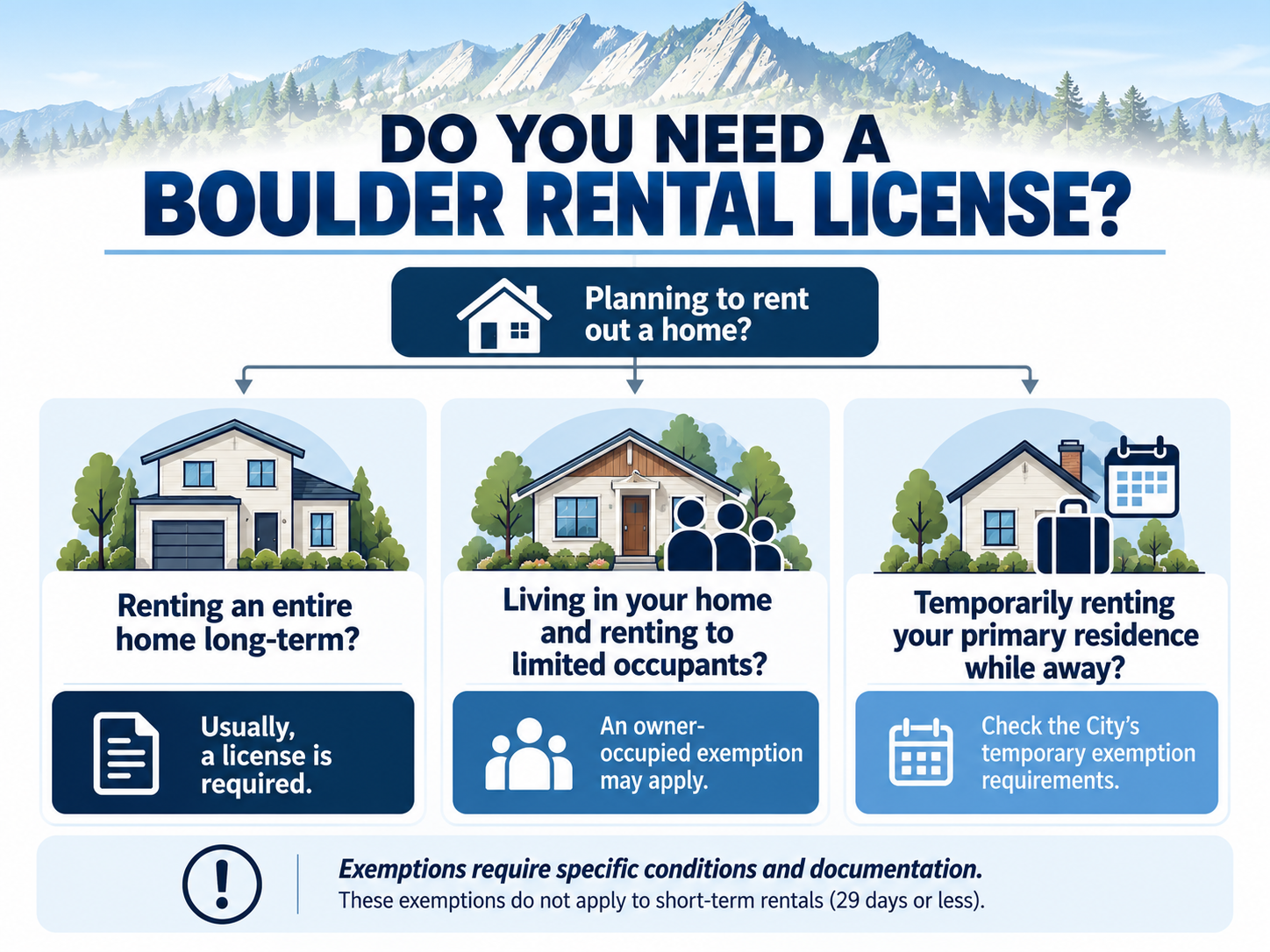
Owners should not assume that simply renting for less than a year automatically qualifies them for this exemption.
These exemptions also do not replace the separate requirements for short-term rentals.
The practical takeaway: Before relying on an exemption, verify the conditions and submit the appropriate affidavit.
Official source: City of Boulder Long-Term Rental Licensing and Exemptions
How to Apply for a Boulder Rental License in 2026
The application process involves more than completing an online form.
A property must also meet applicable safety and energy-efficiency standards.
For a typical long-term residential rental, the following sequence provides a practical starting point.
Step 1: Verify the Property's Jurisdiction and Existing License
Start by confirming that the address is inside City of Boulder limits.
A Boulder mailing address does not automatically mean the property is located within the city.
Next, check whether the property already has an active rental license.
The City provides a public Licensed Residential Rental Properties Map and rental-property list.
City of Boulder Rental Licensing Page and Property Lookup
Step 2: Review the Property's Existing Condition
Before scheduling inspections, walk through the property and identify obvious maintenance or safety issues.
Check smoke alarms, carbon monoxide alarms, doors and windows, visible plumbing problems, heating equipment, and other items covered by the city's Property Maintenance Code.
A property does not need to be new or recently remodeled to qualify, but it must satisfy applicable minimum standards.
Step 3: Schedule a Rental Housing Inspection
Contact an inspector licensed by the City of Boulder.
The City maintains a list of inspectors who are authorized to perform rental housing inspections.
Inspection companies are private businesses, so homeowners should verify current credentials, compare pricing, and confirm what services are included.
Step 4: Complete SmartRegs Requirements
Long-term rental properties generally must demonstrate compliance with Boulder's energy-efficiency standards before submitting the rental-license application, unless an applicable exception has been approved.
Depending on the property's history, this may involve reviewing existing certification or arranging a SmartRegs inspection.
Step 5: Address Any Required Corrections
If an inspection identifies work that must be completed, the owner should arrange the necessary repairs and any required reinspection or verification.
Some issues may be relatively minor.
Others may involve licensed contractors, additional permits, or more extensive improvements.
Step 6: Submit the Rental License Application
After the required compliance documentation is ready, submit the application through the city's online process.
The City may request supporting documentation or further information.
Step 7: Pay the Applicable Fees and Obtain Approval
Once the application is processed, the City provides payment instructions through its Customer Self-Service Portal.
The standard 2026 rental housing license fee is $190.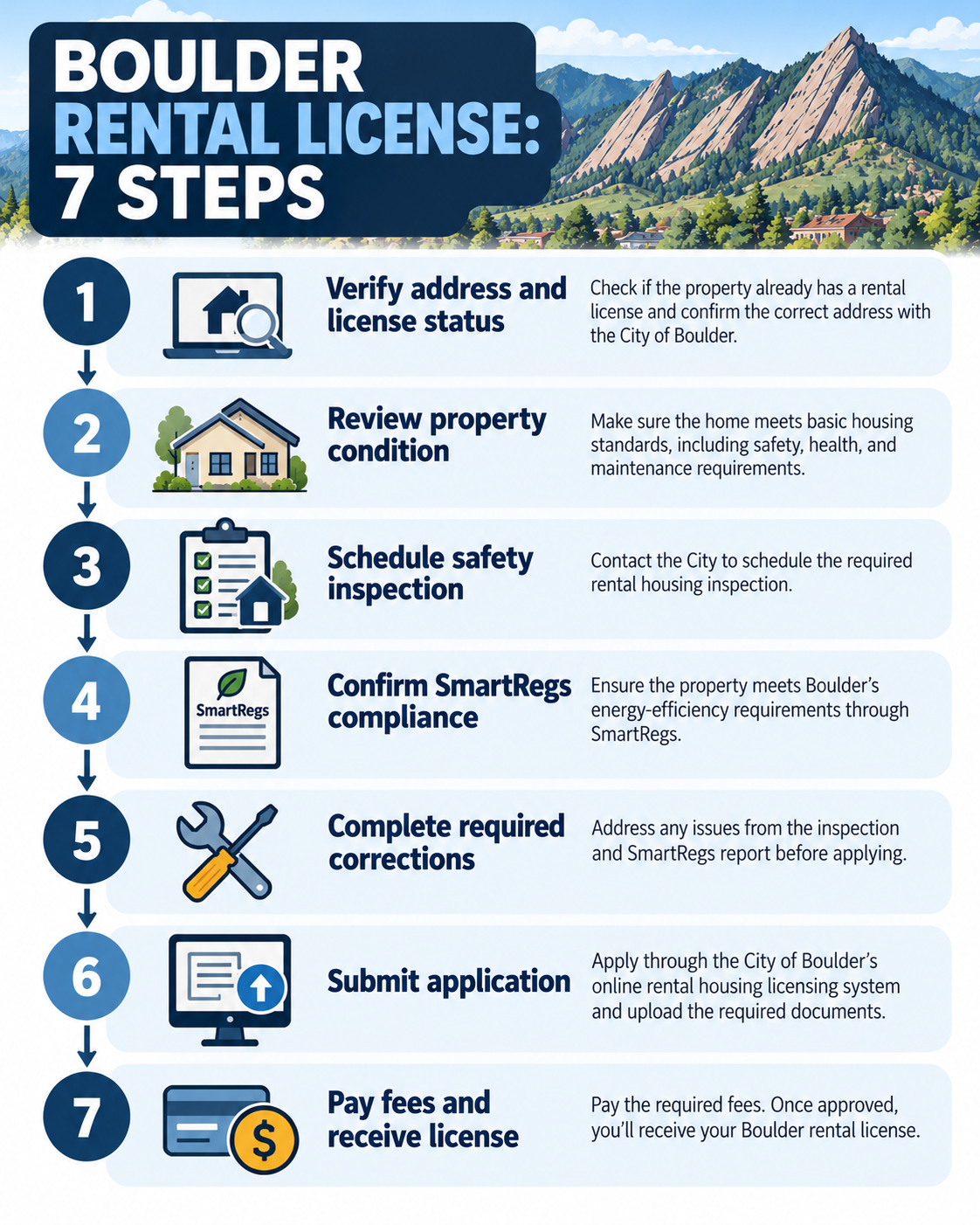
Owners should wait for the appropriate license approval before advertising or offering the property for occupancy, except where the City expressly permits a qualifying pre-leasing arrangement for new construction.
Official application: City of Boulder Long-Term Rental License
What Does a Boulder Rental Inspection Check?
Boulder requires qualifying rental properties to pass an inspection addressing minimum property maintenance and safety standards.
The City identifies four major inspection areas:
General life safety: Conditions involving safe occupancy, access, and other required safety provisions.
Plumbing facilities: The availability and functioning of required plumbing fixtures and systems.
Mechanical and electrical systems: Relevant standards for heating, electrical equipment, and other building systems.
Fire safety: Requirements intended to reduce hazards and support safe occupancy, including applicable alarm and egress provisions.
The inspection must be completed by an appropriately licensed private inspector.
If the property meets the applicable requirements, the inspector provides a signed compliance verification form.
If corrections are needed, the owner may have to complete repairs and obtain additional verification.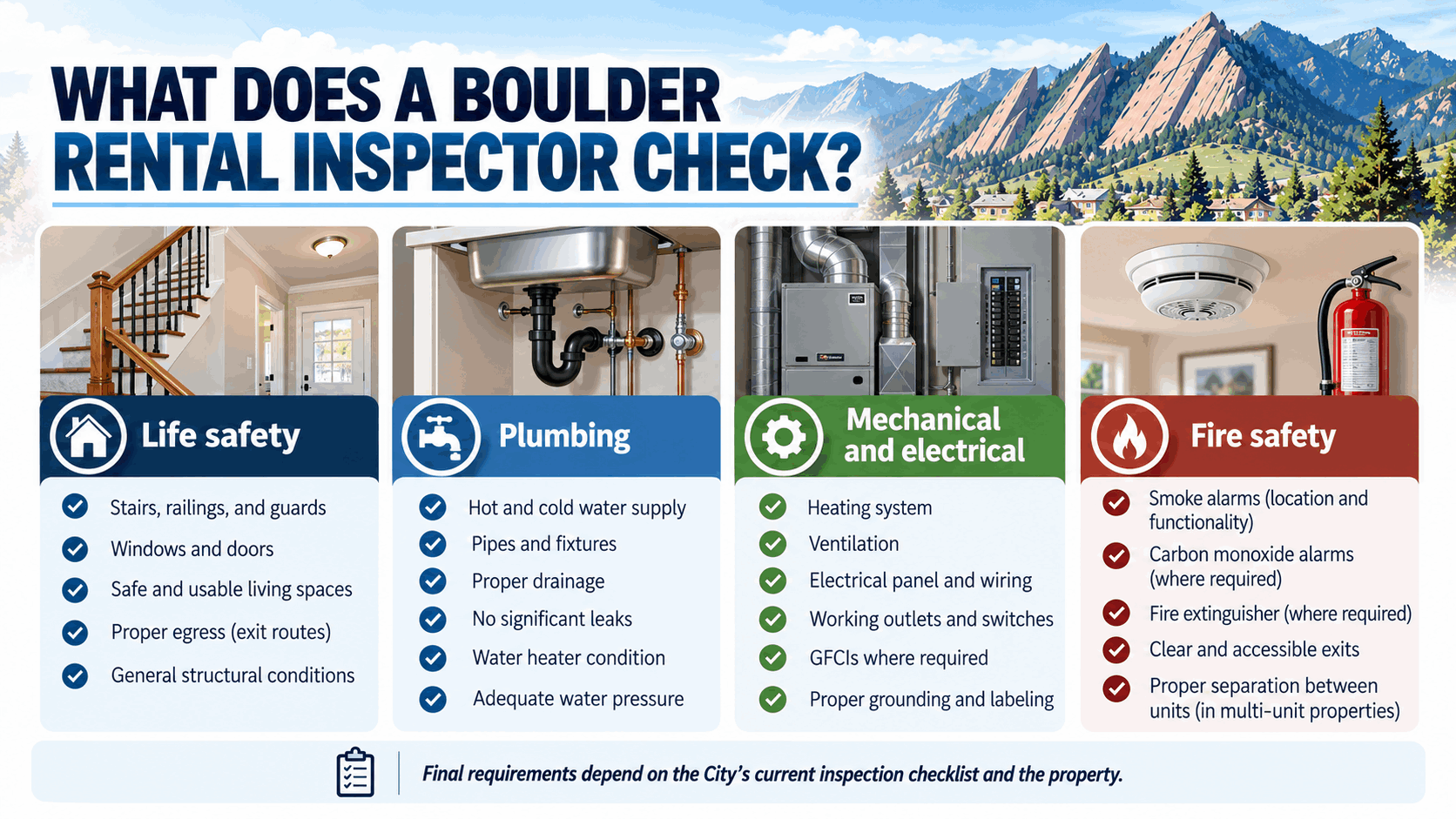
What If the Property Fails the Inspection?
A failed inspection does not necessarily mean the property can never be rented.
It means the identified compliance issues must be addressed through the process required by the City.
The scope of the work matters.
Replacing a missing alarm is very different from correcting unsafe electrical equipment or an improperly converted living area.
Buyers considering an older Boulder rental property should account for this possibility before assuming the property can generate rental income immediately after closing.
For additional property-condition guidance, see my Boulder Home Inspection Checklist, which covers radon, sewer lines, drainage, roofing, and other common due-diligence considerations.
A standard homebuyer's inspection is not a substitute for the City's required rental-license inspection.
Official source: Boulder Rental Inspection Requirements
What Is SmartRegs, and Why Does Boulder Require It?
SmartRegs is Boulder's rental housing energy-efficiency program.
It requires licensed long-term rental housing to meet a basic energy-efficiency standard, subject to recognized exceptions.
The program is separate from the rental housing safety inspection.
That distinction is important because a property can appear structurally sound and still require energy-efficiency work before qualifying for a license.
How SmartRegs Compliance Works
The City provides different compliance pathways.
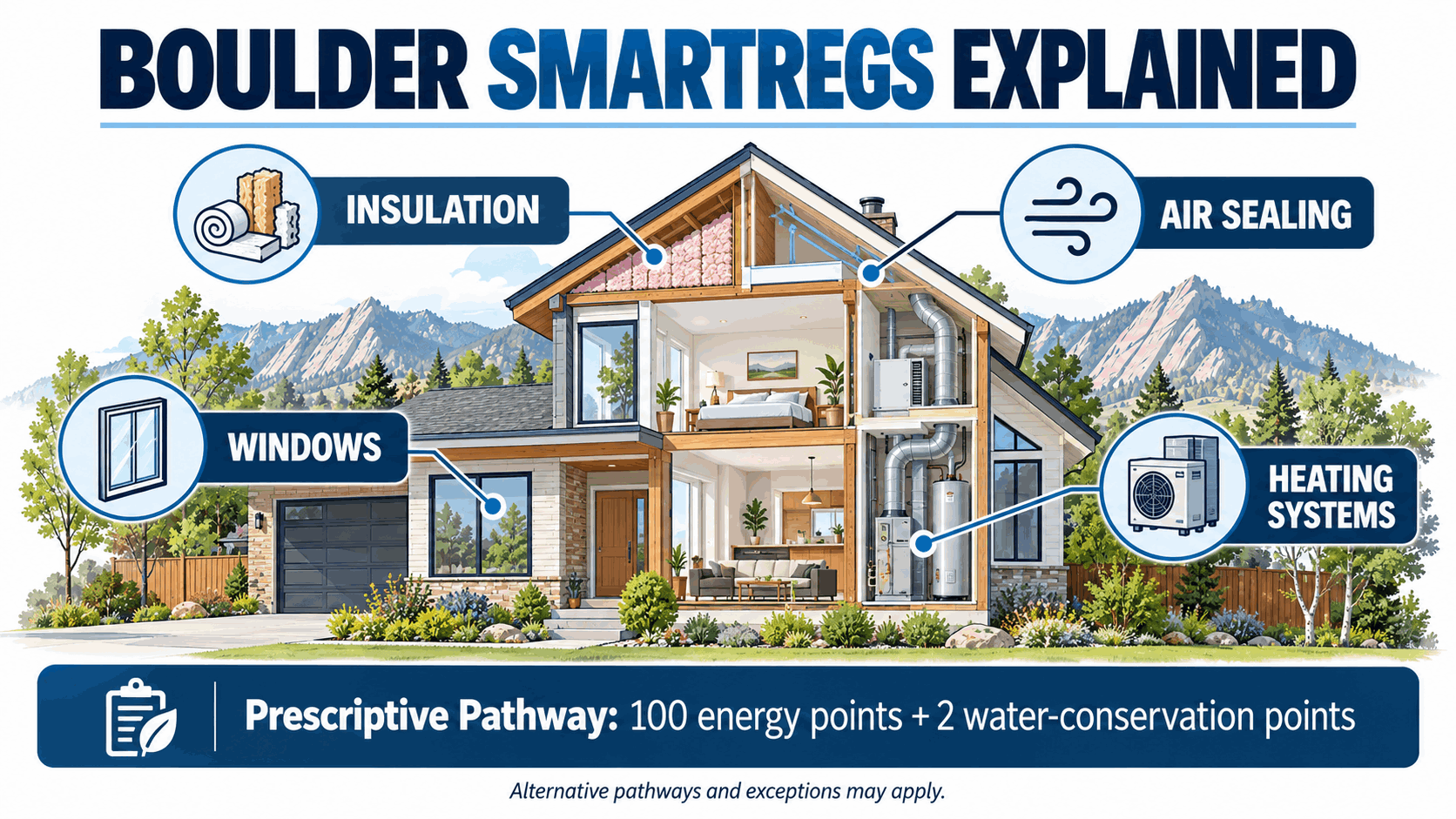
One option is the Prescriptive Pathway, which uses a points-based assessment.
Under the City's published standards, a unit following this pathway must earn at least:
100 energy-efficiency points and two water-conservation points.
A certified energy-efficiency inspector evaluates the property and identifies whether improvements are needed.
Depending on the property's condition, qualifying improvements might involve insulation, air sealing, heating systems, windows, or other energy-related measures.
There is also a performance-based compliance pathway.
The correct approach depends on the property's characteristics and applicable program rules.
The City notes that some properties qualify for exceptions, so owners should verify existing certification and eligibility before paying for unnecessary work.
Why This Matters When Buying an Investment Property
Consider two similar rental houses.
One already has documented SmartRegs compliance and a current rental license.
The other requires a new license, additional insulation, repairs, and verification work.
Both may appear capable of producing the same monthly rental income.
But the second property can involve considerably more upfront expense and a longer period before it can legally be placed into service.
That difference should affect a buyer's evaluation of the property.
Official source: City of Boulder SmartRegs Guide
SmartRegs Prescriptive Pathway
How Much Does a Boulder Rental License Cost in 2026?
According to the City's published 2026 fee schedule, a standard long-term rental housing license costs $190.
The license generally has a four-year renewal cycle.
However, the City's application fee is not necessarily the total amount an owner will spend preparing a property for rental use.
Official Boulder Rental Licensing Fees
| Fee | 2026 amount |
|---|---|
| Standard rental housing license | $190 per license |
| ADU rental housing license | $190 per unit |
| Cooperative housing unit license | $190 per unit |
| City investigative inspection fee | $250 per inspection |
| SmartRegs services fee | $100 per license |
| Short-term rental business license fee | $25 |
| Short-term rental annual certification fee | $20 |
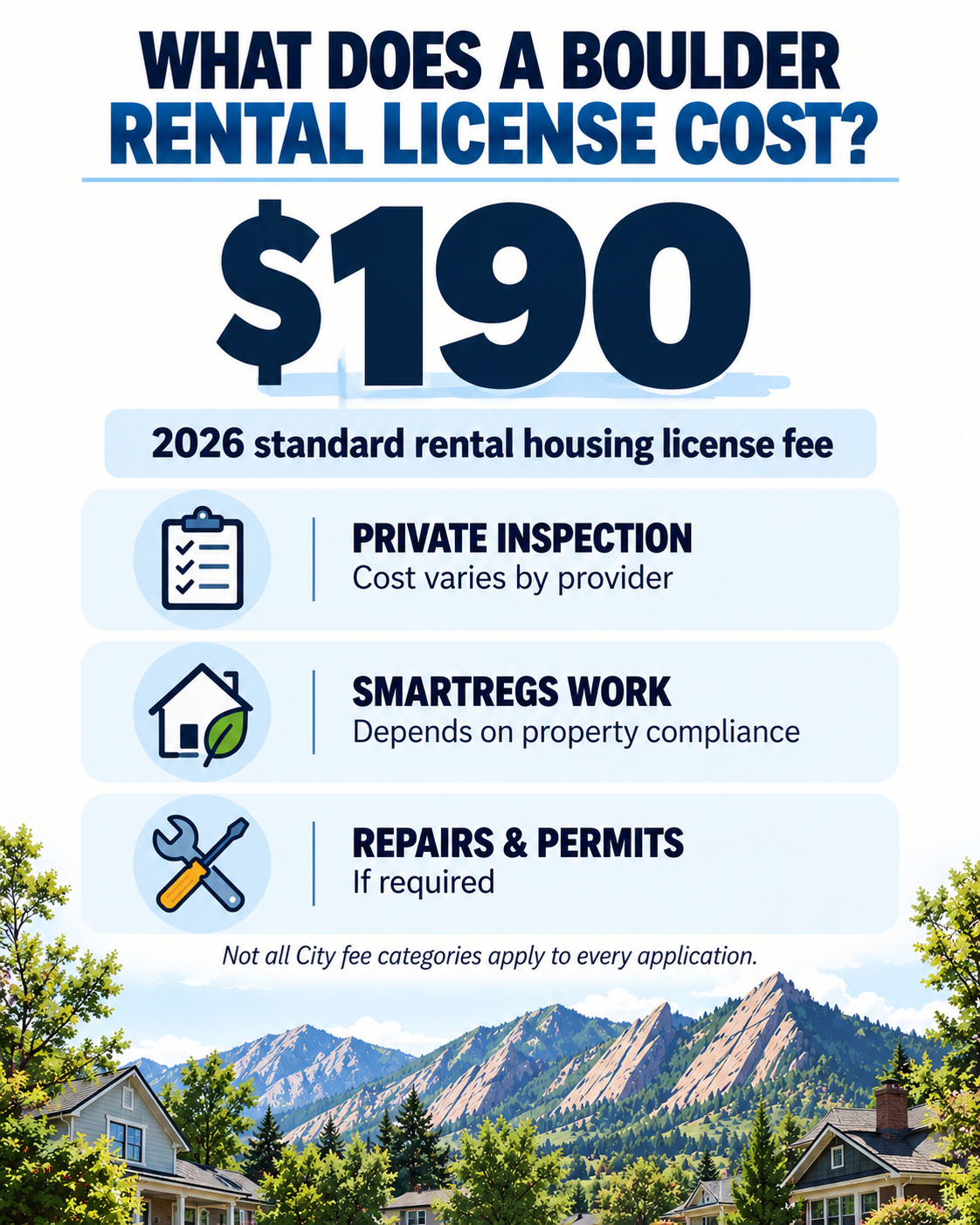
These are the City's published fee categories. They are not all charges that every standard long-term rental applicant automatically pays.
The $250 investigative inspection fee, for example, is not the normal privately contracted inspection price. The SmartRegs services fee is also a listed City fee category rather than a blanket additional charge for every owner.
Additional Costs to Budget For
Owners may also need to pay for:
-
Private rental housing inspections
-
SmartRegs assessments or certification work
-
Required repairs or improvements
-
Contractor services
-
Reinspections where necessary
-
Permits for qualifying repair or renovation work
-
Ongoing property maintenance
The City does not set the fees charged by private rental inspectors.
That means homeowners should request quotes directly from licensed inspection companies.
When evaluating an investment property, the more useful figure is the complete cost of getting the property legally ready for tenants, not simply the $190 application fee.
Official source: City of Boulder 2026 Schedule of Fees
How Long Is a Boulder Rental License Valid?
A standard rental housing license generally follows a four-year renewal cycle.
Renewal is not simply a matter of paying another fee.
The City requires another rental housing inspection, along with continued compliance with applicable standards.
Owners should track their specific license expiration date rather than assuming that all Boulder rental licenses renew on the same calendar date.
What Happens If the Property Is Sold?
A rental license should not be assumed to transfer automatically to a new owner.
The City requires a new licensing process and rental inspection when ownership changes.
That is particularly relevant when purchasing an existing rental property.
A seller may have a valid rental license today, but that does not mean the buyer can simply continue using the seller's license after closing.
Can Code Violations Affect the License Term?
Yes.
The City explains that certain land-use violations can result in a reduced license term of 12 months, while qualifying housing-code violations can result in a 24-month term.
Owners should therefore treat ongoing compliance as part of managing the property—not just an administrative requirement every four years.
Official source: Long-Term Rental Licensing and Renewals
What Are Boulder's Rental Occupancy Rules in 2026?
One important change for landlords concerns how many people can live together in a residential unit.
In April 2024, Colorado enacted HB24-1007, restricting residential occupancy limits based solely on whether people are related.
Boulder subsequently changed its local regulations to comply with state law.
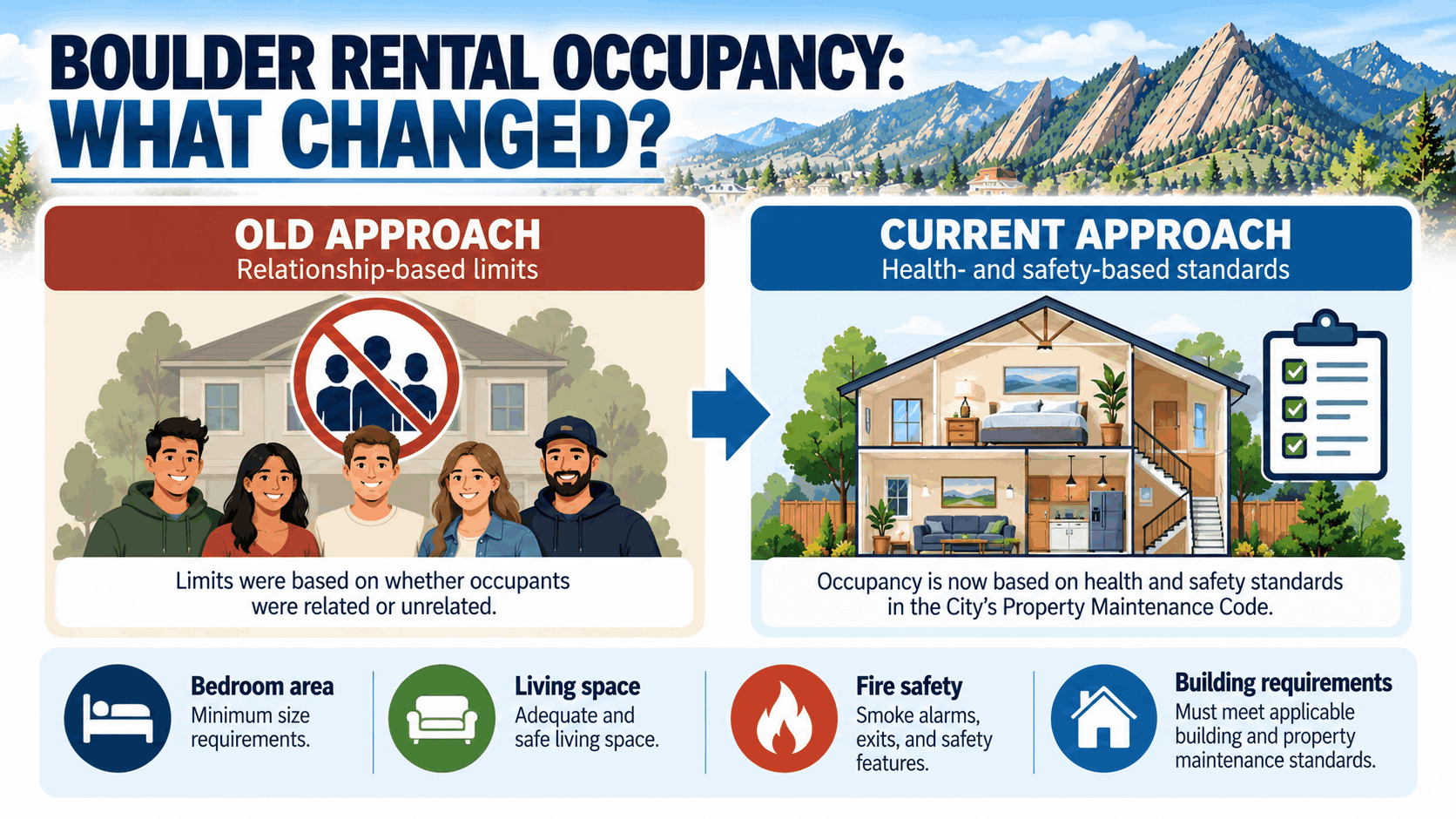
As a result, older rules referring to a fixed maximum number of unrelated occupants should not automatically be treated as current.
However, this does not mean that a Boulder rental property can house an unlimited number of residents.
The City continues enforcing health- and safety-based occupancy standards through its Property Maintenance Code.
These include minimum sleeping-room and living-space requirements.
For example, the City's occupancy guidance identifies a minimum bedroom area of 70 square feet, with at least 50 square feet per bedroom occupant, along with other applicable space standards.
These requirements matter when evaluating student rentals, shared housing, converted bedrooms, and other properties designed for multiple occupants.
A landlord should determine occupancy based on the actual legally permitted dwelling configuration and applicable safety standards—not simply the number of beds that can fit into a room.
Official source: City of Boulder Occupancy Limits
Do ADUs Need a Rental License in Boulder?
Yes, when an accessory dwelling unit is offered for rent under circumstances requiring licensing.
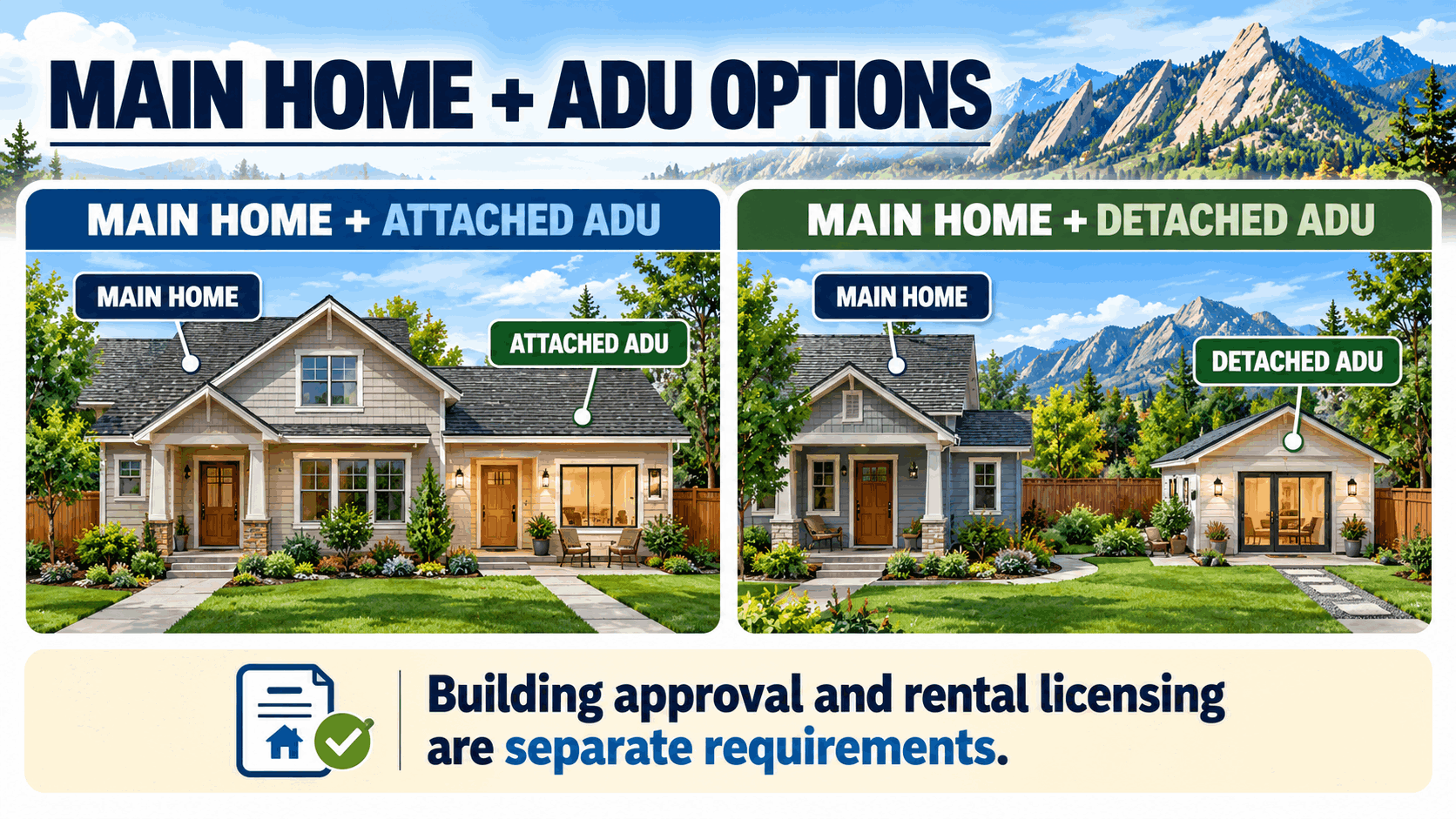
An ADU is a separate dwelling with its own facilities for cooking, sleeping, and bathing.
Although Boulder has made it easier to establish ADUs on many residential properties, the ability to build an ADU and the ability to rent that ADU are separate regulatory questions.
For a qualifying long-term rental, the owner must address the applicable rental licensing and inspection requirements.
A legally built ADU is not automatically licensed as a rental simply because it received building approval.
Owners should also review whether the primary dwelling is being rented and whether additional licensing applies.
What About Short-Term ADU Rentals?
Boulder's short-term rental rules are considerably more restrictive.
The City generally does not allow newly established ADUs to operate as conventional short-term rentals. Limited grandfathered situations may exist for qualifying previously established units and licenses.
This is particularly important for buyers who see a property marketed as having a backyard cottage or secondary apartment.
A legal ADU does not automatically equal a legal Airbnb.
For additional details about zoning, size limits, owner-occupancy changes, and ADU eligibility, see my Boulder ADU Rules 2026 guide.
Official source: City of Boulder Accessory Dwelling Units
Are Short-Term and Festival Rentals Different?
Yes.
A standard Boulder short-term rental is generally a rental lasting 29 days or fewer.
The conventional short-term rental program requires the property to meet principal-residence requirements and obtain an appropriate license.
The City also requires annual certification to maintain short-term rental eligibility.
A non-owner-occupied investment property should not be assumed to qualify for a conventional short-term rental license.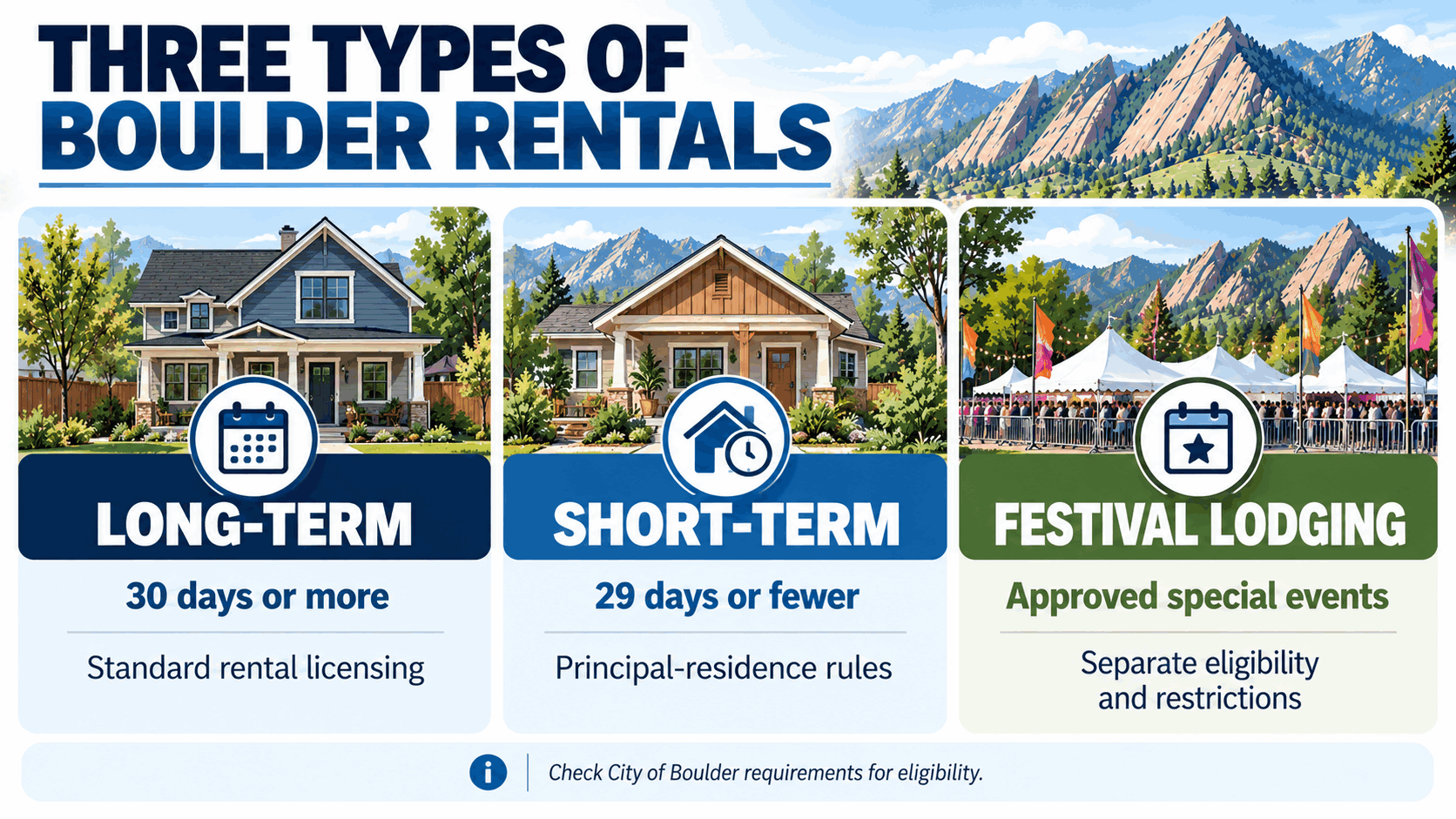
What About Sundance Festival Rentals?
Boulder has a separate festival-lodging license program for designated special events, including the 2027 Sundance Film Festival.
The program has its own eligibility rules and authorized rental window.
It should not be confused with either a four-year long-term rental license or a conventional short-term rental license.
For homeowners exploring that specific opportunity, read my Boulder Festival Lodging Rental License Guide.
Official source: Boulder Short-Term Rental Licensing
City of Boulder vs. Boulder County Rental Rules
One of the most common mistakes investors can make is assuming that every property with a Boulder mailing address follows City of Boulder licensing regulations.
That is not necessarily true.
Properties in unincorporated Boulder County fall under a different local jurisdiction.
The City of Boulder's standard rental licensing program applies within city limits.
Boulder County maintains its own regulations, including separate short-term and vacation rental licensing requirements for unincorporated properties.
The county's short-term rental rules require an applicable local license and distinguish between different eligible rental arrangements.
Individual incorporated communities, such as Louisville, Lafayette, and Longmont, also operate under their respective local regulations.
For an investment property, that means jurisdiction should be confirmed before applying the wrong rental rules to the address.
This is especially important when comparing properties on the edges of Boulder, in Gunbarrel, or elsewhere in Boulder County.
Official source: Boulder County Short-Term and Vacation Rental Licensing
What Rental Property Buyers Should Check Before Closing
For an investor, rental compliance should be part of the property's due diligence.
A house advertised with attractive projected rent is not automatically a turnkey investment.
Before relying on that income, verify the property's current legal use, license status, operating costs, and any work required for compliance.
A practical review should include the following:
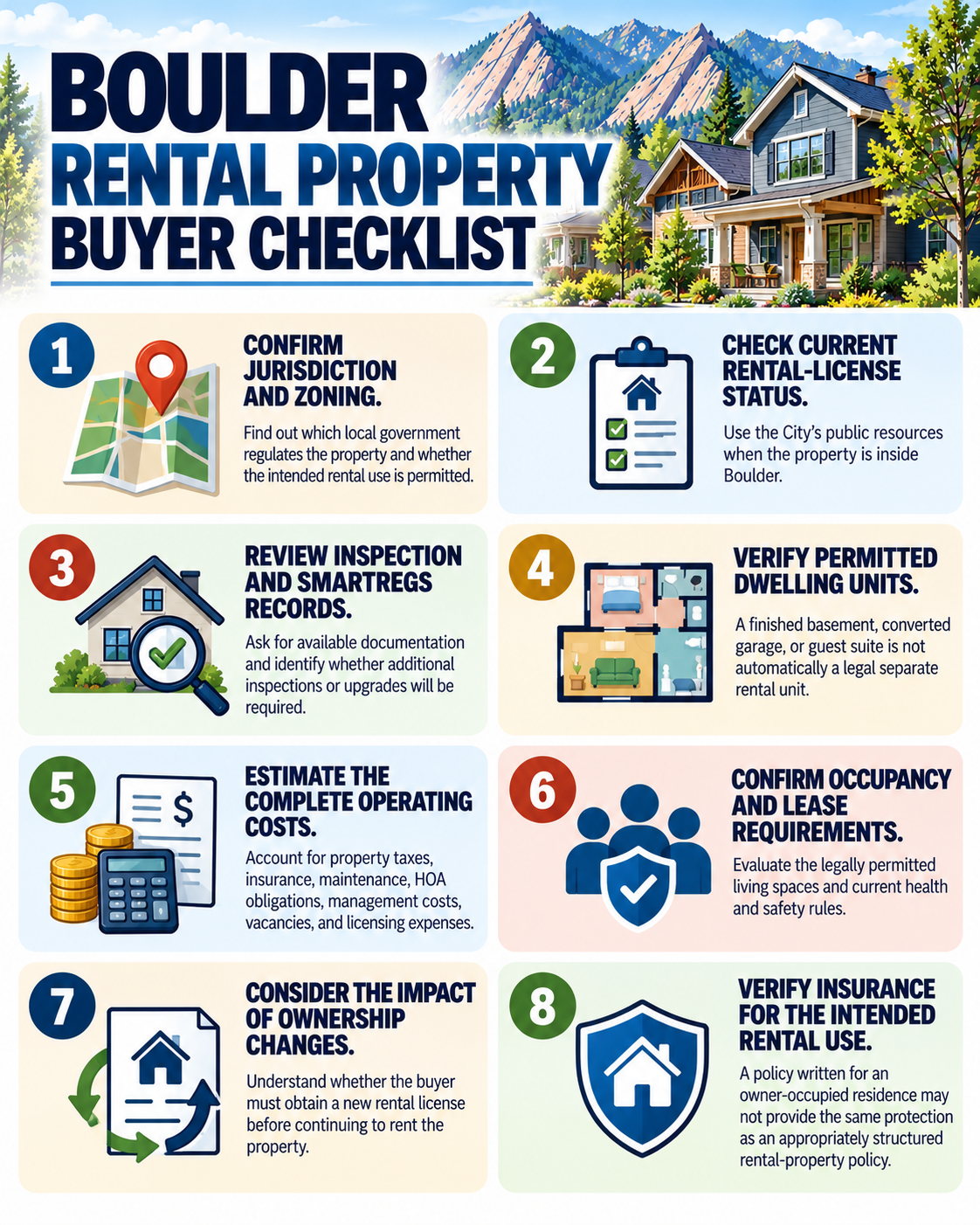
1. Confirm jurisdiction and zoning.
Find out which local government regulates the property and whether the intended rental use is permitted.
2. Check current rental-license status.
Use the City's public resources when the property is inside Boulder.
3. Review inspection and SmartRegs records.
Ask for available documentation and identify whether additional inspections or upgrades will be required.
4. Verify permitted dwelling units.
A finished basement, converted garage, or guest suite is not automatically a legal separate rental unit.
5. Estimate the complete operating costs.
Account for property taxes, insurance, maintenance, HOA obligations, management costs, vacancies, and licensing expenses.
6. Confirm occupancy and lease requirements.
Evaluate the legally permitted living spaces and current health and safety rules.
7. Consider the impact of ownership changes.
Understand whether the buyer must obtain a new rental license before continuing to rent the property.
8. Verify insurance for the intended rental use.
A policy written for an owner-occupied residence may not provide the same protection as an appropriately structured rental-property policy.
For insurance considerations, see my Boulder Homeowners Insurance 2026 guide.
Why This Matters Financially
Imagine buying a property expected to generate $3,000 per month in rent.
That projected figure does not automatically translate into $36,000 in annual operating income or profit.
The property may require inspections, repairs, licensing, utility upgrades, and time without a tenant before rental activity can begin. Ongoing costs will further reduce the amount remaining from collected rent.
The right question is not just:
“How much rent could this property generate?”
It is:
“What will it cost to legally prepare, operate, and maintain this property as a rental?”
That is the question investors should be answering before closing.
The Bottom Line: Renting Out a Property in Boulder Requires Preparation
Owning a property in Boulder can provide opportunities for long-term rental income, but those opportunities come with specific responsibilities.
For most long-term residential rentals inside city limits, owners must obtain the appropriate rental license, complete required inspections, satisfy applicable SmartRegs standards, and maintain ongoing compliance.
The City's standard 2026 rental-license fee is $190, but actual startup expenses can be higher depending on the property's condition and required improvements.
Owners also need to understand renewal requirements, rental occupancy rules, ADU restrictions, and the distinction between long-term, short-term, and festival-lodging programs.
For investors, the smartest approach is to investigate those details before purchasing a property.
For existing homeowners, it means understanding the regulations before advertising a home for rent.
And for sellers, having clear licensing and inspection records can help buyers evaluate a property being marketed for its rental potential.
If you're considering buying or selling a rental property in Boulder or Boulder County, I can help you examine comparable properties, evaluate potential rental use, and organize the property-specific questions that should be answered before a transaction.
For a broader overview of Boulder rental regulations, including short-term rentals and other ownership considerations, see my Boulder Property Owner's Rental Guide.
Eric Farran
Eric Sells Boulder
This article is for general real estate information and reflects publicly available rules reviewed for October 2026. Licensing, land-use, and landlord-tenant requirements can change. Verify property-specific details with the relevant local authority and consult appropriate legal, inspection, tax, insurance, or property-management professionals.
Boulder Rental License FAQ
How much is a rental license in Boulder in 2026?
The City of Boulder's standard long-term rental housing license fee is $190 per license under its 2026 fee schedule. Private inspection charges and any necessary property improvements are additional.
How long does a Boulder rental license last?
Standard rental housing licenses generally follow a four-year renewal cycle. Certain violations or other circumstances can affect the license term.
Do I need an inspection to rent out my house in Boulder?
Generally, yes. Standard long-term rental licenses require a rental housing safety inspection by an appropriately licensed inspector. SmartRegs energy-efficiency compliance is also generally required.
What is SmartRegs in Boulder?
SmartRegs is the City's rental housing energy-efficiency program. Qualifying long-term rentals must meet applicable energy-efficiency standards, subject to recognized exceptions and compliance pathways.
Can I advertise my Boulder rental before receiving the license?
Generally, a valid license is required before advertising or offering a property for rent. The City provides a limited pre-leasing exception for qualifying new construction when a complete application has been submitted. Check the specific rules before advertising.
Do ADUs need rental licenses in Boulder?
Yes, when an ADU is offered for rent under circumstances requiring licensing. Building approval for an ADU does not automatically establish rental-license approval.
Does a Boulder rental license transfer when the property is sold?
Owners should not assume it does. The City requires a new rental-license process and inspection when ownership changes.
Can I operate an Airbnb using a standard Boulder rental license?
Not automatically. Boulder regulates short-term rentals separately from standard long-term rentals, and conventional short-term rental eligibility generally requires the property to be the owner's principal residence.
Do Boulder County properties follow the same rules?
Not necessarily. Unincorporated Boulder County and incorporated communities have separate local regulations. Confirm the property's governing jurisdiction before proceeding.
Is there a limit on how many unrelated people can rent a Boulder house?
Colorado law prohibits residential occupancy restrictions based solely on family relationships. Boulder continues enforcing health- and safety-based limits, including minimum bedroom and living-space standards.
FROM OUR BLOG
Boulder Down Payment Assistance 2026: How First-Time Buyers Can Get Up to $100,000
For many Boulder buyers, the challenge is not simply qualifying for a monthly mortgage payment. It is getting enough cash together for the down payment, closing costs, reserves, and everything else that comes with buying a home in one of Colorado's more expensive housing markets. What many buyers do
Boulder ADU Rules 2026: Can You Build, Rent, or Add an ADU to Your Property?
Accessory dwelling units have become one of the most useful—and frequently misunderstood—housing options in Boulder. An ADU can create a separate place for an aging parent, an adult child, a long-term tenant, a home office setup with living space, or even a future downsizing option for the homeowner

Boulder Housing Market October 2026: Are Home Prices Falling?
Updated October 1, 2026 Search for the Boulder housing market right now, and you can find several very different-looking answers. Realtor.com's September 2026 data shows a $910,000 median sold price in Boulder, down 8.5% from a year earlier. Zillow, however, estimates the typical Boulder home value