
Buying a home in Boulder involves more than finding the right neighborhood, negotiating a purchase price, and qualifying for a mortgage.
There is another important consideration that can affect both the monthly cost of ownership and the ability to complete a purchase: homeowners insurance.
In Boulder, insurance considerations can vary significantly from one property to another. A detached home near the foothills may present different risks from a downtown condo or a house farther east. Roof condition, construction materials, previous claims, wildfire exposure, and the insurance company's underwriting standards can all influence coverage options and premiums.
Colorado's insurance landscape is also changing.
In 2026, the state has taken additional steps addressing wildfire risk transparency, mitigation discounts, and the growing cost of weather-related property damage.
For buyers, this makes one part of the process particularly important:
Confirm that a home can be adequately insured—and understand the cost—before committing to the purchase.
Here is what Boulder buyers, sellers, and homeowners should know about homeowners insurance in 2026.
Why Homeowners Insurance Matters More Than Ever in Boulder
Colorado homeowners face several different types of property risk.
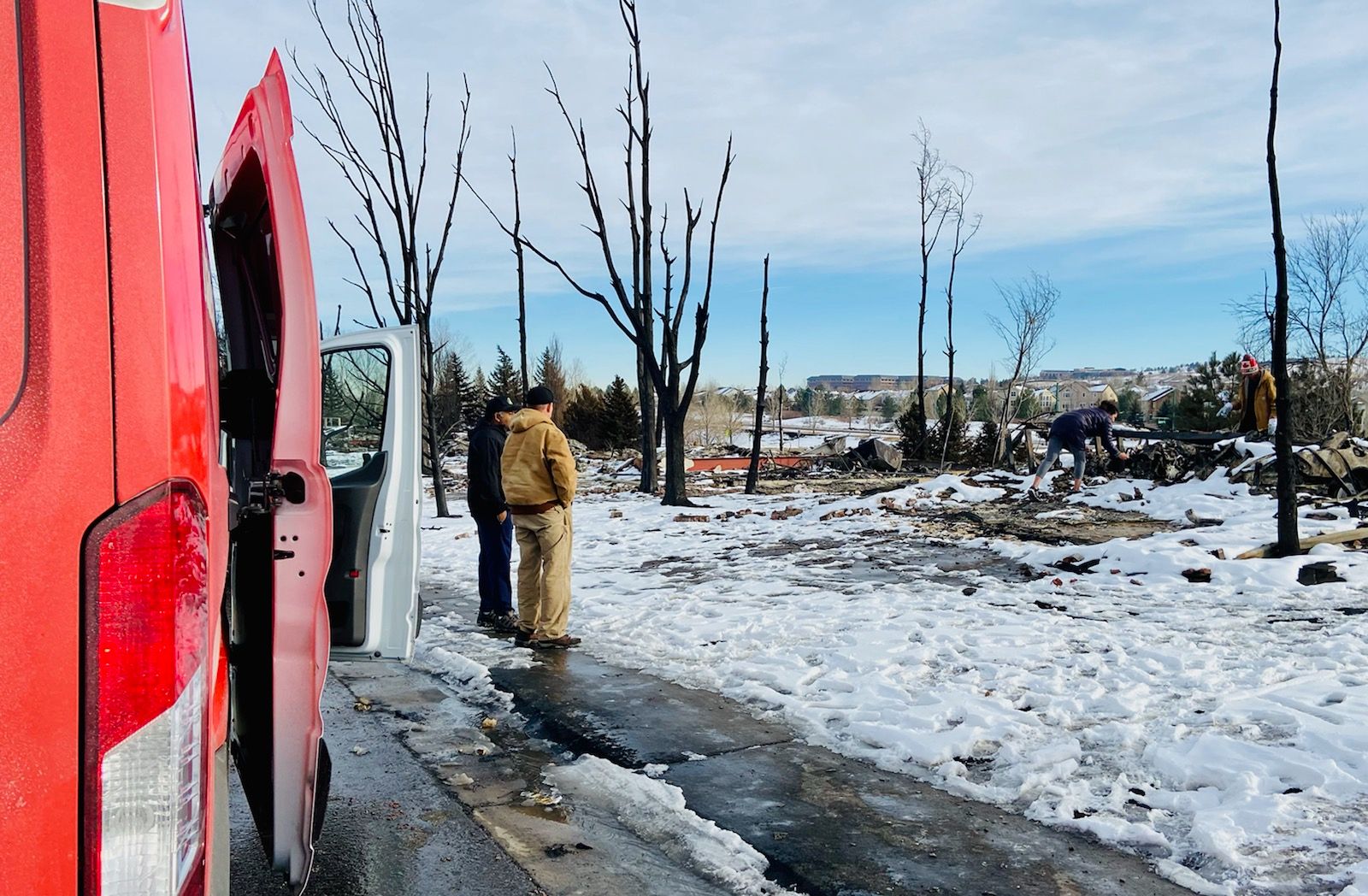
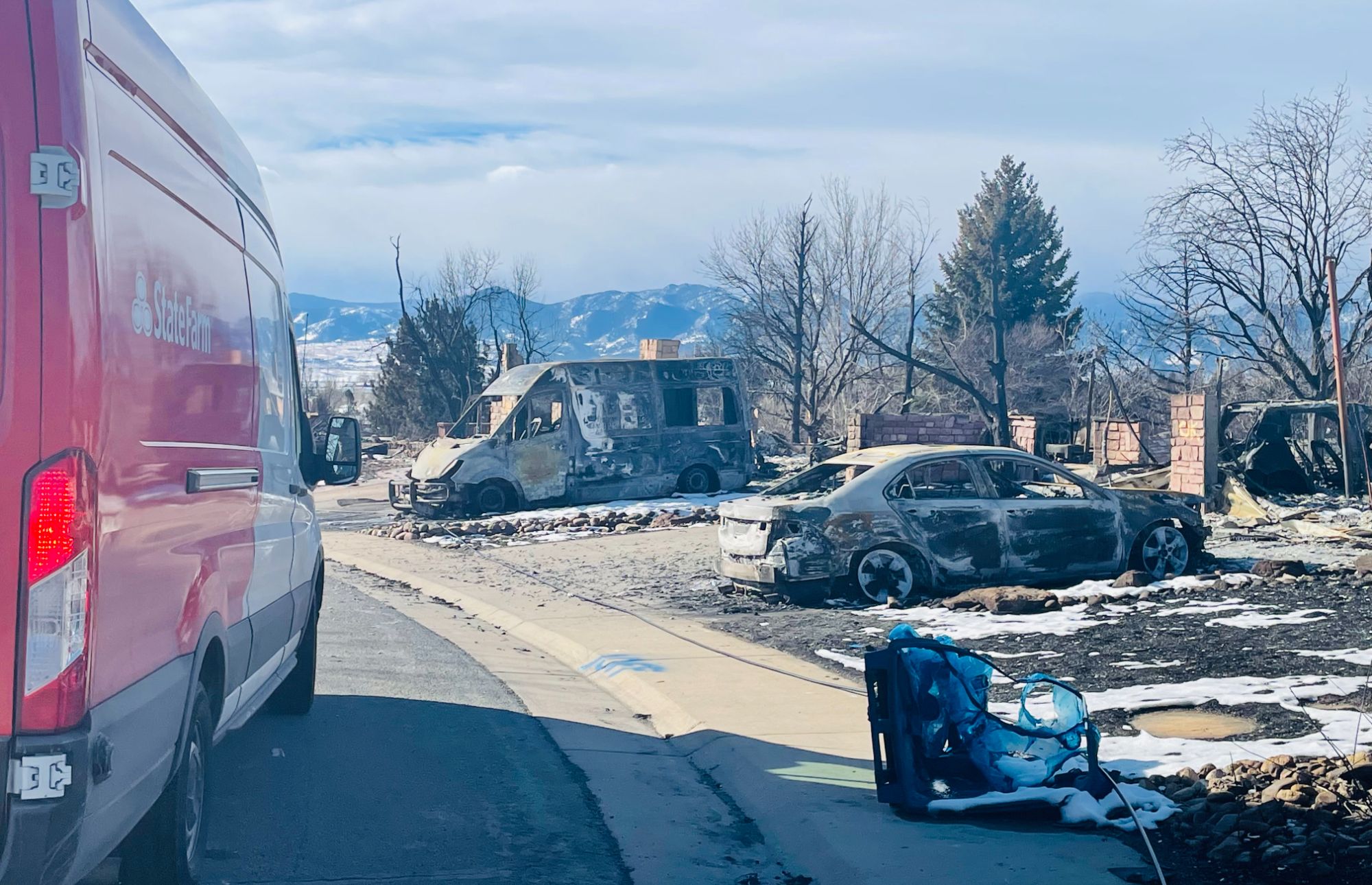
Wildfire often receives the most attention, especially following the Marshall Fire in December 2021, which devastated neighborhoods in Louisville and Superior.
But wildfire is not the only issue affecting homeowners insurance.
Hailstorms can damage roofing materials, siding, windows, and other exterior components. Severe wind can create additional losses, while flooding requires separate consideration because standard homeowners policies generally exclude flood damage.
Colorado's Division of Insurance has identified hail as a major factor in homeowners insurance costs across much of the state. In February 2026, the division released findings based on information requested from 20 insurers representing approximately 80% of the market.
For Boulder homeowners, these risks do not affect every property equally.
A home near open space may require closer examination of wildfire exposure and mitigation. A property with an older roof may encounter different insurance terms than a comparable home with a recently replaced roof.
Likewise, an attached property may have insurance responsibilities divided between an HOA's master policy and the individual owner's coverage.
The important distinction is that insurance costs and coverage depend on the individual property and policy—not simply the Boulder ZIP code.
For buyers, evaluating insurance early can prevent unpleasant surprises after an offer has already been accepted.
How Much Does Homeowners Insurance Cost in Boulder in 2026?
There is no single homeowners insurance premium that accurately represents every Boulder property.
Insurance companies evaluate numerous characteristics when determining whether to offer coverage and how to price it.
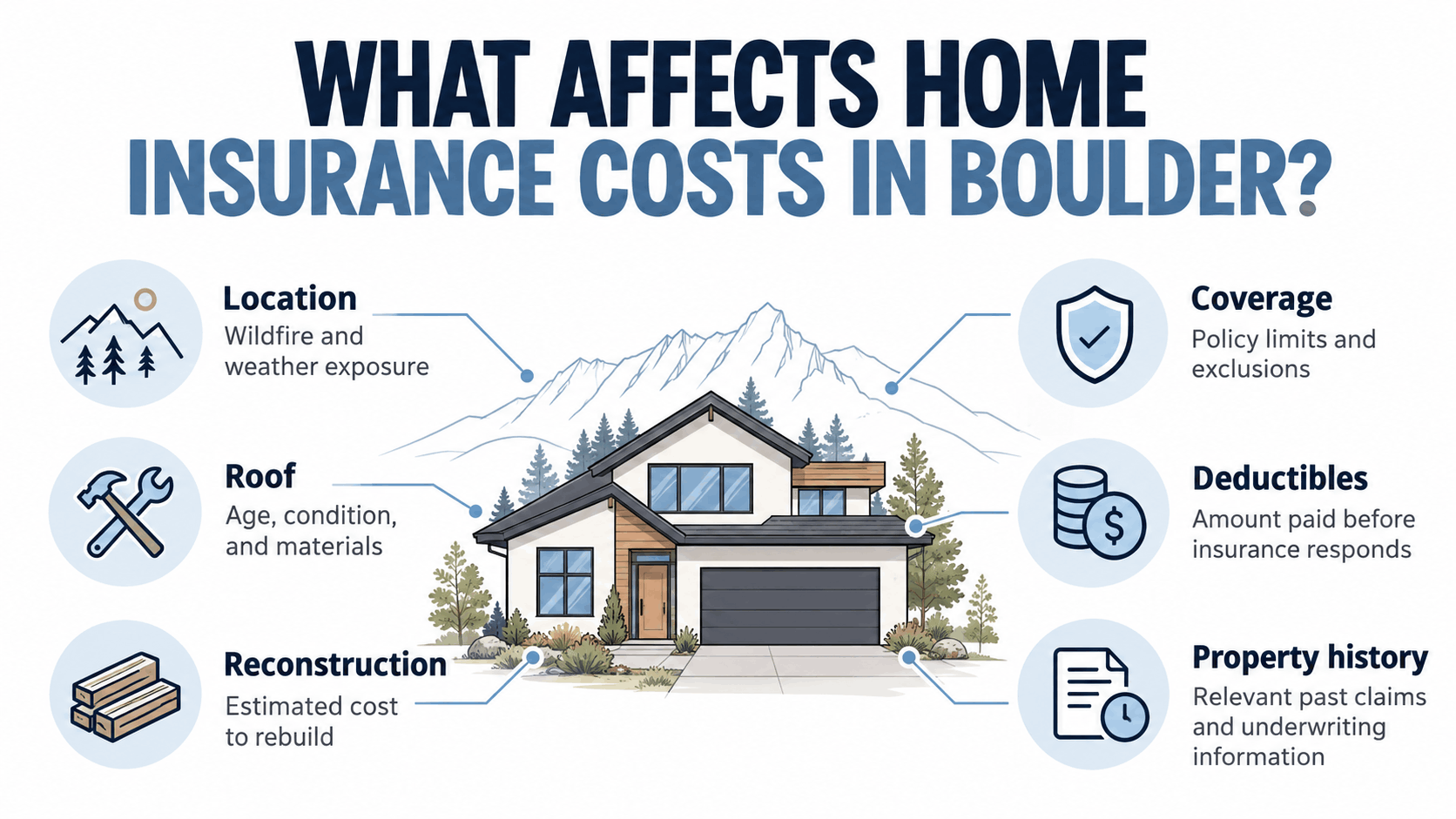
These can include the property's location, estimated reconstruction cost, roof age and material, construction type, exposure to wildfire or hail, claims history, deductible selections, and the insurer's individual underwriting standards.
Two homes with similar purchase prices may receive considerably different insurance quotes.
Purchase Price and Replacement Cost Are Not the Same
One important distinction is the difference between what a home costs to purchase and what it would cost to rebuild.
A Boulder home may have a substantial market value because of its location, land, views, or neighborhood.
The dwelling insurance limit, however, generally focuses on the cost to repair or reconstruct the insured structure, subject to the policy's terms.
That means the purchase price should not automatically determine the amount of dwelling coverage.
Buyers should ask their insurance agent how the estimated reconstruction cost was calculated and whether the policy provides replacement-cost coverage or actual-cash-value coverage.
Why Getting an Actual Quote Matters
Online estimates can help with preliminary budgeting, but they should not replace an address-specific insurance quote.
A realistic homeownership budget should account for the actual annual premium, the deductible, any additional coverage needed, and potential insurance costs not included in the basic homeowners policy.
For financed purchases, the lender will generally need evidence that acceptable insurance coverage is in place before funding the loan.
The Consumer Financial Protection Bureau also notes that homeowners insurance costs are included in the projected payments section of a mortgage Loan Estimate.
The best time to investigate insurance is before making an offer or, at the latest, early enough to satisfy the applicable contract deadlines.
Wildfire Risk and Homeowners Insurance in Boulder
Wildfire exposure is an important consideration for properties throughout the Boulder area.
Homes closer to forested foothills or grassland interfaces can have different risk characteristics from properties surrounded by denser development.
However, wildfire risk is not limited to mountain homes.
The Marshall Fire demonstrated how a fast-moving grassland fire can affect suburban neighborhoods.
For that reason, buyers should evaluate the actual property rather than assuming a home is low-risk because it is not located in the mountains.
What Insurance Companies May Evaluate
Depending on the company and its underwriting methods, insurers may consider surrounding vegetation, roof materials, exterior construction, access for emergency responders, proximity to combustible materials, and the potential for wildfire exposure.
A property's wildfire score or classification may also influence the insurer's decision.
Importantly, different insurance companies may use different models.
A single risk score should not automatically be treated as a definitive measurement of whether a property can be insured.
New Colorado Wildfire Insurance Transparency Requirements
Colorado has taken steps to make wildfire-related insurance decisions more transparent.
In February 2026, the Colorado Division of Insurance adopted Bulletin B-5.56, addressing notices insurers must provide concerning wildfire risk scores, mitigation discounts, and appeal rights.
Under the guidance, property insurers must provide applicants and policyholders with information about the property's wildfire risk score or classification, available mitigation discounts, and relevant appeal rights.
This is significant for Boulder homeowners.
Instead of simply receiving an insurance decision without understanding the underlying wildfire classification, consumers have a clearer framework for requesting information about the score and available opportunities to reduce risk.
It is still important to understand that a mitigation improvement does not automatically guarantee a particular discount or insurance approval.
Those decisions depend on applicable law, the policy, and the insurer's underwriting requirements.
Hail, Roof Damage, and Insurance Deductibles
Wildfire is an important part of the insurance conversation, but homeowners should pay just as much attention to their roofing coverage.
Colorado experiences damaging hailstorms, and homeowners insurance policies can include specific deductibles or coverage terms for wind and hail losses.
One issue that deserves attention is the difference between a fixed-dollar deductible and a percentage-based deductible.
Understanding Percentage-Based Deductibles
A traditional deductible might be a fixed amount, such as $2,500.
A percentage-based deductible works differently.
It is generally calculated as a percentage of the applicable insured value, often the dwelling coverage amount—not as a percentage of the cost of the individual repair.
Consider a hypothetical Boulder home with $700,000 in dwelling coverage.
| Wind/hail deductible | Illustrative deductible amount |
|---|---|
| 1% | $7,000 |
| 2% | $14,000 |
| 3% | $21,000 |
| 5% | $35,000 |
These are calculation examples, not quotes or claims about typical Boulder deductible levels.

A buyer comparing two policies should therefore consider more than the annual premium.
A policy with a lower premium but a substantially higher wind/hail deductible could expose the homeowner to considerably more out-of-pocket expense after a covered storm.
Roof coverage itself also matters.
Some policies provide replacement-cost coverage, while others may settle certain roof losses based on actual cash value, reflecting depreciation.
The Colorado Roofing Association highlighted these changing coverage structures in September 2026, including the importance of reviewing policy declarations and understanding how roof claims are evaluated.
Before purchasing a home, ask the insurance agent whether the roof is covered on a replacement-cost or actual-cash-value basis and whether any separate wind/hail deductible applies.
What Is the Colorado FAIR Plan?
One of the most important insurance developments for Colorado property owners is the availability of the Colorado FAIR Plan.
FAIR stands for Fair Access to Insurance Requirements.
The program is intended to provide limited property insurance to eligible owners who cannot obtain coverage through the standard insurance market.
It is not designed to replace conventional homeowners insurance when ordinary coverage is available.
Who Can Qualify?
According to the Colorado FAIR Plan's current eligibility information, applicants generally must demonstrate that the property cannot obtain standard insurance coverage.
The program requires:
- Working through a licensed insurance agent.
- Providing proof of insurance declinations from three different companies.
- Meeting the program's property and underwriting eligibility requirements.
Eligibility is based on inability to obtain standard insurance rather than income or financial need.
What Does the FAIR Plan Cover?
This is where buyers should read the details carefully.
The Colorado FAIR Plan currently provides a maximum of $750,000 in combined residential property and contents coverage.
Its basic coverage focuses on specific risks such as fire, lightning, and smoke.
Certain additional protections may be available, but the coverage is not equivalent to a comprehensive conventional homeowners policy.
Most importantly, FAIR Plan property coverage is based on actual cash value rather than replacement cost.
That means depreciation can affect the amount recoverable after a covered loss.
For higher-value Boulder properties, the program's coverage limits can be especially important.
A buyer should never assume that obtaining FAIR Plan eligibility means the property is adequately insured for every potential loss or that the coverage automatically satisfies the mortgage lender.
Discuss the limits, exclusions, potential supplemental coverage, and lender requirements with the insurance agent and lender before proceeding.
Can Boulder Homeowners Reduce Their Wildfire Risk?
Reducing physical wildfire risk is worthwhile regardless of the insurance implications.
In Boulder, homeowners have access to several local resources designed to help identify vulnerabilities and improve wildfire resilience.
City of Boulder — Detailed Home Assessments
Boulder Fire-Rescue offers free Detailed Home Assessments for eligible homes in higher wildfire-risk areas.
A Community Risk Reduction Specialist can visit a property, evaluate potential vulnerabilities, and provide recommendations for improving wildfire resilience.
The City describes the assessment as an approximately 90-minute visit followed by a report identifying recommended improvements.
Participation does not automatically obligate the homeowner to complete those improvements.
Homeowners can find the program here:
City of Boulder Wildfire Detailed Home Assessments
Boulder County — Wildfire Partners
Boulder County operates a separate program called Wildfire Partners.
The program offers wildfire mitigation education, assessments, and other assistance for eligible properties.
For qualifying properties in western Boulder County, homeowners may also pursue certification after completing the required mitigation work and passing the applicable assessment process.
Wildfire Partners notes that its certification is recognized by participating insurance companies and may help homeowners obtain or retain coverage.
Certification is not a guarantee of insurability or a specific discount.
Boulder County Wildfire Partners Program
What About Financial Assistance?
The City of Boulder also operates wildfire resilience assistance programs.
However, eligibility, available funding, qualifying projects, and application periods vary.
For example, the city's Wildfire Resilience Assistance Program has supported certain home-hardening and vegetation-management work.
Homeowners should review the current program terms before beginning a project with the expectation of receiving reimbursement.
The important takeaway is that wildfire mitigation is not just an insurance consideration.
It can also help reduce a property's physical vulnerability and improve preparedness.
Does Homeowners Insurance Cover Flooding in Boulder?
Another important distinction for Boulder buyers is the difference between homeowners insurance and flood insurance.
Standard homeowners insurance generally does not cover flood damage.
That includes many types of flooding caused by rising water, overflowing waterways, or surface-water accumulation.
Flood insurance is usually obtained through a separate policy, including coverage offered through the National Flood Insurance Program or eligible private insurers.
This matters in Boulder because the city has multiple waterways and mapped flood hazard areas.
The presence or absence of a creek directly beside the property is not enough to determine whether flood insurance is needed.
Buyers should check the actual property's flood mapping, review any applicable elevation information, and obtain an insurance quote where appropriate.
The City of Boulder provides flood insurance information and resources for finding flood maps and elevation certificates.
The City also notes that many flood insurance policies have a waiting period before coverage takes effect, so homeowners should not assume they can obtain immediate protection just before an anticipated flood.
A property's location in or near a mapped floodplain may also affect financing and development considerations.
For buyers, flood risk and insurance should be part of the property's due diligence—not an afterthought.
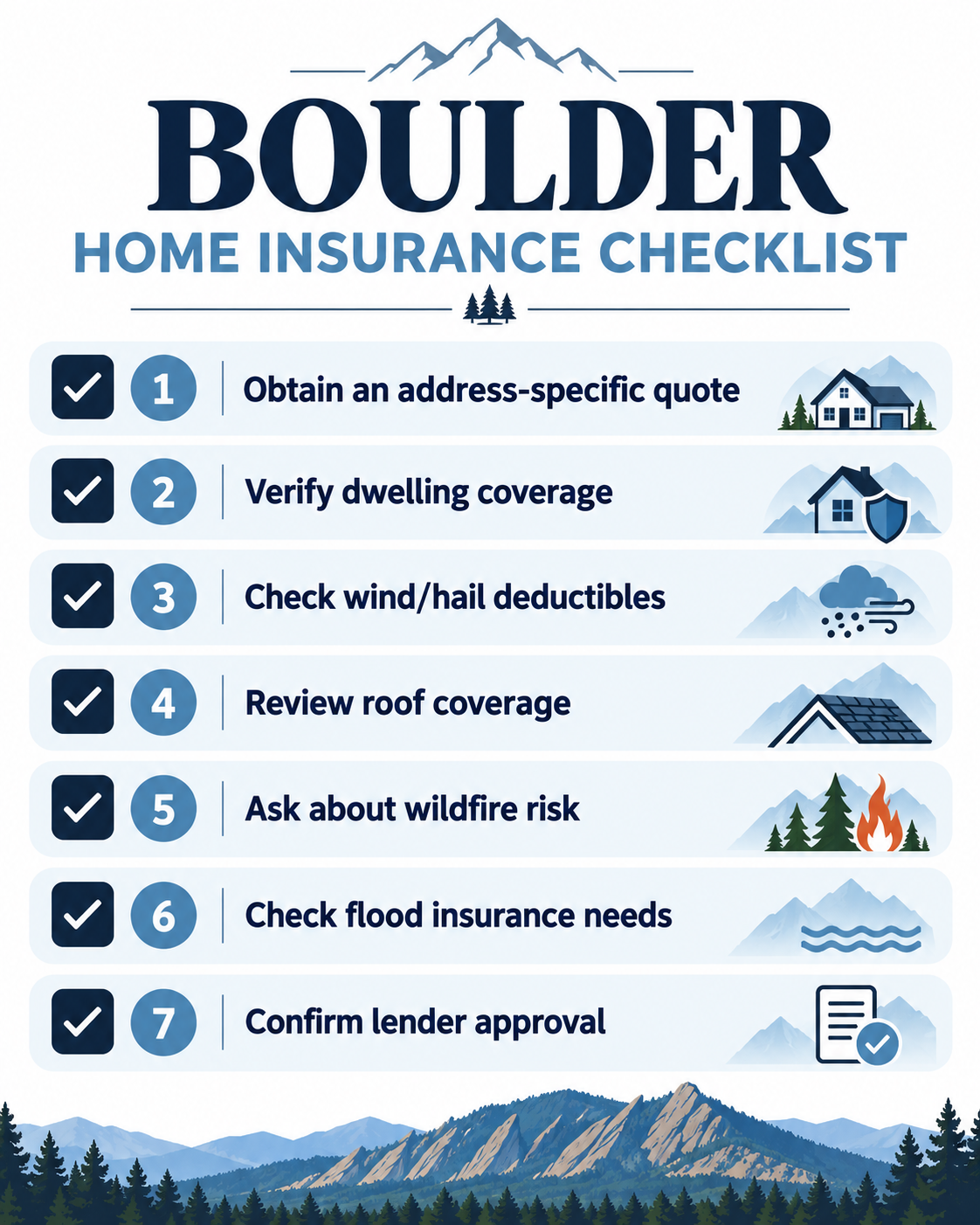
What Boulder Homebuyers Should Check Before Making an Offer
Homeowners insurance should be evaluated alongside the property inspection, title review, financing, and other purchase considerations.
Waiting until shortly before closing can create avoidable complications.
A buyer may discover that the insurance premium is higher than expected, that a roof has coverage limitations, or that additional documentation is needed before an insurer will issue a policy.
In some cases, the available coverage may also need additional review by the mortgage lender.
A practical insurance review should answer several questions.
Is the property currently insurable through a standard insurance company?
Obtain an address-specific quote and confirm whether the insurer is willing to issue coverage for the property.
What is the estimated annual premium?
Use the actual quoted amount when calculating the monthly cost of ownership.
What deductible applies?
Review both the standard deductible and any separate wind, hail, or other applicable deductibles.
Is the dwelling insured for replacement cost or actual cash value?
Understand how a covered claim would be settled, especially when reviewing roof coverage.
Are there wildfire-related underwriting requirements?
Ask whether the insurer needs mitigation work, roof information, vegetation management, or other documentation.
Does the property need separate flood insurance?
Review the relevant maps, lender requirements, and available coverage.
Does the proposed policy satisfy the lender?
The lender should confirm that the evidence of insurance and policy terms are acceptable for the transaction.
These questions apply to sellers as well.
A seller preparing to list a home may benefit from gathering roof permits, replacement records, available mitigation documentation, and other relevant property information in advance.
The goal is not to guarantee that every buyer will obtain the same insurance terms.
It is to reduce uncertainty before it disrupts a transaction.
For more detailed property investigations, see my Boulder Home Inspection Checklist, which covers radon, sewer scopes, roof condition, drainage, wildfire considerations, and other common due-diligence issues.
What Homeowners Insurance Means for Boulder Sellers
Insurance considerations are not limited to buyers.
Sellers should also understand how a property's roof, exterior condition, and documented mitigation work may affect a buyer's insurance review.
A roof that is approaching the end of its expected useful life can create questions during an inspection and insurance underwriting.
Likewise, incomplete records for major repairs or improvements may require additional investigation.
For homes near open space or wildfire-prone landscapes, documentation of completed mitigation work may help a prospective buyer and their insurer evaluate the property.
However, sellers should avoid making assumptions about what a buyer's insurer will accept.
Different insurers may reach different underwriting decisions, and a homeowner's existing policy is not necessarily transferable to the next owner.
For sellers, the best preparation is to make relevant property information available, address known material issues appropriately, and allow buyers to obtain their own insurance quotes.
That approach helps buyers evaluate the home with fewer unanswered questions.
The Bottom Line: Insurance Should Be Part of Every Boulder Real Estate Decision
Boulder continues to offer a distinctive combination of neighborhoods, mountain access, open space, and residential property types.
But buying a home here also means understanding the practical responsibilities of ownership.
Insurance is one of those responsibilities.
Wildfire, hail, roof condition, flood exposure, and reconstruction costs can affect the coverage available for an individual property.
Colorado's expanding wildfire insurance transparency requirements and the availability of the FAIR Plan provide additional resources, but they do not eliminate the need for property-specific research.
For buyers, the most important step is simple:
Obtain a realistic insurance quote before committing to a purchase.
For existing homeowners, regularly reviewing coverage and exploring appropriate mitigation measures can help reduce uncertainty.
And for sellers, documenting relevant property conditions and improvements can make the due-diligence process more straightforward.
In Boulder real estate, understanding the true cost and risks of ownership is just as important as understanding the purchase price.
If you're buying or selling a home in Boulder or Boulder County, I can help you evaluate the property-specific considerations that matter throughout the transaction and coordinate with the appropriate insurance, inspection, lending, and other professionals.
Eric Farran
Eric Sells Boulder
BOULDER HOMEOWNERS INSURANCE FAQ
How much does homeowners insurance cost in Boulder, Colorado?
Homeowners insurance costs depend on the individual property, coverage amount, roof condition, wildfire and weather exposure, deductible selections, and insurer-specific underwriting.
There is no single premium that accurately represents every Boulder home. Buyers should obtain an address-specific quote rather than relying exclusively on general online estimates.
Is homeowners insurance required when buying a home in Boulder?
Homeowners insurance is not universally required simply because someone owns a home. However, mortgage lenders generally require acceptable property insurance coverage before funding a loan.
Cash buyers should also carefully evaluate the financial risks of owning a home without adequate coverage.
Does homeowners insurance cover wildfire damage in Boulder?
Many conventional homeowners policies cover fire damage, including wildfire, subject to the policy's exclusions, limits, and conditions.
However, obtaining coverage and determining the appropriate limits can be more complicated for properties with higher wildfire exposure.
The individual policy must be reviewed to determine the actual protection available.
What happens if I cannot get homeowners insurance in Boulder?
Buyers should first work with a licensed insurance agent to explore available coverage options.
If standard insurance is unavailable, an eligible owner may qualify for the Colorado FAIR Plan after meeting its requirements, including documenting three insurance declinations.
FAIR Plan coverage is limited and uses actual-cash-value terms rather than ordinary replacement-cost coverage.
Can wildfire mitigation lower my homeowners insurance premium?
Potentially.
Colorado has requirements addressing wildfire mitigation discounts and risk-score disclosures.
However, mitigation does not guarantee a particular premium reduction or approval.
Homeowners should ask their insurer which improvements qualify under its underwriting and discount programs.
Is flood insurance included in homeowners insurance in Boulder?
Generally, no.
Standard homeowners policies usually exclude flood damage. A separate flood insurance policy may be necessary or advisable depending on the property and financing requirements.
Buyers should review the actual address using City of Boulder and FEMA flood resources.
Should I get a homeowners insurance quote before making an offer?
Yes, whenever practical.
Obtaining preliminary coverage information before making an offer—and confirming acceptable coverage early during the contractual due-diligence period—can help identify premium, coverage, or underwriting concerns before the transaction reaches its final stages.
FROM OUR BLOG

Boulder ADU Rules 2026: Can You Build, Rent, or Add an ADU to Your Property?
Accessory dwelling units have become one of the most useful—and frequently misunderstood—housing options in Boulder. An ADU can create a separate place for an aging parent, an adult child, a long-term tenant, a home office setup with living space, or even a future downsizing option for the homeowner
Boulder Housing Market October 2026: Are Home Prices Falling?
Updated October 1, 2026 Search for the Boulder housing market right now, and you can find several very different-looking answers. Realtor.com's September 2026 data shows a $910,000 median sold price in Boulder, down 8.5% from a year earlier. Zillow, however, estimates the typical Boulder home value
CU Boulder South Is Closing for Years: What the Flood Project Means for South Boulder Residents and Homebuyers
Updated September 29, 2026 CU Boulder South is about to change dramatically. Beginning the week of October 5, 2026, the entire site, including its existing trails, is scheduled to close to public access while the City of Boulder begins the South Boulder Creek Flood Mitigation Project. Construction i