
The true monthly cost of owning a home in Boulder is more than the mortgage payment shown by an online calculator. A realistic budget should include principal and interest, property taxes, insurance, utilities, HOA dues, maintenance reserves, and any property-specific expenses related to flood exposure, wildfire mitigation, private roads, wells, or septic systems.
The exact number is address-specific. Two similarly priced homes in Boulder County can produce meaningfully different monthly costs because they are in different tax districts, municipalities, insurance zones, or homeowners' associations.
Quick Answer: What Should a Boulder Homeowner Budget For?
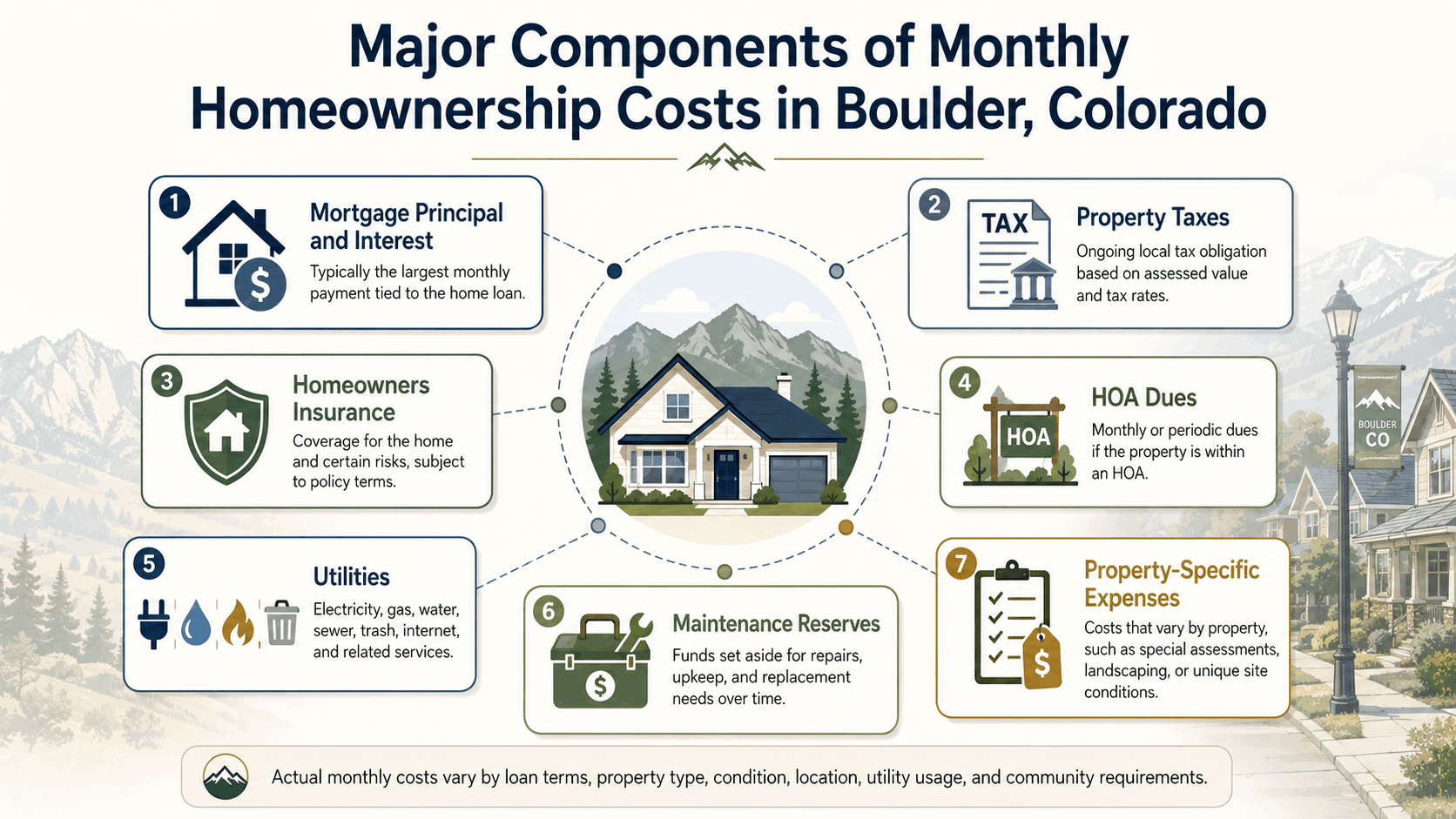
Use this formula:
Principal and interest + property taxes + homeowners insurance + mortgage insurance + HOA dues + utilities + maintenance reserve + property-specific costs = true monthly ownership cost
The Consumer Financial Protection Bureau refers to the four basic mortgage components—principal, interest, taxes and insurance—as PITI. Taxes and insurance may be collected through an escrow account, but HOA dues, utilities, maintenance and many risk-related expenses are generally outside the lender’s advertised payment.
Key takeaways
- Do not compare Boulder-area homes using principal and interest alone.
- Verify property taxes using the exact address and tax district.
- Obtain an address-specific insurance quote before key contract deadlines.
- Review HOA reserves, insurance deductibles and planned projects—not just current dues.
- Budget differently for an older Boulder home, a newer Erie property, a Louisville townhome and a foothills house on well and septic.
- Treat maintenance as a monthly contribution to a reserve account, even when nothing is currently broken.
Best For / Not Ideal For
Best for: relocating families, first-time buyers, downsizers, investors, and homeowners comparing the financial impact of staying, selling or purchasing another property.
Not ideal for: anyone looking for one universal “average Boulder payment.” Your financing, municipality, insurance profile, property condition, and ownership structure matter more than a broad estimate.
What Is Included in the Monthly Cost of Owning a Boulder Home?

1. Mortgage principal and interest
Principal is the portion of the payment that reduces the loan balance. Interest is the lender’s charge for providing the loan.
Your principal-and-interest payment depends on the amount borrowed, loan term, loan type and interest rate available when you lock the loan. Because rates and lending terms change, use a current Loan Estimate from a qualified lender rather than a generic online assumption. The Loan Estimate also identifies mortgage insurance and estimated taxes, insurance and assessments.
A larger down payment may reduce the loan and eliminate certain mortgage-insurance requirements, but it also uses cash that could otherwise remain available for repairs, moving expenses or reserves. The right balance is a household decision, not simply a strategy for producing the lowest possible payment.
2. Property taxes in Boulder County
Property taxes should be researched by address. Boulder County’s calculation incorporates the property’s actual value, applicable residential assessment rates and the mill levies imposed by the taxing authorities serving that property. The Assessor determines values and calculates taxes, while the Treasurer collects them.
Do not assume the seller’s current tax bill will precisely predict your long-term expense. Ask your lender and real estate advisor to review the current tax record, the applicable tax area and how reassessment or exemptions may affect the comparison.
Jurisdiction is particularly important around the edges of the search area. Erie properties may be in either Boulder County or Weld County, and the town directs homeowners to the appropriate county assessor to verify the address and mill levy. Broomfield has its own city-and-county assessor and property-record system.
For budgeting, divide the best available annual estimate by 12—even when the bill is paid through escrow.
3. Homeowners, flood and wildfire-related insurance
Homeowners insurance is not a fixed percentage of the purchase price. Insurers evaluate the structure, replacement cost, roof, claims history, deductible, construction type and location-specific risk.
In Boulder and the foothills, buyers should request an actual quote for the property early in the transaction. A general quote based only on a ZIP code is not enough.
Flood exposure also requires property-level research. Boulder’s floodplain maps are periodically updated, and the city provides an address-searchable map along with information about FEMA flood zones, flood insurance and Letters of Map Amendment.
Wildfire planning is relevant beyond heavily forested mountain properties. Boulder County’s Wildfire Partners program supports mitigation work in both eastern grassland areas and western forested areas. Depending on the home, ongoing ownership costs may include vegetation management, defensible-space work, ember-resistant improvements or maintenance requested by an insurer.
For a condominium or townhome, review both the association’s master policy and the owner’s individual policy. Pay particular attention to master-policy deductibles and which portions of the building are the owner’s responsibility.
4. HOA dues and possible special assessments
HOA dues may cover items such as exterior maintenance, landscaping, snow removal, trash, water, amenities or common-area insurance. The included services vary considerably, so a higher fee is not automatically worse—and a low fee is not automatically safer.
Before purchasing, review:
- The current operating budget
- Reserve balances and reserve studies
- Recent board meeting minutes
- Master insurance coverage and deductibles
- Pending litigation
- Approved or discussed special assessments
- Responsibility for roofs, siding, windows, decks and utilities
Colorado’s Division of Real Estate recommends reviewing the governing documents and evaluating how the association manages maintenance obligations before purchasing in an HOA.
A special assessment is not technically a permanent monthly expense, but it represents a real ownership liability. I prefer to evaluate the HOA’s financial position alongside the monthly dues rather than treating dues as the entire cost.
5. Utilities vary across Boulder-area communities
Utility costs depend on the municipality, provider, home size, landscaping, efficiency, occupancy and household habits.
Within the City of Boulder, customers receive monthly charges for water, wastewater, and flood and stormwater services. Boulder also uses water budgets, which can make irrigation needs and lot characteristics relevant to the ownership calculation.
The billing structure changes as you move through the Front Range:
- Louisville manages water, sewer, refuse, recycling and compost billing.
- Lafayette provides municipal utility billing and publishes separate water, wastewater and stormwater information.
- Superior manages water, sewer and trash billing.
- Longmont operates a municipal electric utility.
- Erie provides an address-based utility-provider map because providers may differ by location.
Request approximately 12 months of utility history when practical, but interpret it carefully. A seller’s household size, thermostat settings, irrigation habits and remote-work schedule may be very different from yours.
6. Maintenance and capital replacements
Maintenance is the category most often omitted from affordability calculations. It is also the category most likely to produce an unpleasant surprise.
Instead of relying on a universal percentage, build a property-specific reserve. Consider the age and remaining life of:
- Roof and gutters
- Furnace, boiler, heat pump or air-conditioning system
- Water heater
- Windows and insulation
- Sewer line
- Electrical panel and wiring
- Plumbing supply lines
- Decks, siding and exterior paint
- Irrigation and mature trees
- Driveways, drainage and retaining walls
A mid-century ranch in South Boulder should not carry the same reserve assumptions as a recently built Erie home. An older downtown Boulder property may have valuable character but require closer review of sewer, electrical, drainage and prior renovation permits. A newer townhome may reduce some exterior responsibilities while shifting those costs into HOA dues.
The inspection identifies current conditions; the ownership budget should also anticipate systems that are functional today but approaching replacement.
7. Foothills and unincorporated Boulder County costs
Mountain and rural properties require a different worksheet. Potential expenses include well testing, septic maintenance, propane, private-road agreements, snow removal, backup power, tree work and wildfire mitigation.
Boulder County notes that private drinking water commonly comes from wells or cisterns, while public water is generally supplied by a municipality or water district. The county also maintains septic records and guidance for ongoing system maintenance and property transfers.
These homes can provide privacy, land and direct access to the foothills lifestyle, but the operating responsibilities are different from those of an in-town property connected to municipal systems.
8. Transportation and household logistics
Transportation is not part of the mortgage, but it belongs in a relocation budget.
A household may willingly pay more for a location that reduces driving, allows biking or provides useful transit access. RTD’s Flatiron Flyer connects Boulder with Louisville, Superior, Broomfield and Denver along the U.S. 36 corridor.
Families should also verify school assignments by exact address rather than relying on listing language. Boulder Valley School District provides an address-based school finder and maintains a separate choice-enrollment process.
Commute time, parking, school transportation and childcare logistics can change the household budget enough to influence which community represents the best overall fit.
How to Calculate Your True Monthly Boulder Housing Cost
Create one worksheet for every serious property:
| Cost category | Monthly amount |
|---|---|
| Principal and interest | $_____ |
| Property taxes ÷ 12 | $_____ |
| Homeowners insurance ÷ 12 | $_____ |
| Flood or supplemental coverage ÷ 12 | $_____ |
| Mortgage insurance | $_____ |
| HOA dues | $_____ |
| Electricity and gas | $_____ |
| Water, wastewater, stormwater and trash | $_____ |
| Maintenance reserve | $_____ |
| Well, septic, private road or mitigation reserve | $_____ |
| Estimated true monthly cost | $_____ |
Keep down payment, closing costs, moving expenses, and immediate post-closing work in a separate cash-to-close calculation. They affect affordability, but they are not recurring monthly expenses.
Boulder vs. Nearby Front Range Communities
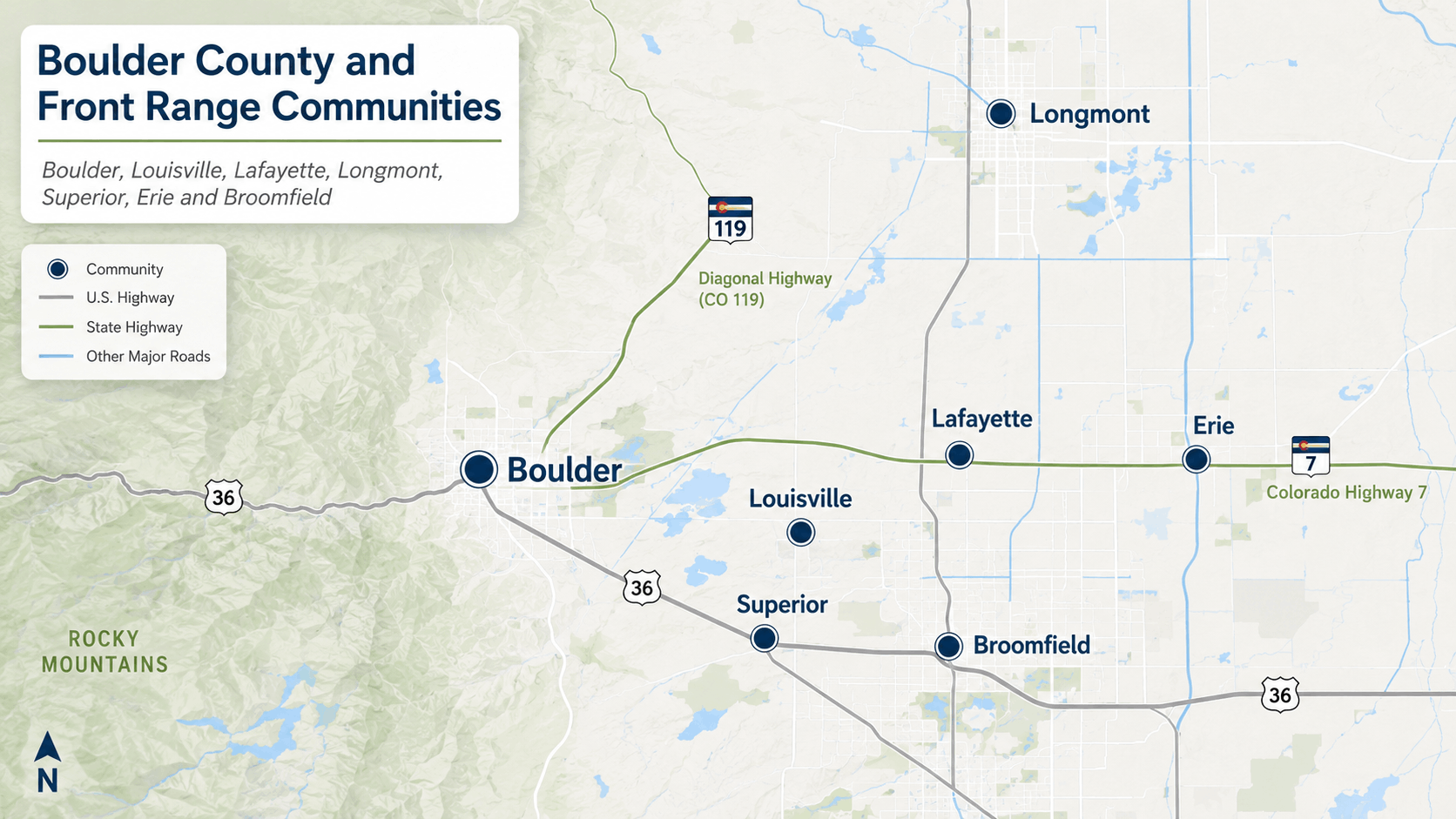
The most economical choice cannot be determined from the city name alone. Compare the whole property.
Boulder: Pay close attention to floodplain status, older building systems, renovation history, irrigation needs, and the value you place on proximity to trails, employment, schools, and daily amenities.
Louisville, Lafayette, and Superior: Review municipal utility responsibilities, HOA coverage, and insurance documentation. For properties affected by or rebuilt after the Marshall Fire, understand the construction, warranties, landscaping, and resilience features rather than making assumptions based on age alone.
Longmont: Confirm utility providers, commuting requirements, and the practical difference between being close to Boulder and needing to make the trip during peak periods.
Erie: Verify the county, tax area, utility provider, and HOA for the exact address. Do not apply one set of assumptions to every Erie listing.
Broomfield: Use Broomfield’s own assessor and parcel resources. For Denver or Boulder commuters, compare both driving and Flatiron Flyer access.
What Sellers Should Understand About Monthly Ownership Costs

Buyers increasingly evaluate homes through the monthly-payment lens. Sellers can reduce uncertainty by organizing utility history, HOA documents, insurance information that can be shared appropriately, permit records, solar agreements, roof documentation, and details about major system replacements.
This does not mean promising a buyer what the property will cost. It means making the home easier to evaluate.
A seller deciding whether to move should run the same analysis in reverse: compare the current home’s true cost with the likely cost of the replacement property, including taxes, HOA obligations, maintenance, and transportation—not just the next mortgage.
A Practical Local Approach
Before a buyer makes a final decision, I want the budget to answer three questions:
- Can the household comfortably carry the normal monthly expenses?
- Is there enough reserve capacity for predictable repairs and irregular costs?
- Does this location reduce or create other household expenses?
That produces a more useful answer than asking whether a lender will approve the loan. Qualification is important, but sustainable ownership is the goal.
For help comparing the real monthly cost of specific homes in Boulder, Louisville, Lafayette, Longmont, Superior, Erie, Broomfield, or unincorporated Boulder County, contact Eric Farran for a property-by-property ownership analysis and local buyer or seller guidance. Eric’s website identifies his Boulder office, Colorado real estate license, and direct contact information.
FAQs
What costs are included in the monthly cost of owning a home in Boulder?
Include principal, interest, property taxes, homeowners insurance, mortgage insurance when applicable, HOA dues, utilities, and a maintenance reserve. Add flood, wildfire, well, septic, private-road, or other property-specific costs when relevant.
Are Boulder property taxes included in the mortgage payment?
They may be included through an escrow account, but not every loan is structured that way. Whether escrowed or paid directly, divide the expected annual tax bill by 12 when comparing monthly ownership costs.
Are HOA dues included in a mortgage payment?
Usually not. HOA dues are generally paid directly to the association, although lenders include them when evaluating the borrower’s overall housing obligations.
Do all Boulder homeowners need flood insurance?
No. The requirement depends on the property’s flood-zone status, lender requirements, and the owner’s risk decision. Check the City of Boulder and FEMA maps using the exact address and discuss coverage with a qualified insurance professional.
Can wildfire risk increase the cost of owning a Front Range home?
It can. The effect may appear through insurance premiums, deductibles, required mitigation, landscaping work, or ongoing defensible-space maintenance. Obtain an address-specific insurance quote rather than assuming all foothills or grassland properties will be treated the same.
How much should I budget for home maintenance?
Use the property’s condition and major-system ages rather than a single universal percentage. Build a reserve plan around the roof, heating and cooling equipment, water heater, sewer, windows, exterior, drainage, and any near-term inspection findings.
Which Boulder-area community has the lowest monthly ownership cost?
There is no reliable answer based only on the municipality. A home with a lower purchase price could have different taxes, HOA dues, insurance needs, utilities, or commuting costs. Compare specific addresses using the same worksheet.
Can my total monthly mortgage payment change?
Yes. Even with a fixed-rate loan, changes in property taxes, insurance premiums, escrow requirements, or mortgage insurance can change the total amount collected by the servicer.
FROM OUR BLOG


Boulder Rental License Requirements 2026: Fees, Inspections & How to Apply
Renting out a home in Boulder involves more than finding a tenant, setting a monthly rent, and signing a lease. Before most residential properties inside Boulder city limits can legally be advertised or rented, the owner must obtain a rental housing license from the City of Boulder. That requirement

Boulder Homeowners Insurance 2026: Wildfire, Hail & What Buyers Need to Know
Buying a home in Boulder involves more than finding the right neighborhood, negotiating a purchase price, and qualifying for a mortgage. There is another important consideration that can affect both the monthly cost of ownership and the ability to complete a purchase: homeowners insurance. In Boulde

Boulder Down Payment Assistance 2026: How First-Time Buyers Can Get Up to $100,000
For many Boulder buyers, the challenge is not simply qualifying for a monthly mortgage payment. It is getting enough cash together for the down payment, closing costs, reserves, and everything else that comes with buying a home in one of Colorado's more expensive housing markets. What many buyers do