
Selling a luxury home in Boulder is largely an exercise in reducing uncertainty around a property that may have few true comparables. A custom foothills residence, architect-designed city home, extensively renovated historic property, or large parcel in unincorporated Boulder County cannot always be priced or marketed the same way as a more standardized subdivision home.
That matters especially in a measured market. In its July 2026 market review, the Colorado Association of REALTORS described Boulder County prices and inventory as relatively steady and reported that homes were averaging about 63 days to sell. Buyers therefore had time to compare properties rather than automatically chasing new listings.
For a high-end seller, the practical questions are how to establish the right competitive set, which improvements are worth completing, what documentation should be assembled before listing, how to present the home's distinctive features, and which Boulder-specific risks could surface during due diligence.
1. Treat a Boulder luxury home as its own micro-market
The first rule of selling a luxury home in Boulder is not to rely on a single citywide definition of "luxury." There is no official price threshold that makes a residence a luxury property, and an arbitrary cutoff can obscure the factors that actually determine buyer demand.
A more useful approach is to identify the home's competitive micro-market. That can include its location, lot characteristics, architecture, renovation quality, views, privacy, access, construction era, size, property condition and features that are difficult to reproduce.
For example, a hypothetical contemporary home on a smaller in-town parcel may compete primarily on architecture, interior design and proximity to Boulder amenities. A foothills property at a similar price could instead compete on acreage, mountain views, access, wildfire mitigation, well or septic infrastructure and the condition of private roads or retaining structures.
The buyer pools may overlap, but they are not identical.
Current conditions reinforce the need for precision. The Colorado Association of REALTORS reported in August 2026 that the Boulder County market was moving at a measured pace, with pricing accuracy especially important for sellers.
A luxury-market analysis should therefore separate:
- Recent closed sales with genuinely comparable characteristics.
- Pending properties, when reliable information about their positioning is available.
- Active listings competing for the same buyers today.
- Expired, withdrawn or significantly reduced listings that reveal pricing resistance.
- Property-specific advantages and limitations that are not captured by square footage.
Price per square foot can provide context, but it should not become the valuation method by itself. A substantial portion of a Boulder property's appeal may be tied to its parcel, architecture, view corridor, renovation quality or regulatory circumstances rather than interior square footage.
2. Price from evidence, not from the home's replacement cost or history
A strong Boulder luxury pricing strategy begins with what today's buyers can purchase instead, not what the seller spent building, remodeling or acquiring the property.
Custom improvements can be valuable without producing a dollar-for-dollar resale return. The same applies to specialized landscaping, imported finishes, extensive home automation and highly personalized architecture. The question is how buyers compare those features with available alternatives.
Start with several pricing lenses:
- Comparable closed sales. Give the greatest weight to properties with similar location, lot utility, condition and overall market position.
- Current competition. Buyers will compare the listing with what they can tour now, not only what sold six months ago.
- Failed pricing. Listings that accumulated substantial market time or required repeated reductions can be highly informative.
- Replacement difficulty. A genuinely scarce feature may justify a premium, but scarcity should be demonstrated rather than assumed.
- Expected buyer objections. Deferred maintenance, difficult access, insurance issues, incomplete permits or dated interiors can affect value even when the home has exceptional strengths.
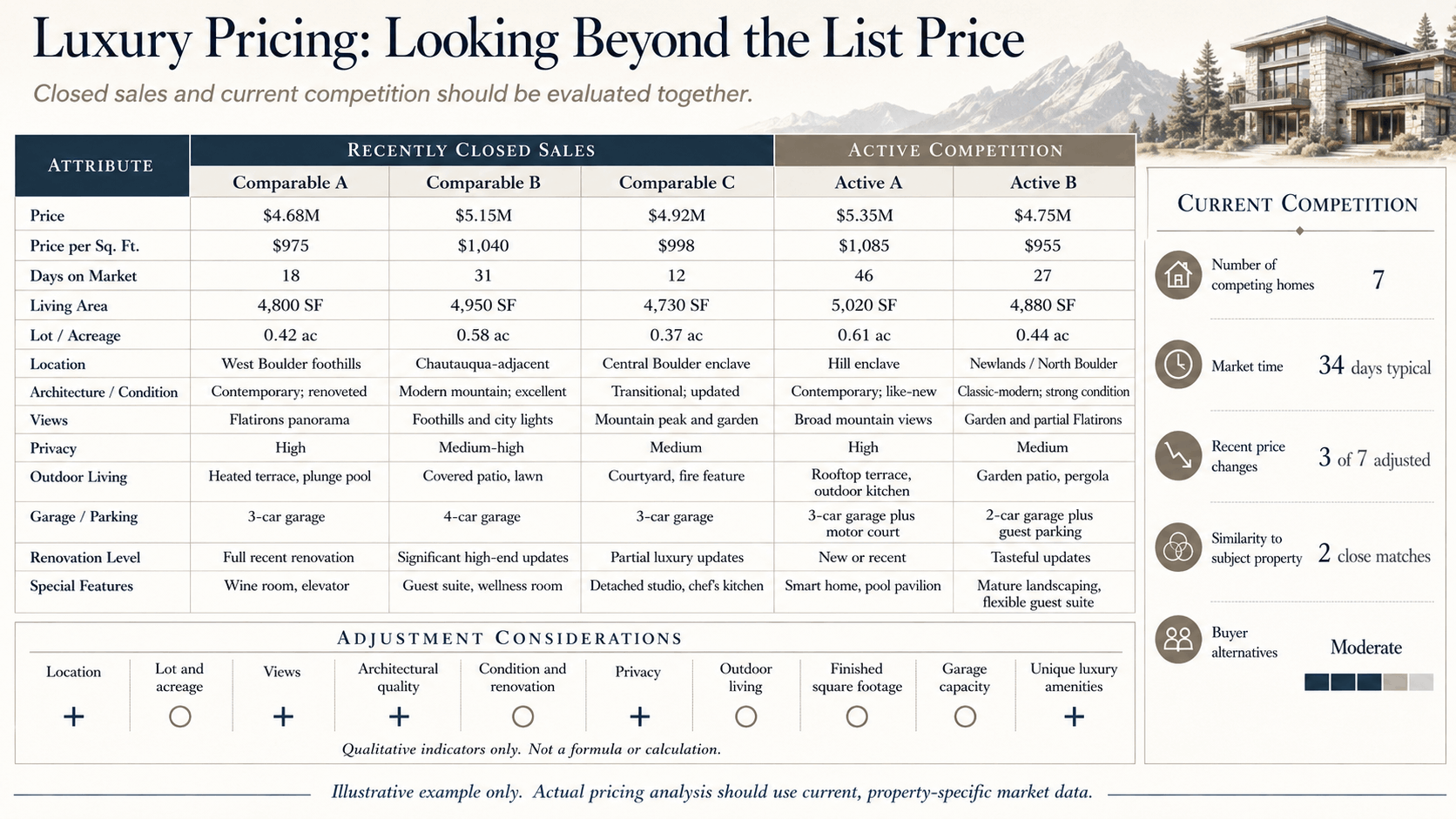
This matters because an initial luxury listing price also communicates a market position. Starting substantially above supportable value can produce weeks of weak activity and eventually force a reduction after the listing has lost its new-to-market advantage.
A hypothetical example: if two otherwise comparable homes are available but one has complete renovation records, updated major systems and clear permit history while the other leaves buyers uncertain about expensive work, buyers may discount the second property even if its finishes photograph better.
The objective is not necessarily to choose the lowest defensible price. It is to select a price that can be explained through current evidence to sophisticated buyers, their brokers, lenders and, when financing is involved, an appraiser.
3. Prepare the property and its records before the listing goes live
For a high-value Boulder sale, documentation can be almost as important as staging. The goal is to answer predictable buyer questions before they become negotiation problems.
Before photography, assemble a property file that may include:
- Building permits, final inspections and certificates of occupancy when applicable.
- Architectural plans and surveys that can legally be shared.
- Receipts and warranties for substantial improvements.
- Roof, HVAC, electrical, plumbing and major appliance information.
- Solar, battery, generator or home-automation documentation.
- Well, water and septic information for applicable properties.
- HOA or common-interest-community documents when applicable.
- Prior inspection, engineering, drainage or environmental reports that should be disclosed or reviewed with counsel.
- Documentation of material wildfire-mitigation work.
- Records relating to additions, finished basements, accessory structures and significant remodeling.
The City of Boulder provides address-based property resources and permit-record searches, although the city's records page notes that permit documentation is not retained for every type of project. Sellers should therefore compare official records with the home's actual condition instead of assuming that the absence of an online record settles the issue.
Colorado disclosure obligations also deserve attention. The Colorado Real Estate Commission's current residential Seller's Property Disclosure form, SPD19, has a mandatory-use date of January 1, 2026. The form states that when the contract requires the disclosure, the seller completes it based on the seller's current actual knowledge and must promptly disclose newly discovered adverse material facts in writing. The Commission also emphasizes that the disclosure is not a substitute for an inspection.
That does not mean sellers should diagnose technical conditions themselves. When the facts are uncertain, use the appropriate inspector, engineer, attorney, contractor, environmental specialist or other qualified professional.
Property preparation should follow the same principle. Repair visible defects and deferred maintenance that could distract from the home's value proposition before spending heavily on speculative cosmetic remodeling. In many cases, neutral presentation, excellent maintenance, strong lighting and carefully edited furnishings are more useful than trying to redesign a distinctive home for an imaginary buyer.
4. Luxury marketing should explain the property, not simply make it look expensive
The most effective high-end marketing gives a qualified buyer enough information to understand why the property is different.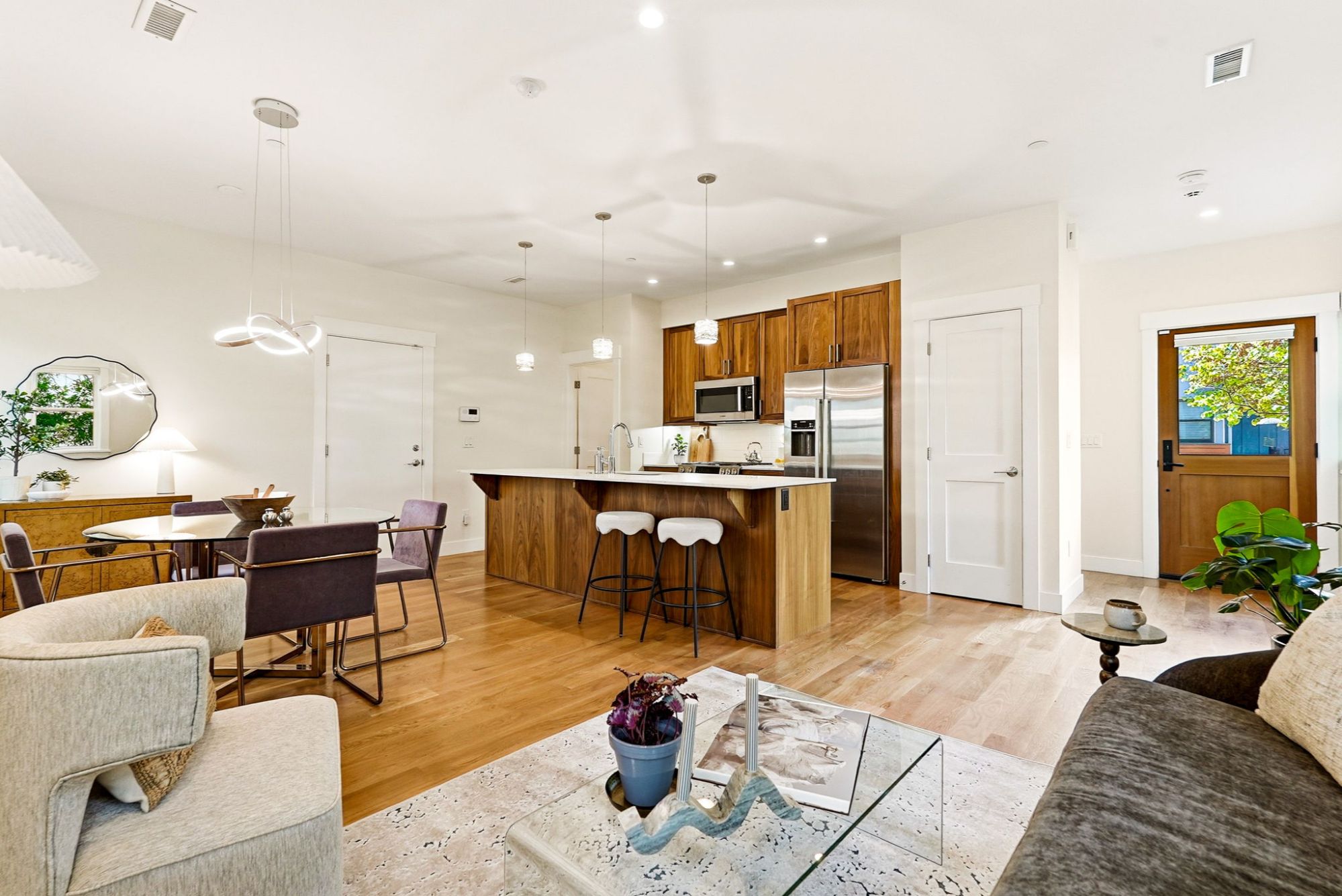
Professional photography remains important, but a Boulder luxury campaign may also benefit from carefully planned video, floor plans, drone imagery where legally permitted, architectural details, site orientation, outdoor-living spaces and concise documentation of significant improvements.
The listing narrative should prioritize verifiable characteristics. Depending on the property, those might include:
- Lot size and recorded property characteristics.
- Architectural design and documented renovation history.
- Natural light and orientation.
- Views that can be accurately represented.
- Outdoor spaces and connection between interior and exterior areas.
- Garage, workshop, storage or gear-management space.
- Documented energy or mechanical improvements.
- Proximity to objectively identified trails, open space, commercial areas or transportation routes.
- Property-specific water, septic, access or infrastructure information.
Avoid turning marketing copy into unsupported claims about future value, school quality, neighborhood safety or the type of person who "belongs" in the area.
Privacy also deserves a deliberate plan. Luxury listings can reveal artwork, technology, security equipment and personal possessions. Colorado Division of Real Estate guidance encourages brokers to discuss photography and video permissions with sellers because images can expose security systems and personal information.
Before launch, decide what should appear publicly, what should be removed or obscured, whether buyer photography will be permitted during showings, and which detailed documents should be released only through an appropriate process.
The distribution strategy should then match the property rather than defaulting to one advertising channel. MLS exposure, brokerage networks, direct agent outreach, digital distribution and property-specific campaigns can work together. The objective is broad enough exposure to locate the right buyer without sacrificing accuracy or privacy.
5. Resolve Boulder-specific due-diligence questions before buyers find them
Some of the largest transaction risks in Boulder have little to do with countertops or staging. Floodplain status, wildfire considerations, historic restrictions, permits and private wastewater systems can materially affect a buyer's decision.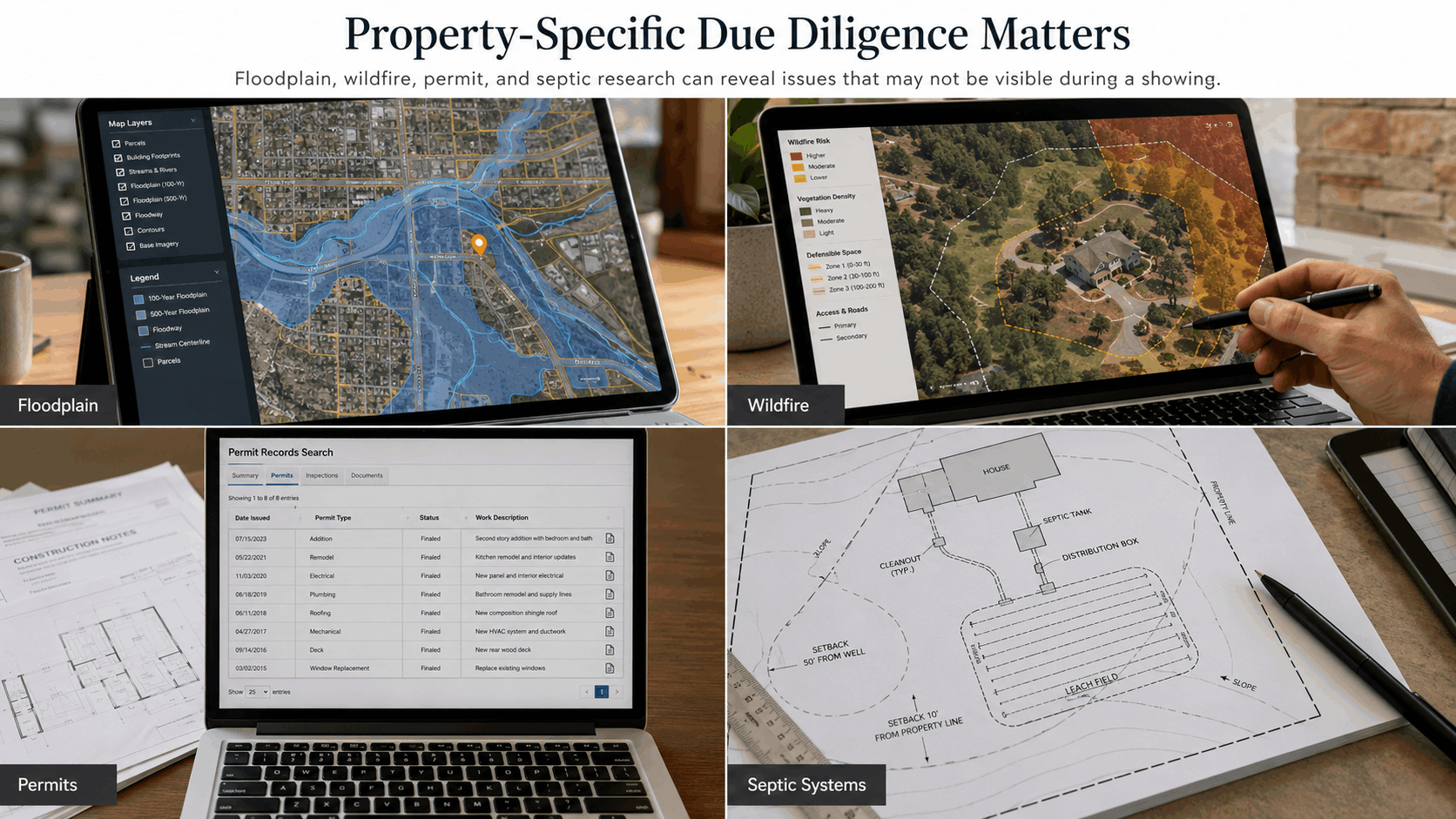
Floodplain and drainage
The City of Boulder maintains an interactive floodplain map and notes that its floodplain maps form the basis for floodplain regulation and can affect insurance requirements. The city also directs property owners to FEMA flood information. Because maps can be revised, sellers and buyers should check the exact parcel rather than relying on neighborhood assumptions.
A mapped floodplain is also different from site drainage. Buyers may separately investigate grading, window wells, retaining structures, groundwater, prior water intrusion and drainage systems.
Wildfire and insurance
Wildfire due diligence can apply to foothills, mountain, open-space-edge and other Boulder County properties. Boulder County's Wildfire Mitigation division provides home-hardening and defensible-space resources, while the City of Boulder offers address-based curbside information and detailed home assessments.
Sellers who have completed documented mitigation should organize those records, but mitigation should never be presented as a guarantee of insurability or protection from wildfire. Buyers should obtain property-specific insurance information directly from an insurer.
Historic status and permits
Within the City of Boulder, individually landmarked properties and homes in historic districts can face additional review. The city states that exterior changes to designated individual landmarks or properties within historic districts require a Landmark Alteration Certificate. Sellers can use the city's historic-property resources to check a property's status.
Permit history deserves the same parcel-level review, particularly after substantial additions or renovations.
Septic systems in Boulder County
Properties using onsite wastewater treatment systems have another important timeline. Boulder County Public Health's property-transfer regulation generally requires qualifying septic systems to be addressed as part of a sale or transfer. As of September 1, 2026, the county lists a $500 Property Transfer Certificate fee and advises that processing can take up to 10 business days. Certain exemptions and conditional-transfer options apply.
For a seller, the lesson is simple: identify these questions before accepting an offer. A problem discovered during the buyer's contingency period usually creates more pressure than the same issue identified and managed before listing.
6. Evaluate the strongest offer by net proceeds and probability of closing
On a luxury sale, the highest headline price is not automatically the strongest offer. Contract structure can materially change both net proceeds and transaction risk.
Review each offer across the same categories:
- Purchase price.
- Earnest money.
- Cash versus financing and the quality of supporting documentation.
- Loan amount and financing deadlines.
- Appraisal provisions.
- Inspection rights and deadlines.
- Insurance contingencies when applicable.
- Requested seller concessions or credits.
- Title and HOA review provisions.
- Sale-of-property or other contingencies.
- Closing date and possession.
- Personal property included in the transaction.
- Any unusual terms requiring legal review.
Higher-priced properties can also require more appraisal support because the comparable-sales pool may be thin. Preparing a factual package of permitted improvements, significant features and relevant comparable information can help the listing side answer questions, although the appraiser remains independent.
Before accepting an offer, ask for an estimated seller net sheet rather than focusing exclusively on the contract price. Brokerage compensation, title and closing charges, property-tax prorations, negotiated concessions, mortgage payoff amounts and other transaction expenses can affect the result. Tax consequences can also be substantial for a high-equity property, so sellers should consult their tax professional rather than relying on a real estate estimate.
Once under contract, organization matters. Keep inspection responses, insurance questions, appraisal access, title matters and property documents moving according to the contract deadlines instead of waiting for the final week before closing.
Finally, remember that every Boulder luxury property carries a different combination of market, regulatory and physical considerations. Buyers and sellers should independently verify zoning, school boundaries when relevant, permits, property condition, HOA requirements, flood information, wildfire considerations, insurance availability and cost, utilities, septic or well records, taxes and other property-specific matters with the appropriate agencies and qualified professionals.
If you are preparing to sell a distinctive or high-value property in Boulder or Boulder County, contact Eric for a property-specific pricing and preparation review. Eric can help organize the real estate side of the process, from comparable-market analysis and listing preparation through marketing, offer evaluation and closing coordination. Online guidance is a useful starting point, but it cannot replace reviewing the actual property, disclosure documents, contract, permit record, HOA documents, insurance information and financial or tax circumstances involved in your sale.
FROM OUR BLOG


Boulder Homeowners Insurance 2026: Wildfire, Hail & What Buyers Need to Know
Buying a home in Boulder involves more than finding the right neighborhood, negotiating a purchase price, and qualifying for a mortgage. There is another important consideration that can affect both the monthly cost of ownership and the ability to complete a purchase: homeowners insurance. In Boulde

Boulder Down Payment Assistance 2026: How First-Time Buyers Can Get Up to $100,000
For many Boulder buyers, the challenge is not simply qualifying for a monthly mortgage payment. It is getting enough cash together for the down payment, closing costs, reserves, and everything else that comes with buying a home in one of Colorado's more expensive housing markets. What many buyers do
Boulder ADU Rules 2026: Can You Build, Rent, or Add an ADU to Your Property?
Accessory dwelling units have become one of the most useful—and frequently misunderstood—housing options in Boulder. An ADU can create a separate place for an aging parent, an adult child, a long-term tenant, a home office setup with living space, or even a future downsizing option for the homeowner