
For many Boulder buyers, the challenge is not simply qualifying for a monthly mortgage payment.
It is getting enough cash together for the down payment, closing costs, reserves, and everything else that comes with buying a home in one of Colorado's more expensive housing markets.
What many buyers do not realize is that Boulder has a city program specifically designed to help address that problem.
The House to Homeownership program—usually called H2O—can provide qualifying first-time buyers with a second loan of up to $100,000 toward the purchase of a market-rate home inside Boulder city limits. The program uses a shared-appreciation structure, requires no regular payments for as long as 30 years, and is separate from Boulder's permanently affordable housing program. Funds are limited and distributed on a first-come, first-served basis.
That does not mean every first-time buyer qualifies, and receiving assistance does not automatically make every Boulder home affordable.
But for the right buyer, it can significantly change the amount of cash needed to make a purchase possible.
Here is how the program works in 2026—and what buyers should understand before building a home search around it.
What Is Boulder's H2O Down Payment Assistance Program?
H2O stands for House to Homeownership.
It is a City of Boulder shared-appreciation loan intended to help eligible first-time homebuyers purchase an ordinary market-rate property inside Boulder city limits.
That last part matters.
The home does not become a permanently affordable or price-restricted property simply because the buyer uses an H2O loan. The City specifically states that H2O is separate from the Boulder Regional Affordable Homeownership Program and that a market-rate home purchased with H2O does not carry the same resale-price restriction.
The maximum H2O loan is currently:
Up to $100,000
It operates as a second loan, meaning the buyer still needs to qualify for a first mortgage.
H2O is also not free money.
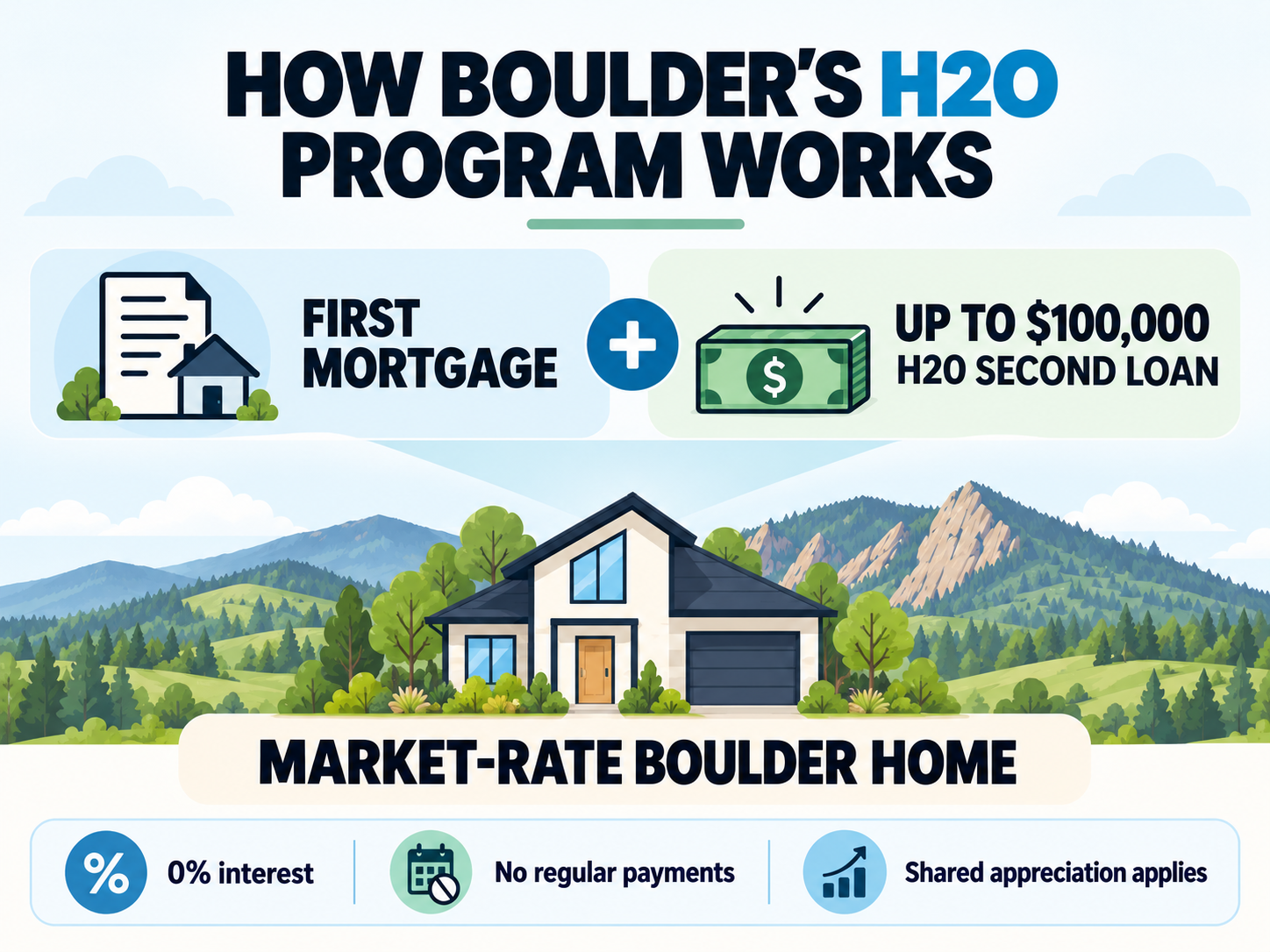
The loan has zero interest and no regular monthly payment, but it must eventually be repaid. When the loan becomes due, the borrower repays the original principal plus an agreed share of the home's appreciation. The loan can generally remain deferred for up to 30 years unless an earlier repayment event occurs, such as selling the property or transferring title.
That makes H2O very different from a traditional second mortgage with monthly principal-and-interest payments.
How Does Shared Appreciation Work?
This is the part buyers should understand before focusing on the $100,000 headline.
H2O is not a grant.
The City participates in some of the home's future appreciation because its loan helped fund the original purchase.
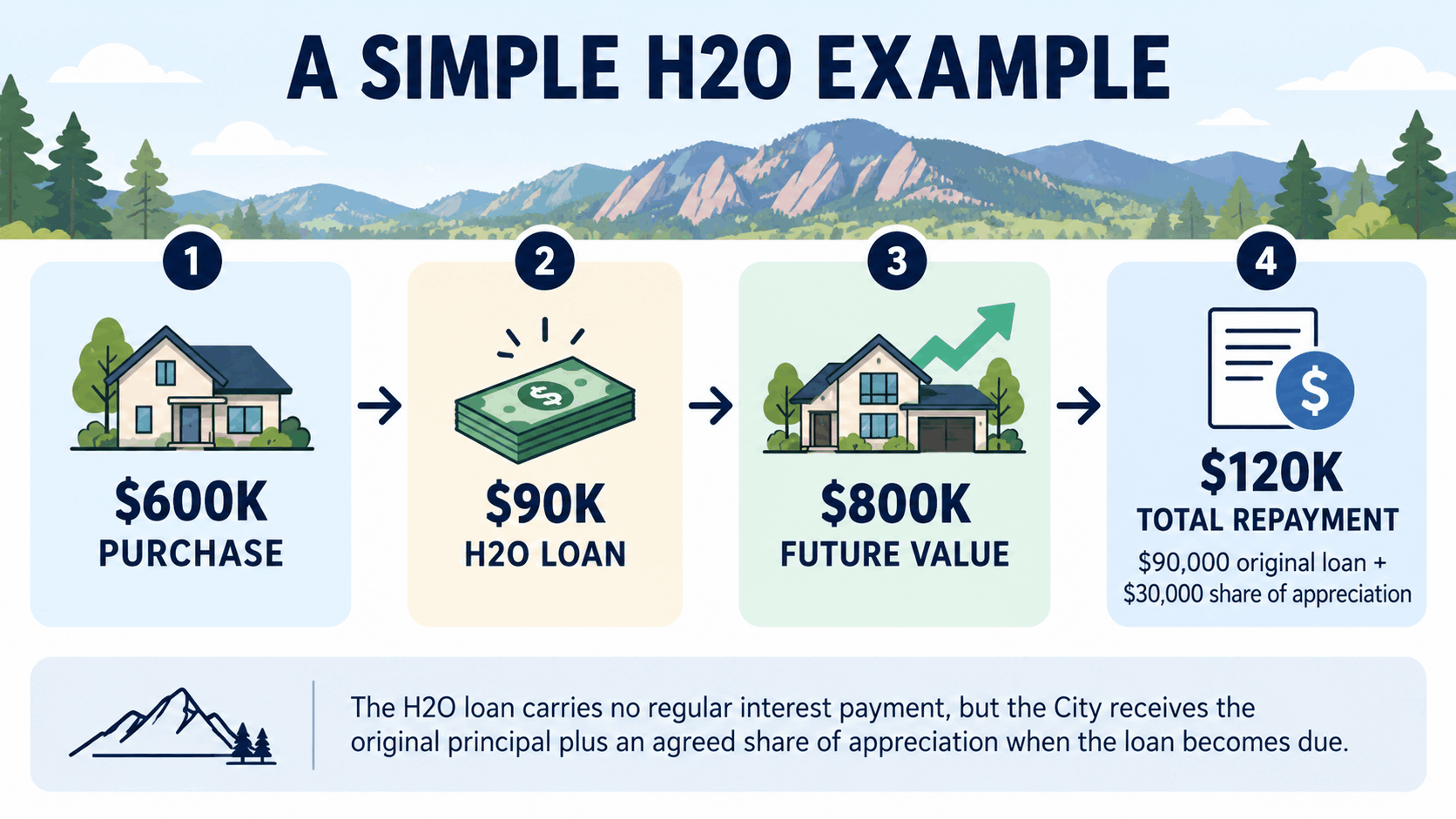
The City's own example makes the calculation easier to understand. A buyer purchases a home for $600,000 and receives a $90,000 H2O loan. The H2O loan represents 15% of the original purchase price.
If the property is worth $800,000 when the H2O loan becomes due, it has appreciated by $200,000. In the City's example, the repayment becomes the original $90,000 loan plus 15% of that $200,000 appreciation, or another $30,000.
The total repayment would therefore be $120,000.
| City's sample H2O transaction | Amount |
|---|---|
| Original purchase price | $600,000 |
| H2O assistance | $90,000 |
| H2O share of purchase price | 15% |
| Later home value | $800,000 |
| Appreciation | $200,000 |
| 15% share of appreciation | $30,000 |
| Total H2O repayment | $120,000 |
This structure creates an important tradeoff.
The buyer receives substantially more purchasing assistance upfront and avoids monthly H2O payments, but part of the future appreciation is shared when the loan is repaid.
That does not automatically make the program good or bad.
The right comparison is between the actual H2O terms and the alternatives available to that buyer: waiting longer to save, buying a less expensive property, making a smaller conventional down payment, choosing another assistance program, or purchasing outside Boulder.
Who Can Qualify for H2O in 2026?
The program is narrower than simply being a buyer who needs help with a down payment.
The current City guidance says an H2O applicant must be a first-time homebuyer, generally defined as someone who has not owned a home during the previous three years, subject to the City's stated exceptions. The buyer must purchase a market-rate home within Boulder city limits, and the program also includes work-history, income, asset, education, financing, owner-occupancy, and debt requirements.
Among the City's currently published requirements are completing the required orientation and homebuyer education, contributing at least $2,000 toward the purchase and closing costs, qualifying for a first mortgage, and generally keeping total debt-to-income at no more than 45%.
The City also requires applicable employment history in Boulder and says at least one household member generally must work at least 30 hours per week unless an applicable retired or disabled exception applies.
Buyers should not wait until they have already found the perfect property before checking eligibility.
Assistance programs can affect financing, purchase contracts, timelines, and which homes qualify.
2026 Income and Asset Limits
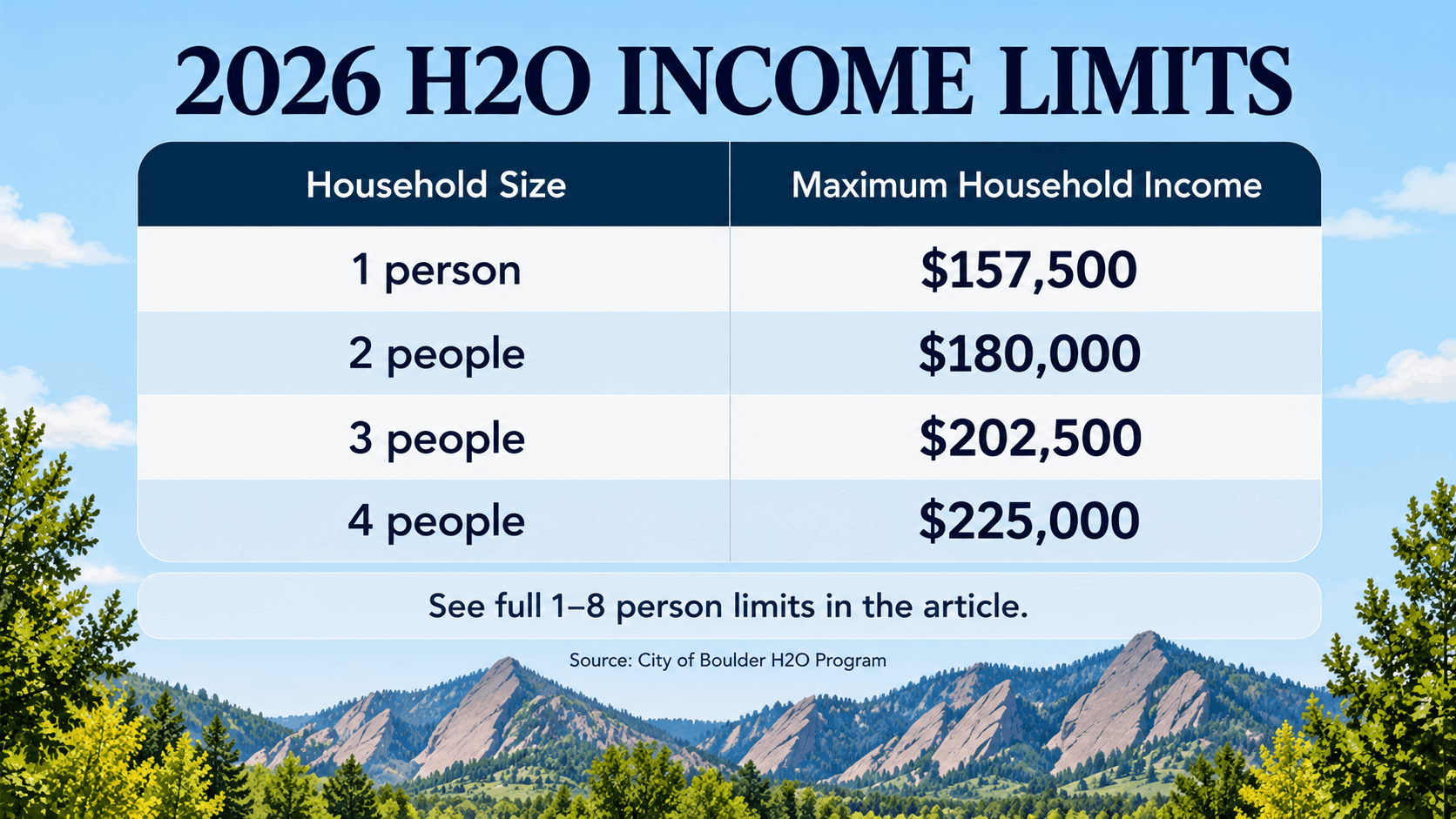
The current H2O program page publishes the following maximums:
| Household size | Maximum income | Maximum assets |
|---|---|---|
| 1 person | $157,500 | $158,250 |
| 2 people | $180,000 | $180,750 |
| 3 people | $202,500 | $203,400 |
| 4 people | $225,000 | $225,900 |
| 5 people | $243,000 | $244,050 |
| 6 people | $261,000 | $262,050 |
| 7 people | $279,000 | $280,200 |
| 8 people | $297,000 | $298,200 |
The City says income is generally based on gross income for standard employees and net income for self-employed applicants. It also publishes exemptions for portions of certain retirement assets, with the amount depending on age.
View current H2O income and asset limits — City of Boulder.
These limits can change, and program funding can run out. A buyer should therefore verify eligibility directly with the program administrator before treating H2O money as part of an available down payment.
What Homes Can You Buy With H2O?
H2O is intended for market-rate housing inside the City of Boulder.
That can be an important advantage compared with programs that restrict buyers to a specific inventory of deed-restricted homes.
A qualifying H2O buyer can work with a real estate agent to search the ordinary Boulder market rather than choosing only from the Boulder Regional Affordable Homeownership Program inventory. The City's application guidance specifically states that approved H2O households can work with their agent to search for market-rate homes within Boulder city limits.
However, H2O still has property requirements.
The home must be used as the buyer's primary residence, rental restrictions apply, and the program states that the number of bedrooms generally may exceed the number of household members by only one.
That last requirement can matter in Boulder.
A one-person household hoping to buy a four-bedroom detached home should not assume the property will qualify simply because the buyer meets the income and financing requirements.
Jurisdiction matters too.
A listing can have “Boulder, CO” in its mailing address without actually being inside Boulder city limits. A property in unincorporated Boulder County would not automatically qualify for this City of Boulder program.
Always verify the jurisdiction of the exact address before building an offer around H2O assistance.
H2O Is Not Boulder's Only Homebuyer Assistance Option
This is where buyers can easily become confused.
Boulder and Colorado have several programs with similar-sounding goals, but they work very differently.
H2O vs. Permanently Affordable Homes
The Boulder Regional Affordable Homeownership Program offers qualifying buyers homes sold at below-market prices.
Unlike an H2O-assisted market-rate purchase, these properties carry an affordability covenant that limits future resale pricing and imposes other ownership restrictions intended to keep the home affordable for future buyers.
That means these are two very different strategies:
H2O: Buy a qualifying market-rate Boulder home with shared-appreciation assistance.
Boulder Regional Affordable Homeownership: Buy a price-restricted property at a below-market price, subject to the program's long-term covenant.
Neither is automatically better. The buyer needs to understand what they receive today and what restrictions or repayment obligations continue after closing.
Other Assistance Programs
The City's current down-payment guide lists several additional programs that may apply depending on income, location, lender, and buyer circumstances.
| Program | Current assistance structure |
|---|---|
| Boulder H2O | Up to $100,000 shared-appreciation second loan on qualifying market-rate Boulder homes |
| Solution Grant | Up to 5% of purchase price on eligible permanently affordable or qualifying land-trust homes |
| MetroDPA | Up to 5% of the primary loan, with the assistance currently described as forgivable after three years when program conditions are met |
| Colorado Roots | Up to 10% of purchase price, maximum $50,000, with program-specific interest and income rules |
| CHFA assistance | Grant up to the lesser of $25,000 or 3% of the first mortgage, or a deferred second mortgage up to the lesser of $25,000 or 4% |
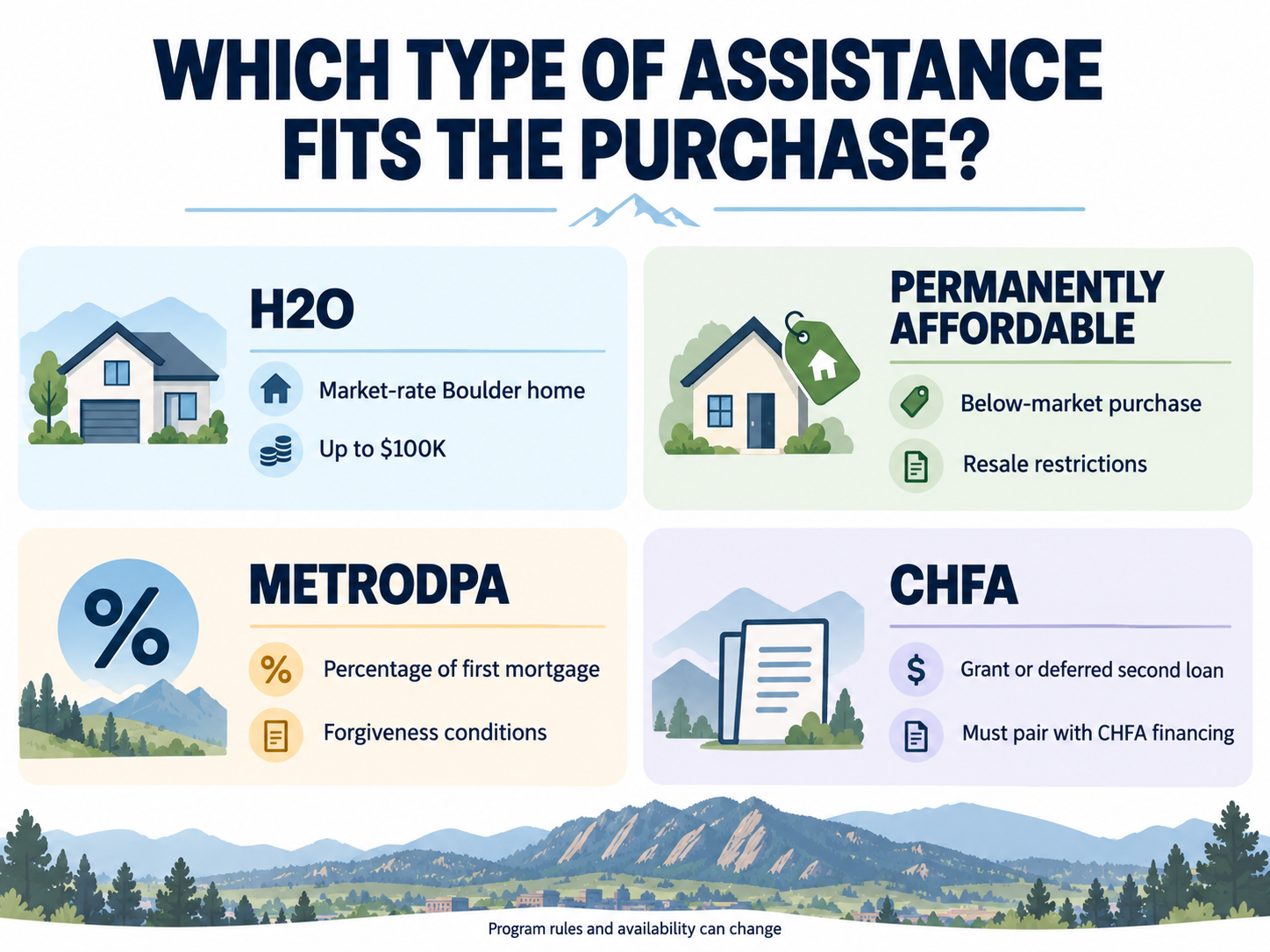
City of Boulder assistance-program comparison
CHFA down payment assistance details
The City provides details on Boulder and regional assistance options, while CHFA separately confirms its current grant and second-mortgage structures.
The important part is not to choose the program with the biggest number.
Compare repayment, interest, mortgage rate, shared appreciation, occupancy requirements, income limits, resale restrictions, lender requirements, and the type of property you can buy.
Does $100,000 of Assistance Make a Boulder Home Affordable?
Not necessarily.
This is one of the most important distinctions in any down-payment-assistance conversation.
Cash needed to close and long-term affordability are not the same problem.
A buyer could receive substantial assistance and still end up with a monthly payment that is too high once the first mortgage, property taxes, homeowners insurance, HOA dues, mortgage insurance where applicable, utilities, maintenance, and other expenses are included.
H2O itself recognizes this by requiring first-mortgage qualification and setting a debt-to-income guideline.
For example, using assistance to make a larger down payment may reduce the first mortgage. But the buyer still needs enough ongoing income to carry the property—and eventually must account for the H2O repayment structure.
That is why I would evaluate the program in this order:
- Determine a sustainable total monthly housing budget.
- Find out whether you qualify for H2O or another assistance program.
- Calculate how the assistance changes the first mortgage and cash needed to close.
- Compare actual Boulder properties using taxes, HOA costs, insurance, condition, and expected maintenance.
- Review what happens when the assistance eventually has to be repaid.
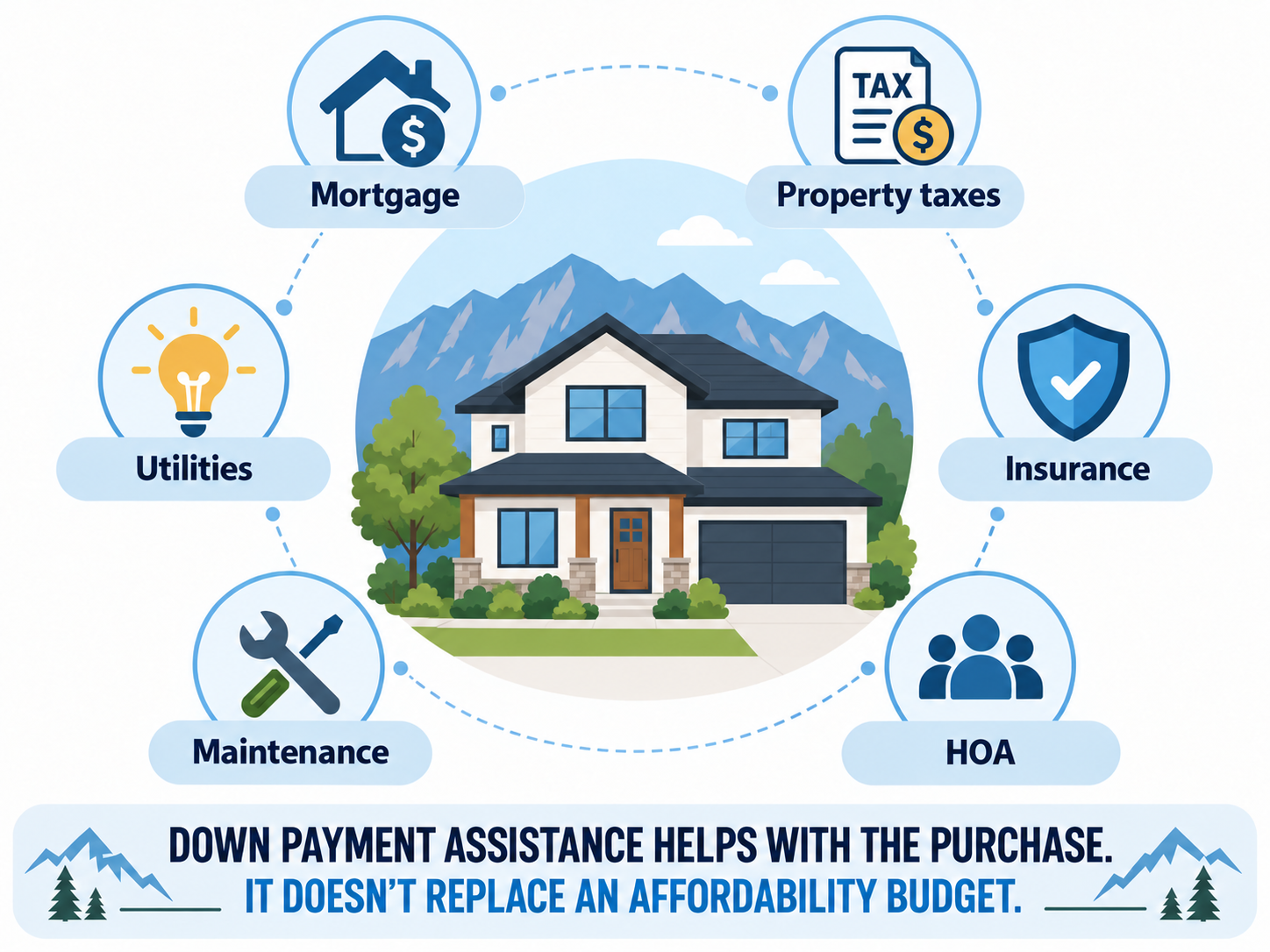
For a deeper calculation, see How Much Income You Need to Buy a Home in Boulder, which breaks Boulder ownership costs into mortgage, taxes, insurance, HOA costs, and other property-specific expenses.
How to Start the H2O Process Before You Find a Home
Do not wait until you are preparing an offer.
The City's current H2O page directs buyers who are specifically interested in the program to Impact Development Fund, which administers the H2O loan. Applicants do not need to complete the City's broader affordable-homeownership application simply to pursue H2O.
A practical sequence is to confirm program eligibility first, complete required education and financing steps, obtain the appropriate first-mortgage qualification, and then begin comparing market-rate Boulder homes that fit both the program and the buyer's personal budget.
Once a buyer has a property under contract, program requirements and normal real-estate deadlines have to work together.
That is where coordination among the buyer, lender, H2O administrator, real estate agent, inspector, insurer, title company, and other professionals becomes important.
Assistance should be part of the purchase strategy before the offer—not something everyone tries to add during the final week before closing.
What First-Time Boulder Buyers Should Remember
Boulder's H2O program is significant because it addresses one of the hardest parts of purchasing in a high-cost market: the upfront cash requirement.
For an eligible buyer, a deferred second loan of as much as $100,000 can change what is possible.
But the smartest use of that assistance is not simply to increase the maximum purchase price.
It is to create a purchase that works from three directions at once:
enough cash to close, a manageable ongoing payment, and a clear understanding of the future shared-appreciation obligation.
Buyers should also compare H2O with permanently affordable homes, CHFA financing, MetroDPA, Colorado Roots, and other programs for which they may qualify rather than assuming the largest assistance amount is automatically the best option.
And once the search begins, the property itself still matters.
HOA obligations, insurance, taxes, flood or wildfire considerations, permits, condition, location, and future repairs can make two similarly priced Boulder homes very different financial commitments.
For more of the purchase process, see the First-Time Homebuyer Guide to Boulder, CO, which covers financing, assistance, inspections, insurance, property-specific due diligence, and the path from preapproval through closing.
If you're trying to determine what type of Boulder home fits your budget and whether local assistance could change the numbers, Eric can help you compare available properties and coordinate the real-estate side of the process with your lender and applicable program administrators.
Eric Farran
Eric Sells Boulder
FROM OUR BLOG

Boulder ADU Rules 2026: Can You Build, Rent, or Add an ADU to Your Property?
Accessory dwelling units have become one of the most useful—and frequently misunderstood—housing options in Boulder. An ADU can create a separate place for an aging parent, an adult child, a long-term tenant, a home office setup with living space, or even a future downsizing option for the homeowner

Boulder Housing Market October 2026: Are Home Prices Falling?
Updated October 1, 2026 Search for the Boulder housing market right now, and you can find several very different-looking answers. Realtor.com's September 2026 data shows a $910,000 median sold price in Boulder, down 8.5% from a year earlier. Zillow, however, estimates the typical Boulder home value

CU Boulder South Is Closing for Years: What the Flood Project Means for South Boulder Residents and Homebuyers
Updated September 29, 2026 CU Boulder South is about to change dramatically. Beginning the week of October 5, 2026, the entire site, including its existing trails, is scheduled to close to public access while the City of Boulder begins the South Boulder Creek Flood Mitigation Project. Construction i