
Accessory dwelling units have become one of the most useful—and frequently misunderstood—housing options in Boulder.
An ADU can create a separate place for an aging parent, an adult child, a long-term tenant, a home office setup with living space, or even a future downsizing option for the homeowner. But simply having room in the backyard does not automatically mean you can build one.
Boulder has changed its ADU regulations substantially over the past several years. The City of Boulder removed several previous barriers, including its owner-occupancy requirement and neighborhood saturation limits. Meanwhile, Boulder County is in the middle of reconsidering its own rules for accessory dwellings in unincorporated areas.
That distinction matters.
A property with a Boulder mailing address is not necessarily governed by City of Boulder rules, and an attractive listing advertised as having “ADU potential” should never be assumed to qualify without checking the specific parcel.
Here is what Boulder homeowners and buyers should know in 2026.
What Is an ADU in Boulder?
An accessory dwelling unit, or ADU, is an additional dwelling on the same property as a principal home.
To qualify as an ADU, the secondary unit has its own facilities for cooking, sleeping, and bathing. It may be located inside or attached to the main house, or it may be a separate detached structure.
An attached ADU might be created from part of a basement, an addition, or another portion of the existing home.
A detached ADU is a separate building, sometimes informally called a backyard cottage, carriage house, or granny flat.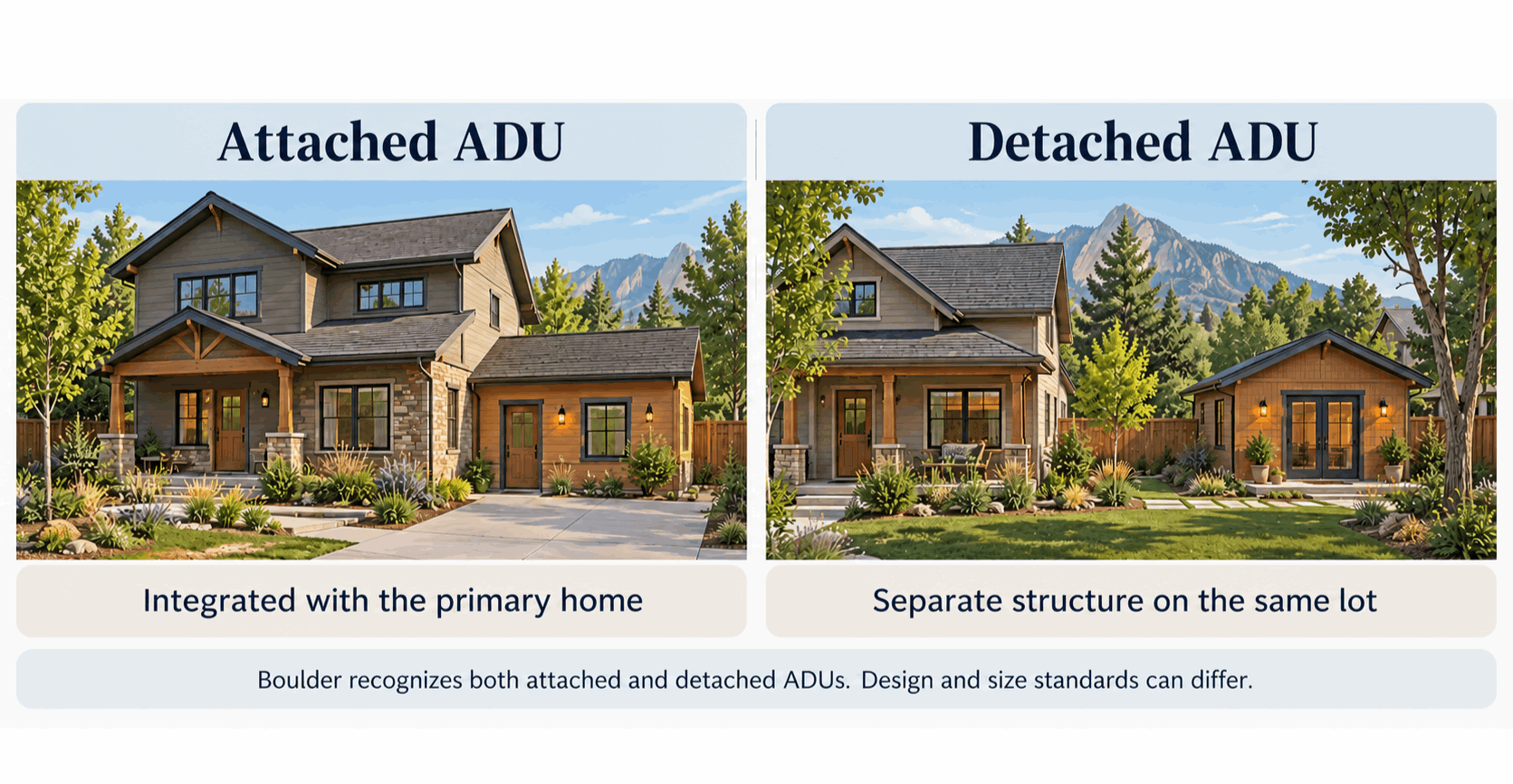
The important distinction is that an ADU is legally a dwelling unit—not simply a finished garage, studio, guest room, or detached office.
That means permitting and code compliance matter.
Since September 2023, the City of Boulder has reviewed ADUs through the normal building permit process rather than requiring the separate administrative-review process that existed previously.
Can You Build an ADU in Boulder in 2026?
In many cases, yes.
The City's current ADU guide says an ADU is allowed by right on a property with a detached dwelling in most Boulder zoning districts.
The exceptions currently listed by the city are:
RH-6, MH, BMS, BCS, IS-1, and IM.
Even when the zoning district allows an ADU, however, the property and proposed design must still meet other development standards.
Those can include requirements related to:
- setbacks,
- floor-area ratio,
- building coverage,
- height,
- solar access,
- side-yard bulk plane,
- utility connections,
- prior planned-unit approvals,
- floodplain requirements,
- historic review,
- and other property-specific conditions.
So the right question is not simply:
“Does Boulder allow ADUs?”
It is:
“Does this particular property support the ADU I want to build?”
Before spending money on architectural plans, start by confirming the parcel's actual zoning and jurisdiction.
How Big Can an ADU Be in Boulder?
The answer depends on whether the ADU is attached or detached and whether it qualifies for one of the city's larger-size allowances.
For a standard market-rate ADU, the current City of Boulder limits are:
| ADU type | Standard maximum |
|---|---|
| Detached ADU | 800 sq. ft. |
| Attached ADU | Half the principal home's floor area or 1,000 sq. ft., whichever is less |
| Attached ADU when the principal home is under 1,500 sq. ft. | 750 sq. ft. maximum |
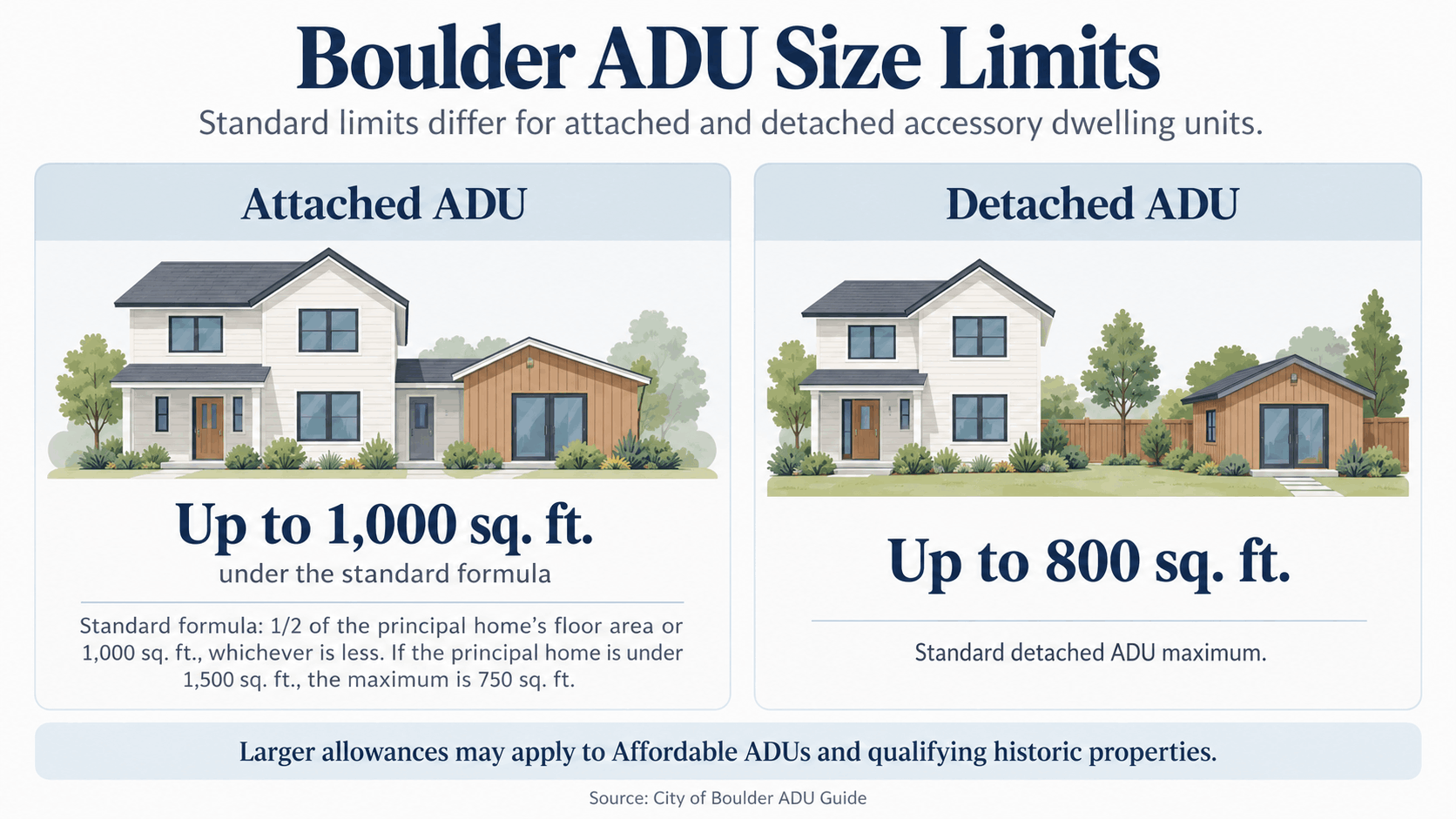
Affordable ADUs and ADUs on qualifying designated historic properties can receive larger allowances. A qualifying detached unit can reach 1,000 square feet, while an attached qualifying ADU may be up to two-thirds of the main structure's floor area or 1,200 square feet, whichever is less, subject to the city's additional formula for smaller homes.
Detached units also have specific building-form requirements.
The normal maximum height for an accessory structure is 20 feet, although a detached ADU with a roof pitch of at least 8:12 may reach 25 feet under the city's rules. Detached ADUs must generally maintain at least six feet of separation from another building.
This is one reason homeowners should work backward from the property rather than starting with a predesigned 800-square-foot ADU and assuming it will fit.
Do You Have to Live on the Property?
No.
This is one of the biggest changes to older information about Boulder ADUs.
As of March 8, 2025, the City of Boulder no longer requires an ADU property to be owner-occupied. The city says the change was made in accordance with state legislation.
That means older articles, neighborhood discussions, or property marketing materials that say the homeowner must live in either the ADU or the main house may be outdated.
Eliminating the owner-occupancy requirement creates more flexibility, particularly for owners who later move but want to retain the property as a long-term rental.
It does not, however, eliminate the city's rental-license or ADU requirements.
Can You Rent an ADU in Boulder?
Yes.
The City allows long-term rental of an ADU for 30 days or more, although a rental license is required if either the ADU or principal dwelling is being rented.
That creates several potential uses.
A homeowner might live in the main house and rent the ADU. Another owner may choose to occupy the smaller unit while renting the primary home. Others may use the ADU for extended family without renting it at all.
What owners should not assume is that an ADU automatically qualifies as an Airbnb or vacation rental.
Can You Airbnb a Boulder ADU?
Generally, no for newly established ADUs.
Under the City's current ADU rules, short-term rental—defined here as rental for fewer than 30 days—of either the ADU or the principal home is prohibited in this setup unless the ADU and applicable short-term-rental license were established before February 1, 2019.
Boulder now also has a separate Festival Lodging Rental License program for certain city-approved events, but that does not turn newly created ADUs into ordinary short-term rentals. The City's festival-lodging guidance continues to impose special limitations on ADUs.
If rental income is part of the reason you are considering a particular property, verify the exact licensing rules before calculating projected returns.
What Is an Affordable ADU?
Boulder also offers incentives for owners who voluntarily establish an ADU under the city's affordability requirements.
An Affordable ADU limits rent to the city's affordability standard—currently tied to 75% of Area Median Income—in exchange for incentives that can include larger size allowances.
For the 2026–27 rent year, effective June 6, 2026, Boulder publishes the following maximum Affordable ADU rents:
| Bedrooms | Maximum monthly rent |
|---|---|
| Studio | $1,969 |
| 1 bedroom | $2,109 |
| 2 bedrooms | $2,531 |
| 3 bedrooms | $2,925 |
| 4 bedrooms | $3,263 |
Importantly, the City says utilities must be included in those maximum rents, including electricity, natural gas, water/sewer, and waste services.
An approved Affordable ADU also involves a recorded Declaration of Use so that future owners are on notice about the affordability requirements attached to the unit.
This is not the right option for every homeowner, but the larger permitted ADU size can make it worth evaluating.
What About Garage Conversions or Existing Unpermitted ADUs?
One of the easiest mistakes to make when looking at an older Boulder property is assuming that an existing second kitchen, basement apartment, converted garage, or backyard living space is already a legal ADU.
Sometimes it is.
Sometimes it is not.
The City specifically notes that previously unpermitted ADUs are common in Boulder. It is possible to legalize an existing unit, but the process may require bringing it into compliance with currently adopted building and land-use codes.
That can involve more than paperwork.
According to the City's current guidance, finishes may need to be removed so inspectors can verify framing, insulation, plumbing, mechanical systems, and electrical work. A licensed design professional may also need to prepare stamped plans. Detached units can require fire-suppression systems to meet current code.
Even if no construction is planned, establishing an existing space as an ADU may still require a change-of-use permit so the City can verify life-safety requirements and formally recognize the dwelling unit.
For buyers, that makes permit history extremely important.
A listing description saying “mother-in-law suite,” “separate apartment,” or “ADU-style space” is not proof that the unit is legally established.
City of Boulder and Boulder County ADU Rules Are Not the Same
This may be the most important distinction for buyers.
A property can have “Boulder, CO” in its mailing address without actually being located inside the City of Boulder.
Homes in unincorporated Boulder County follow Boulder County land-use regulations, not City of Boulder zoning rules.
And those county rules are currently being reconsidered.
In March 2026, the Boulder County Commissioners authorized DC-26-0002, a Land Use Code amendment specifically focused on accessory dwelling units. County staff are studying whether ADU allowances should be broadened, the different ways an ADU could be created, and where accessory dwellings may be appropriate in unincorporated Boulder County.
The County's published schedule currently calls for:
Planning Commission public hearing — October 2026
and
Board of County Commissioners public hearing — November 2026.
Those are still part of an active code-update process. The proposed changes should not be treated as though they are already adopted.
If you are evaluating a property outside Boulder city limits, verify its current rules directly with Boulder County Community Planning & Permitting rather than relying on City of Boulder ADU information.
Can an ADU Increase a Boulder Home's Value?
Potentially—but there is no responsible way to say that adding an ADU automatically increases a home's value by a specific percentage.
Buyers may place meaningful value on a legally permitted secondary unit because it can offer:
rental income potential, multigenerational living space, separation for adult children or parents, greater household flexibility, or a future downsizing option.
But the resale value depends on the individual property.
A well-designed detached ADU on a lot that still retains good outdoor space may appeal very differently from a poorly positioned addition that reduces privacy or compromises the main house.
Construction cost matters too.
Owners should compare the likely cost of design, permitting, utilities, construction, financing, landscaping, and ongoing maintenance with the way similar Boulder properties with legal ADUs actually perform in the market.
The word legal is important.
A fully permitted unit with clear records is easier for a buyer, lender, appraiser, and future owner to evaluate than an undocumented conversion.
For homeowners considering an ADU specifically to raise resale value, the best starting point is not a national “ADU return on investment” statistic. It is a comparison with relevant Boulder properties.
Buying a Boulder Home Because It Has “ADU Potential”? Verify It First
This is where ADU rules become especially relevant to real estate buyers.
A listing may have a large backyard.
The garage may appear convertible.
A seller may even say that previous owners considered adding an ADU.
None of that guarantees approval.
Before paying a premium for “ADU potential,” confirm the property itself.
At minimum, buyers should investigate zoning and jurisdiction, lot dimensions, existing floor area and building coverage, setbacks, solar-access requirements, prior PUD or site-review approvals, utility connections, floodplain conditions, historic restrictions, HOA covenants where applicable, existing permits, and whether the proposed design could meet current building-code requirements.
The City's ADU guide specifically notes that properties with prior approvals may require a Minor Modification before the building permit can be submitted. Historic properties can involve additional review, while detached ADUs require wet-utility permitting for connections between the primary home and ADU.
For buyers, that means “possible” and “permitted” are very different things.
A strong due-diligence process should answer the question before the purchase:
What can actually be built here under today's rules?
For additional Boulder-specific buying considerations, see Eric's First-Time Homebuyer Guide to Boulder, which also explains why buyers should verify zoning, jurisdiction, insurance, permits, flood conditions, and the full cost of ownership at the parcel level.
The Bottom Line on Boulder ADUs in 2026
Boulder has become considerably more ADU-friendly than it was several years ago.
The City eliminated neighborhood saturation limits in 2023, removed the owner-occupancy requirement in 2025, and now allows both attached and detached ADUs across most applicable zoning districts. Long-term rental is allowed with the appropriate license, and the City offers larger size allowances for Affordable ADUs and qualifying historic properties.
But an ADU is still not automatic.
The property's zoning, existing development, lot dimensions, building coverage, setbacks, utilities, flood or historic conditions, and other approvals can determine whether a project works.
And outside City of Boulder limits, the rules can be completely different—especially while Boulder County is actively considering changes to its own accessory-dwelling regulations.
For homeowners, the opportunity is real.
For buyers, the important part is verifying it.
If an ADU is part of your plan for buying, selling, or improving a Boulder property, evaluating the real estate and the development potential together can prevent expensive assumptions later.
Eric Farran
Eric Sells Boulder
Boulder ADU FAQ
Can I build an ADU in Boulder?
ADUs are allowed on properties with detached dwellings in most City of Boulder zoning districts, subject to zoning, development standards, and building-permit approval. Certain zoning districts are excluded, and property-specific restrictions may still apply.
How large can a detached ADU be in Boulder?
A standard detached Boulder ADU may be up to 800 square feet. Affordable ADUs and ADUs on qualifying designated historic properties may be allowed up to 1,000 square feet.
How large can an attached ADU be?
A standard attached ADU is generally limited to half the floor area of the principal structure or 1,000 square feet, whichever is less. If the main structure contains less than 1,500 square feet, the standard maximum is 750 square feet.
Do I have to live on the property if I have an ADU?
No. The City of Boulder eliminated its ADU owner-occupancy requirement effective March 8, 2025.
Can I rent my Boulder ADU?
Yes. Long-term rental of an ADU for 30 days or more is allowed, subject to the City's rental-license requirements.
Can I Airbnb an ADU in Boulder?
Generally not if it is a newly established ADU. Short-term rental of either the ADU or main house is prohibited under the current ADU rules unless the ADU and applicable short-term-rental license were established before February 1, 2019.
Can an ADU be sold separately from the main house?
No. City regulations state that the ADU cannot be independently conveyed or sold separately from the principal dwelling.
Are Boulder County ADU rules the same as City of Boulder rules?
No. Unincorporated Boulder County uses its own Land Use Code. The County is currently reviewing proposed changes to its ADU rules under docket DC-26-0002, so buyers and property owners should confirm which jurisdiction governs their property.
FROM OUR BLOG


CU Boulder South Is Closing for Years: What the Flood Project Means for South Boulder Residents and Homebuyers
Updated September 29, 2026 CU Boulder South is about to change dramatically. Beginning the week of October 5, 2026, the entire site, including its existing trails, is scheduled to close to public access while the City of Boulder begins the South Boulder Creek Flood Mitigation Project. Construction i

Family-Friendly Things to Do in Boulder: Parks, Trails & More
Boulder is often associated with serious hiking, climbing, and cycling, but experiencing the city with children does not require turning every outing into an endurance event. Some of Boulder's most useful family activities are much simpler: a playground beside a multi-use path, a short walk around a

Pearl Street Mall Guide: Where to Eat, Shop, and People-Watch
Pearl Street Mall is one of the easiest places to start understanding Boulder, but there is an important distinction first-time visitors often miss: the pedestrian mall itself is only four blocks, from 11th Street to 15th Street. Downtown shopping and dining continue east and west well beyond those