
Say you keep a Boulder condo so you can spend summers here and visit family over the holidays. When you draw up your 2028 budget, one question will matter more than what the condo is worth: How many days of the year does someone live there?
On November 3, 2026, Boulder voters approved Ballot Issue 2J. Starting January 1, 2028, the City of Boulder will impose an annual vacancy tax starting at $4,000 on qualifying homes. The ballot sets the threshold at 183 occupied days or fewer per year. City Council will take up the rules for administering the tax in 2027.
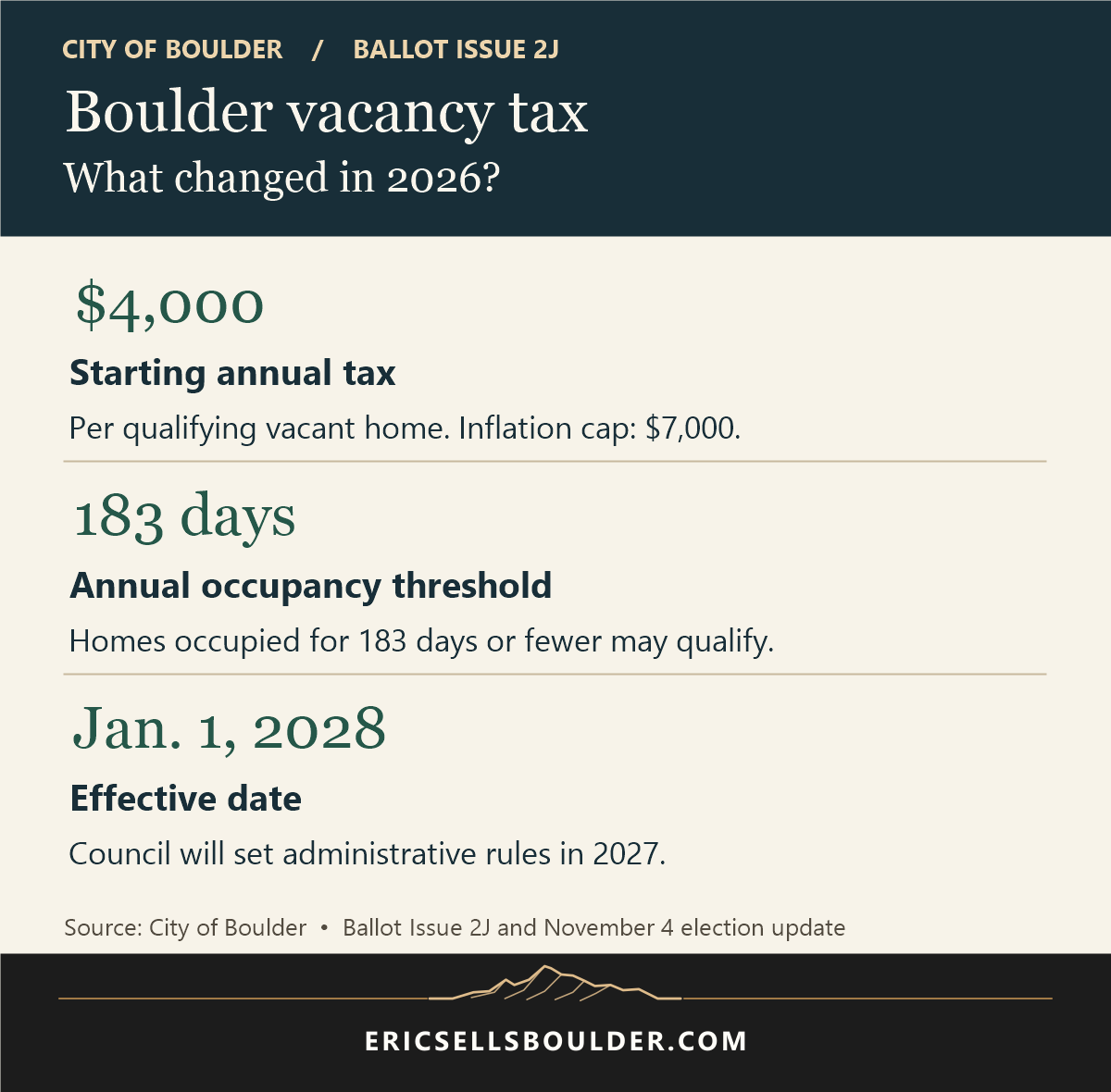
Ballot Issue 2J sets the starting amount, occupancy threshold and inflation limit. Graphic by Eric Sells Boulder.
Which Boulder homes could be affected?
First, check the address. This is a City of Boulder measure. A Boulder mailing address can belong to a property in unincorporated Boulder County. If you’re comparing homes, look up the jurisdiction for each parcel before putting a vacancy tax in your budget.
Next, think about who uses the home over the course of a year. A condo where a student lives during the academic year and one a family uses for occasional football weekends might look identical in a listing. Their occupancy calendars could look very different. Calling either home a “second home” tells you little about the number of days someone actually lives there.
The official wording of Ballot Issue 2J counts occupied days. Exactly 183 falls within the threshold. At 184 occupied days, a home is above that numerical cutoff. The 2027 ordinance will matter for anyone close to the line who needs to know which days the city will count.
How much should an owner budget?
The starting amount is $4,000 a year for each qualifying vacant home. That works out to about $333 a month if you’re setting money aside. The city has yet to specify a payment schedule. The measure ties future adjustments to the Denver–Aurora–Lakewood Consumer Price Index, with a $4,000 floor and a $7,000 ceiling.
The vacancy tax has no percentage-of-value calculation. A buyer reviewing a seller’s property tax bill should budget for regular property taxes separately. My guide to Boulder property taxes for 2026–2027 explains how assessed values and mill levies affect that bill.
What happens between the vote and January 2028?
Boulder’s November 4 election update reported that the measure passed and identified January 1, 2028, as its effective date. In between, City Council will adopt an ordinance setting out how the tax will work. Owners have time to read that ordinance before making decisions that depend on the details.
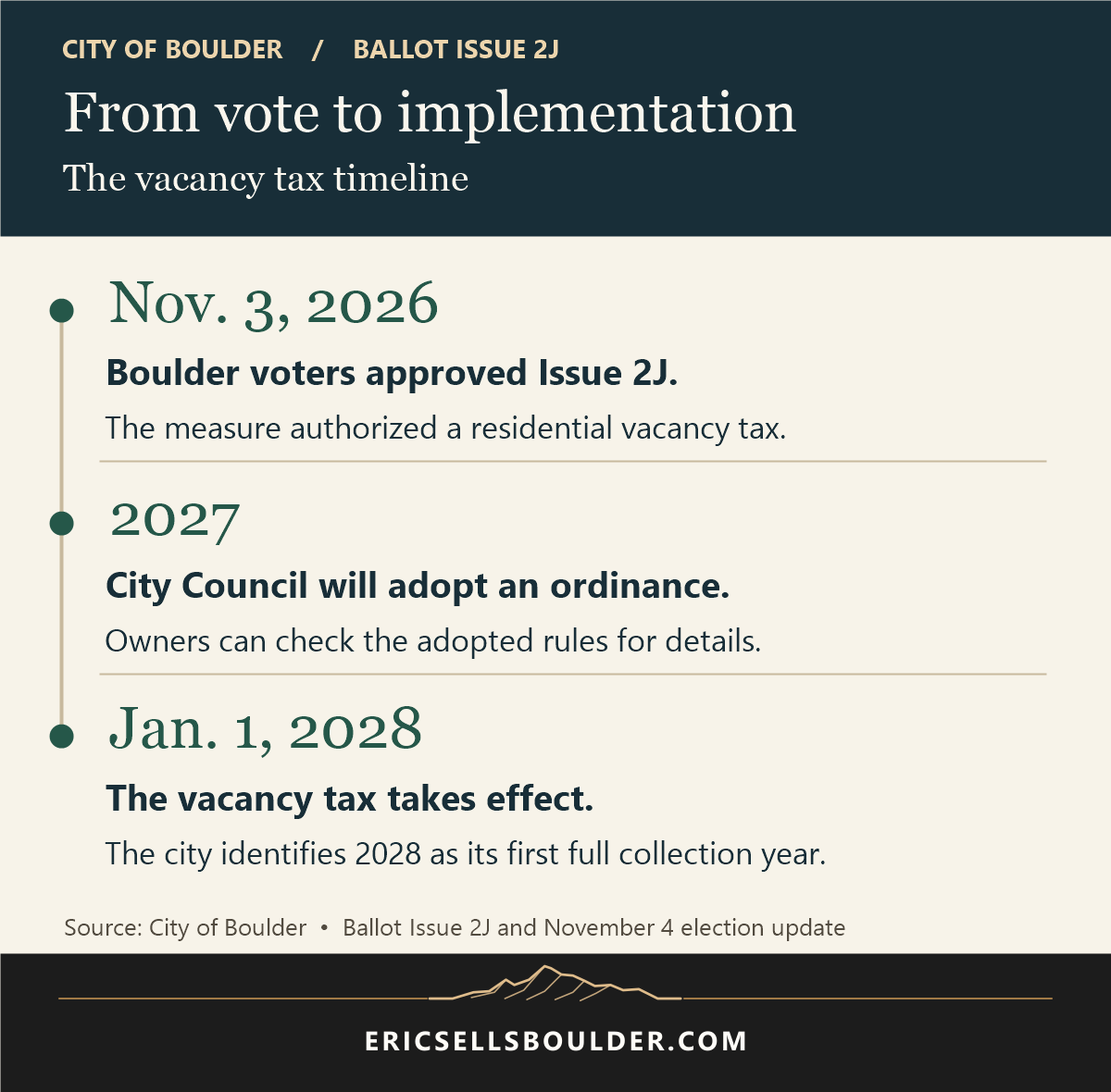
The 2027 ordinance is the next milestone for property owners. Graphic by Eric Sells Boulder.
One question worth following is what happens when a home is empty during a renovation, while it is listed for sale, or after its owner moves into care. The ballot language does not settle those cases. The same goes for what proof an owner must supply and how to handle a purchase partway through the year. Look for those answers in the adopted city rules before relying on an exemption.
Buying, selling or keeping a part-time home
If you’re buying, sketch out a realistic year. A summer in Boulder plus a handful of weekend trips may add up to fewer days than you expect. Run your annual ownership budget once with the starting tax included and once without it. You’ll see whether the difference changes what you can comfortably spend.
If you’re selling, a buyer may ask how long the home has been empty. You can give a useful answer with dates, such as when a tenant moved out or when work began. Until the city explains how it will handle a transfer, avoid promising how it will treat either side of a closing.
If you’re keeping the home, start with records you already have. A simple calendar of stays, leases and move-in or move-out dates can help you reconstruct the year. These are planning notes. The city’s forthcoming instructions will tell you what it accepts as documentation.
Two questions I’d ask before making a decision
Where will the money go? Voters authorized the city to use the revenue for general services, including fire and police protection, parks and transportation. The $6 million figure in the ballot was an estimate of citywide revenue for 2028.
When should I revisit my plans? When Council releases the 2027 ordinance, read it with your own occupancy calendar in hand. If you’re close to the cutoff or have an unusual ownership situation, ask the city how the adopted rules apply to your facts.
For more background, watch my earlier video on Boulder’s vacancy tax. If you’re weighing a year-round home against a place you’ll use part time, reach out to Eric Sells Boulder. We can put both ownership budgets side by side using the addresses and dates you have in mind.
FROM OUR BLOG

Boulder Home Energy Rebates 2026: What's Still Available and the December 31 Deadline
If you've been thinking about upgrading your Boulder home's heating system, improving insulation, or replacing an aging water heater, 2026 has brought some important changes to the financial incentives available. Some rebate programs are still offering meaningful savings. Others have changed their e
Buying a Historic Home in Boulder? Renovation Rules, Permits & What Buyers Should Know in 2026
There is something special about walking through an older Boulder home. Maybe it's a Victorian house in Mapleton Hill with its original woodwork and covered front porch. Maybe it's a cottage near Chautauqua, or a century-old property with tall windows, mature trees, and architectural details that wo

Boulder Homeowners' Winter Checklist 2026: 9 Things to Do Before the Next Freeze
Winter in Boulder has a way of catching homeowners off guard. One afternoon, the sun is shining over the Flatirons, and the temperature feels comfortable enough to enjoy a walk outside. A few days later, a cold front can bring freezing temperatures, snow-covered sidewalks, and unexpected maintenance