
If you own a home in Boulder County, you may have noticed that your property tax bill looked different in 2026.
You may have seen two assessed values instead of one, encountered an unexpected increase, or wondered why your taxes changed even though your property's assessed market value barely moved.
Those changes aren't necessarily mistakes.
Colorado has adjusted how residential property taxes are calculated, and Boulder County's 2026 tax bills reflected some of those changes for the first time.
There is another adjustment worth understanding: the rules for tax year 2026, payable in 2027, are different from those used for the bills homeowners paid earlier this year.
For someone who already owns a home, that can affect future expenses. For buyers, it makes estimating a property's taxes more complicated than simply looking at the seller's most recent tax bill.
The good news is that the system becomes easier to understand once you separate three things: the property's assessed value, the assessment rate, and the local mill levy.
Here's what Boulder homeowners, buyers, and sellers should know about property taxes heading into 2027.
Why Did Boulder Property Taxes Change in 2026?
One reason involves the expiration of temporary property-tax relief that Colorado had provided in earlier years.
In January 2026, Boulder County announced that a $55,000 reduction in residential property value used for the previous tax year was no longer available for tax year 2025, payable in 2026.
That reduction had helped lower the amount of property value subject to assessment.
When it expired, some homeowners experienced higher tax bills even when the county's estimated value of their property had changed very little.
Boulder County also introduced a different way of displaying residential property assessments.
Beginning with the 2025 tax year, homeowners were subject to two assessment rates:
- 7.05% for school districts
- 6.25% for other local governments

Before this change, many homeowners were accustomed to seeing a single residential assessed value.
Under the updated system, the school portion and the other local-government portions are calculated separately.
As a result, homeowners may see two different assessed values associated with the same property.
That isn't automatically a billing error.
It's a reflection of the separate rates established under Colorado's revised property-tax framework. Boulder County
Why This Matters
A homeowner might reasonably assume that if their property's market value stayed the same, their tax bill should also remain unchanged.
But the property's assessed market value is only one part of the calculation.
Changes in assessment rates, value reductions, local mill levies, or exemptions can affect the final tax bill.
That is why comparing two years of property taxes requires more than looking at the home's estimated value.
What Changes for Boulder Property Taxes Payable in 2027?
The next distinction is between the tax year and the year the taxes are actually paid.
Colorado property taxes are generally collected in the year following the tax year.
For example:
| Property tax year | Year taxes are paid |
|---|---|
| 2025 | 2026 |
| 2026 | 2027 |
This distinction is particularly important in October 2026 because the County has already published how the 2026 assessment rules work, even though the resulting tax bills will be payable in 2027.
Residential Assessment Rates for 2026 and 2027 Payments
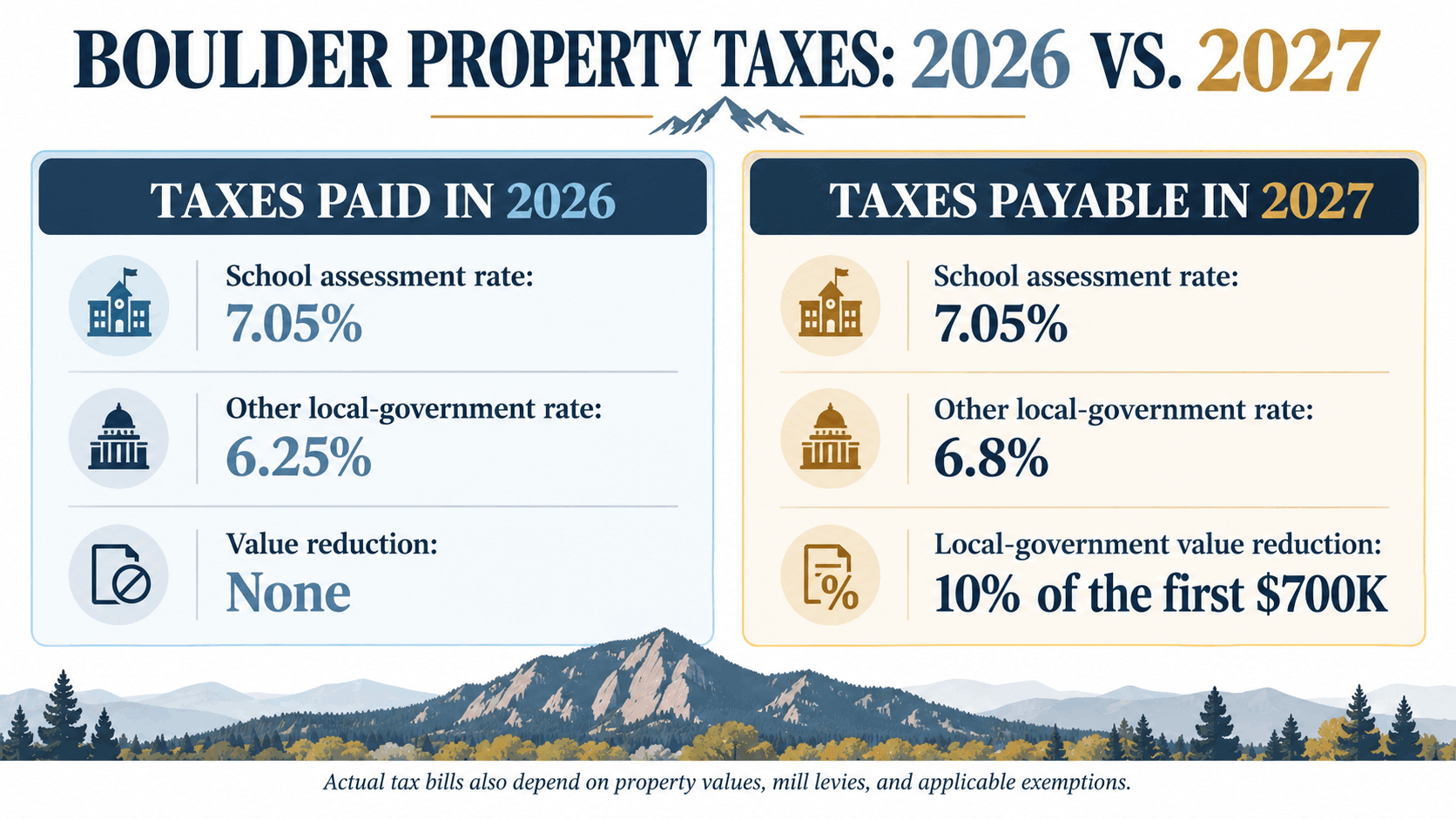
Boulder County currently publishes the following residential assessment rates:
| Assessment category | Tax year 2025 — paid in 2026 | Tax year 2026 — paid in 2027 |
|---|---|---|
| School districts | 7.05% | 7.05% |
| Other local governments | 6.25% | 6.8% |
| Local-government value reduction | None | 10% of the first $700,000 in actual value |
The value reduction for tax year 2026 applies to the local-government assessment calculation—not to the school-district calculation.
For a residential property valued at $700,000 or more, that adjustment reduces the value used for the local-government assessment by $70,000.
For a property valued below $700,000, the adjustment is 10% of its actual value.
This does not mean homeowners receive a direct $70,000 reduction in their tax bills.
It means the value used in one portion of the assessment calculation is reduced before the relevant rate is applied.
Boulder County's official calculation guide explains both systems and provides worked examples. Boulder County
Will Property Taxes Automatically Decrease in 2027?
Not necessarily.
Although the value adjustment may provide some relief, it operates alongside a different local-government assessment rate.
The final tax bill will still depend on the property's assessed value, the applicable mill levies, and any exemptions or other adjustments.
A homeowner should not assume that a new value reduction guarantees a lower total bill.
Likewise, the fact that an assessment rate increased does not automatically mean the final tax bill will increase by the same percentage.
The complete calculation matters.
How Are Property Taxes Calculated in Boulder County?
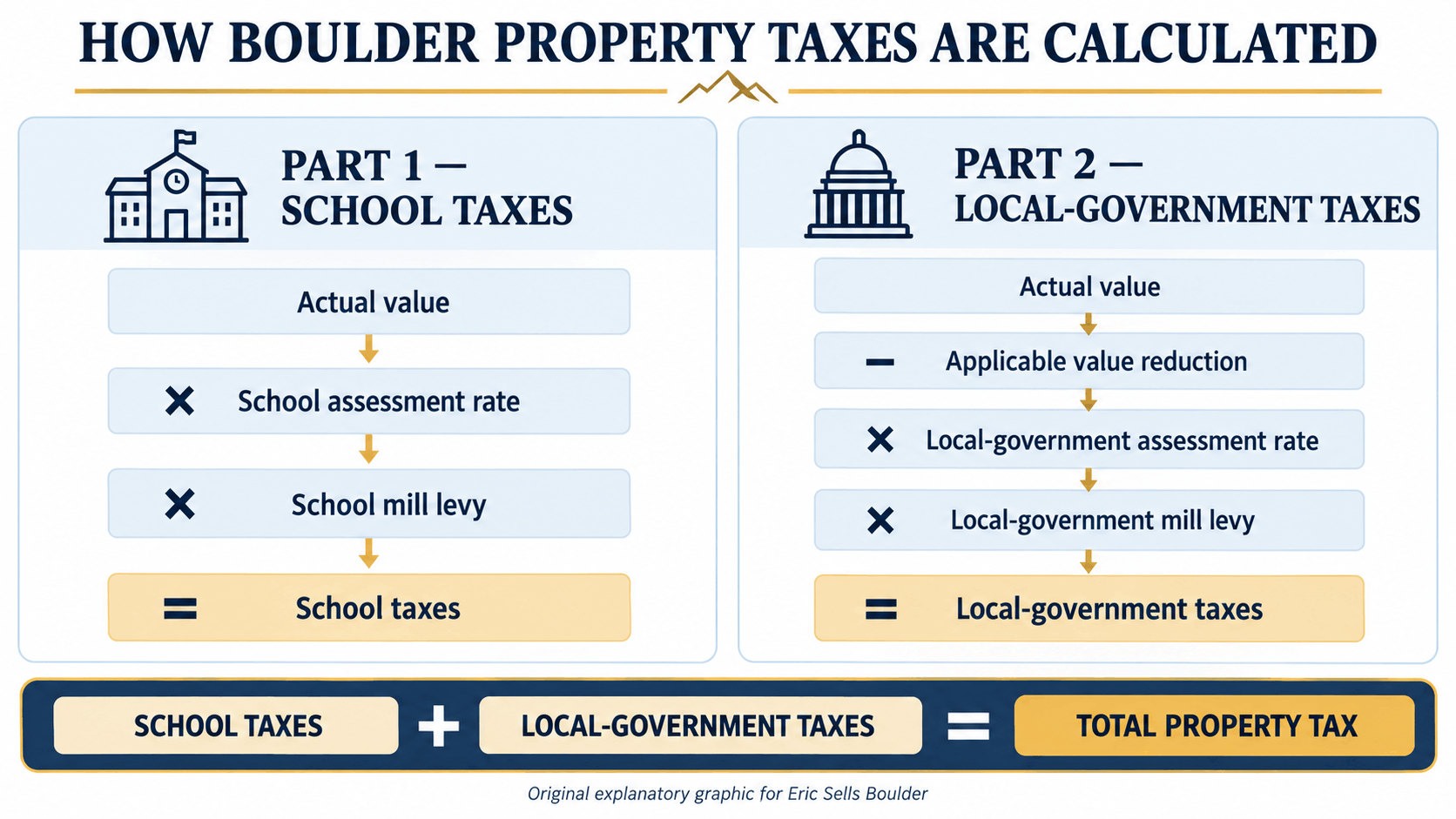
Colorado property taxes are calculated using three main components:
Actual value × assessment rate × mill levy
However, beginning with the 2025 tax year, the residential calculation must account for separate school and local-government assessment rates.
The two portions are calculated individually and then added together.
1. Actual Property Value
The Boulder County Assessor determines the property's value using the valuation process established under Colorado law.
This value is not necessarily the same as the property's current listing price or the amount someone recently offered to pay for it.
2. Assessment Rate
The assessment rate determines what portion of the property's actual value becomes assessed value for taxation.
For residential properties, the applicable assessment rate now differs between school districts and other local governments.
3. Mill Levy
The mill levy represents the tax imposed by the applicable taxing authorities.
One mill equals $1 in property tax for every $1,000 of assessed value.
Properties may be subject to multiple taxing authorities, including school districts, municipalities, counties, fire districts, and other local districts.
Those rates are combined to determine the applicable tax amounts.
Example: Property Valued at $800,000
Boulder County provides an example using an $800,000 residential property.
The County assumes:
- School district mill levy: 30 mills
- Other local-government mill levies combined: 65 mills
These are example mill levies, not rates that apply to every Boulder property.
Here is how the calculations compare.
| Calculation | Taxes paid in 2026 | Taxes payable in 2027 |
|---|---|---|
| Actual property value | $800,000 | $800,000 |
| School assessment rate | 7.05% | 7.05% |
| School taxes | $1,692 | $1,692 |
| Local-government assessment rate | 6.25% | 6.8% |
| Local-government value reduction | $0 | $70,000 |
| Local-government taxes | $3,250 | $3,227 |
| Total estimated property tax | $4,942 | $4,919 |
These figures reproduce the County's hypothetical examples. They are not an estimate for a specific Boulder home and do not predict that every owner's bill will fall by $23.
The examples hold the property's actual value and mill levies constant to demonstrate the different assessment formulas.
Real tax bills can change when those inputs or exemptions change. Boulder County
For homeowners, this is a useful illustration of why focusing on the assessment rate alone can produce an inaccurate estimate.
Why Property Taxes Differ Across Boulder County
Two homes with similar market values can have different property tax bills.
That is because the property's actual value is only one component.
A home inside the City of Boulder may be subject to different taxing districts from a similar property in Longmont, Louisville, Lafayette, or an unincorporated part of Boulder County.
Those differences can affect the total mill levy.
Even properties within the same city may fall into different taxing districts.
This is one reason a countywide average property-tax rate can be misleading when evaluating a specific property.
Special Districts Can Affect Your Tax Bill
Some properties are located within districts that provide or finance particular local services or improvements.
Depending on the location, these may include fire protection districts, water districts, metropolitan districts, or other authorized taxing entities.
The applicable levies depend on the specific parcel.
A buyer evaluating two homes should therefore compare the actual tax records rather than assuming the properties have identical tax obligations because their asking prices are similar.
City of Boulder vs. Boulder County
It is also important to distinguish the City of Boulder from Boulder County.
Boulder County includes several incorporated communities and unincorporated areas.
A property with a Boulder mailing address is not necessarily inside Boulder city limits.
The governing jurisdiction and taxing districts should always be verified through the property's official records.
Does the Boulder County Assessor Use the Current Market Price?
Not necessarily.
This is another area where buyers and homeowners sometimes become confused.
The assessed value of a home does not automatically change every time a similar property sells nearby.
Colorado uses a property valuation system with designated reassessment cycles.
Boulder County explains that 2025 was a reappraisal year, with property values based on a valuation date of June 30, 2024.
For most properties, the 2026 tax year is an intervening year.
That means the assessed market value generally remains the same as in 2025 unless the property experienced a relevant change.
Examples may include new construction, additions, changes in classification, or other property-specific circumstances.
The County explains that properties with changes requiring a new valuation may receive a 2026 Notice of Value. Boulder County
What About a Home That Sells for More Than Its Assessed Value?
Imagine a Boulder property with a county-assessed market value of $850,000.
The owner lists the home for $950,000 and eventually sells it for $925,000.
That sale does not automatically mean the property's tax assessment immediately becomes $925,000.

The County's statutory valuation process determines how and when sales information affects assessments.
The new purchase price can become relevant evidence in future assessments, but it should not be treated as an automatic replacement for the property's official value.
For buyers, the practical lesson is straightforward:
Check the County's current assessed value, but don't assume that value will remain unchanged throughout your ownership.
How to Check Your Boulder Property Taxes Online
One of the most useful things a homeowner or buyer can do is look up the official tax record for the actual address.
Boulder County provides online resources for property assessments and tax information.
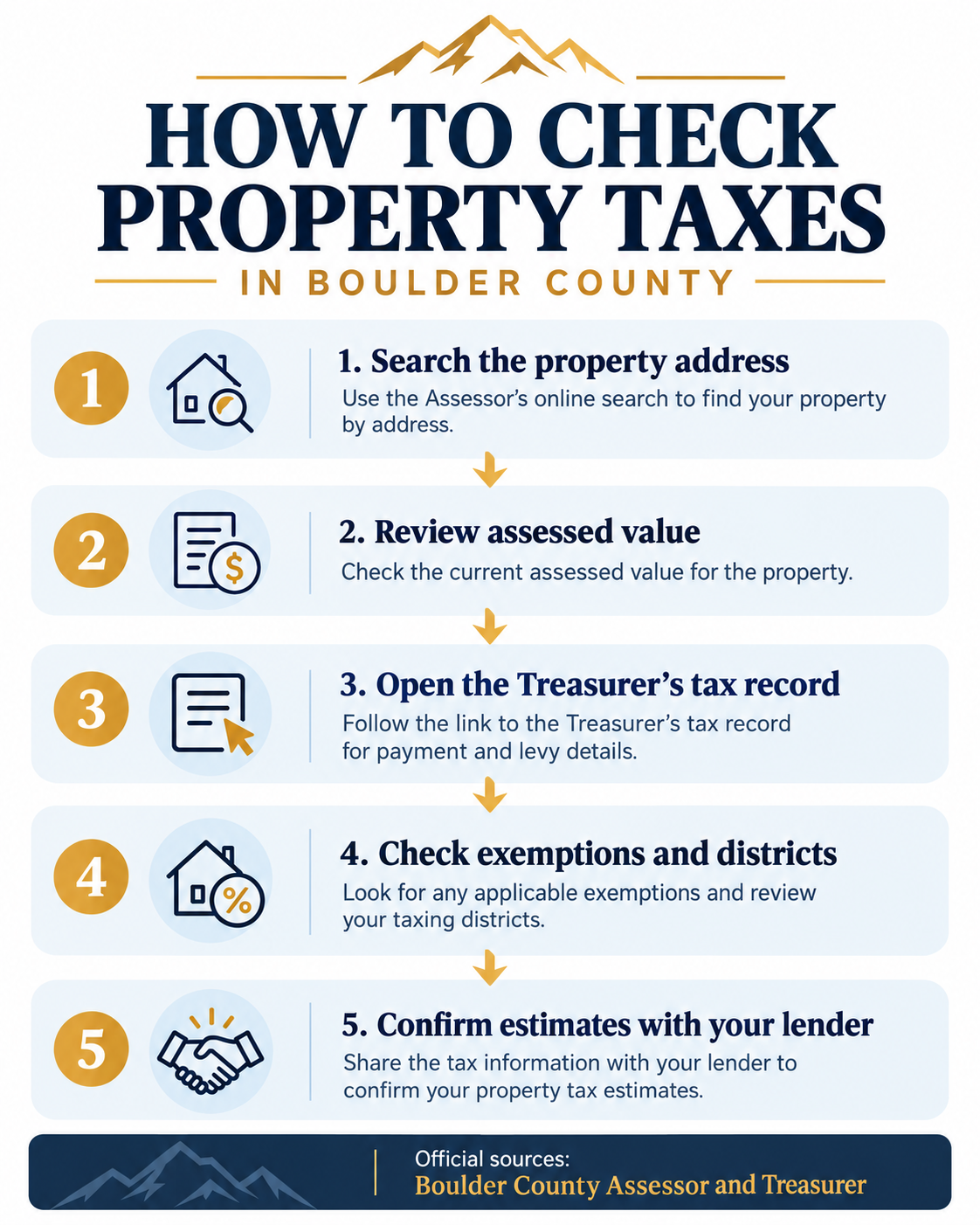
Step 1: Search for the Property
Start with the Boulder County Assessor's Property Search.
Boulder County Property Search
The system allows users to search by address, owner name, parcel number, and other identifiers.
Step 2: Review the Assessed Value
Find the property's actual value and assessed-value information.
Review the listed property characteristics, including square footage, lot information, and other relevant details.
If something appears incorrect, contact the Assessor's Office.
Step 3: Review the Tax Record
Next, use the Boulder County Treasurer's tax search.
Boulder County Treasurer Property Tax Search
The Treasurer's system provides taxpayer access to property-tax account information.
Review the applicable tax amounts and payment status.
Step 4: Check Taxing Districts and Exemptions
If you're evaluating a home for purchase, review whether the property receives exemptions and which taxing districts apply.
A seller's current exemption may not necessarily continue for the buyer.
For example, an existing senior exemption may end when a property changes ownership unless the new owner independently qualifies.
Step 5: Confirm the Estimated Amount Before Closing
If you're buying a home, ask your lender and closing professionals how the property's current tax record affects the estimated monthly payment and closing adjustments.
The most recent tax bill is a starting point.
It is not a guarantee of the amount you will pay in future years.
Are There Property Tax Exemptions in Boulder County?
Yes.
Colorado offers property-tax relief programs for certain qualifying property owners.
Eligibility depends on the particular program.
Senior Property Tax Exemption
Colorado's Senior Homestead Property Tax Exemption is available to qualifying homeowners who meet age, ownership, and primary-residence requirements.
Generally, the program requires the applicant to be at least 65 and to have owned and occupied the home as a primary residence for the required continuous period.
For qualifying applicants, 50% of the first $200,000 of the property's actual value is exempted, producing a maximum exemption of $100,000 in actual value.
That is an exemption from the value used for taxation, not a direct $100,000 payment to the homeowner.
As of October 2026, Boulder County states that the application deadline for tax year 2026 has passed.
The County says it will begin accepting applications for the 2027 tax year after January 1, 2027. Boulder County

Qualified Senior Primary Residence Classification
Colorado also has a separate classification for certain seniors who previously qualified for the Senior Property Tax Exemption but lost eligibility, often after moving.
This program has additional requirements and should not be confused with the standard senior exemption.
Boulder County says the application deadline for the 2026 tax year has already passed.
Boulder County Qualified Senior Primary Residence Information
Veteran-Related Exemptions
Qualifying veterans with certain disabilities, and some surviving spouses, may also be eligible for property-tax exemptions.
The requirements differ from the standard senior exemption.
Boulder County reports that its 2026 application deadline has passed and that 2027 applications will begin after January 1, 2027. Boulder County
Homeowners should confirm the current program requirements directly with the County before assuming they qualify.
Can You Appeal Your Boulder Property Tax Assessment?
Yes, property owners can challenge an assessment through the applicable appeal process.
However, there is an important distinction between appealing a property's assessed value and questioning the amount of a tax bill.
The Boulder County Assessor determines property values.
The Treasurer collects property taxes based on the certified information and applicable levies.
That means a disagreement over the property's value should generally be directed to the Assessor.
A question about payment, balances, or collection should generally be directed to the Treasurer.

What Evidence Can Support an Assessment Appeal?
Relevant evidence may include comparable sales, incorrect property characteristics, or other documentation showing that the property's assessed value may not reflect the required valuation standard.
For example, an owner might discover that the County's records list incorrect square footage or information about improvements that were never completed.
The County provides an appeals process and explains how comparable sales may be used to support a valuation challenge.
However, property owners must follow the applicable filing deadlines.
As of October 20, the regular 2026 appeal deadlines have passed. Owners preparing for a future appeal should review the County's current appeal calendar rather than assuming a previous year's dates will apply. Boulder County
Where to Get Help
Boulder County Assessor
Phone: 303-441-3530
Boulder County Real Property Appeals
Boulder County Treasurer
Phone: 303-441-3520
What Should Boulder Homebuyers Know About Property Taxes?
Property taxes are part of the actual cost of owning a home.
For buyers using a mortgage, they are often included in the estimated monthly housing payment through an escrow account.
That makes accurate estimates important.
The Seller's Tax Bill Is Not Always Your Future Tax Bill
A property may currently benefit from an exemption that will no longer apply after a sale.
Likewise, new construction, changes in assessed value, or changes to local mill levies may affect future property taxes.
Buyers should not automatically use the seller's last annual tax bill as a permanent estimate.
Property Taxes and Your Monthly Budget
Suppose a buyer is evaluating a home with a hypothetical annual property tax estimate of $6,000.
That represents approximately $500 per month when divided across 12 months.
But if a future tax bill increases, the amount required through escrow may also increase.
This can affect the monthly mortgage payment even when the interest rate and loan principal remain unchanged.

For a broader look at how property taxes fit into a purchase budget, see my guide to how much income you need to buy a home in Boulder.
Insurance is another part of that calculation. My Boulder Homeowners Insurance 2026 guide explains why buyers should obtain property-specific insurance quotes before completing a purchase.
What Should Boulder Sellers Know About Property Taxes?
For sellers, property taxes can affect the financial details of a transaction.
Colorado property taxes are generally paid in arrears, meaning taxes associated with a particular year are collected the following year.
During a real estate closing, buyers and sellers commonly account for property taxes through prorations or other adjustments under their contract.
The exact treatment depends on the purchase agreement and closing calculations.
Sellers should also be prepared to provide accurate information about current property taxes and any applicable exemptions.
A buyer may want to understand why the current tax bill appears unusually low or high compared with similar properties.
For a home with a recent addition, renovation, or other improvements, buyers may also want to understand whether those changes have been reflected in the County's assessment records.
Clear documentation can help reduce confusion during the purchase process.
The important point for both parties is that the property's current tax bill and the closing adjustments are separate from a guarantee about future taxes.
When Are Boulder Property Taxes Due?
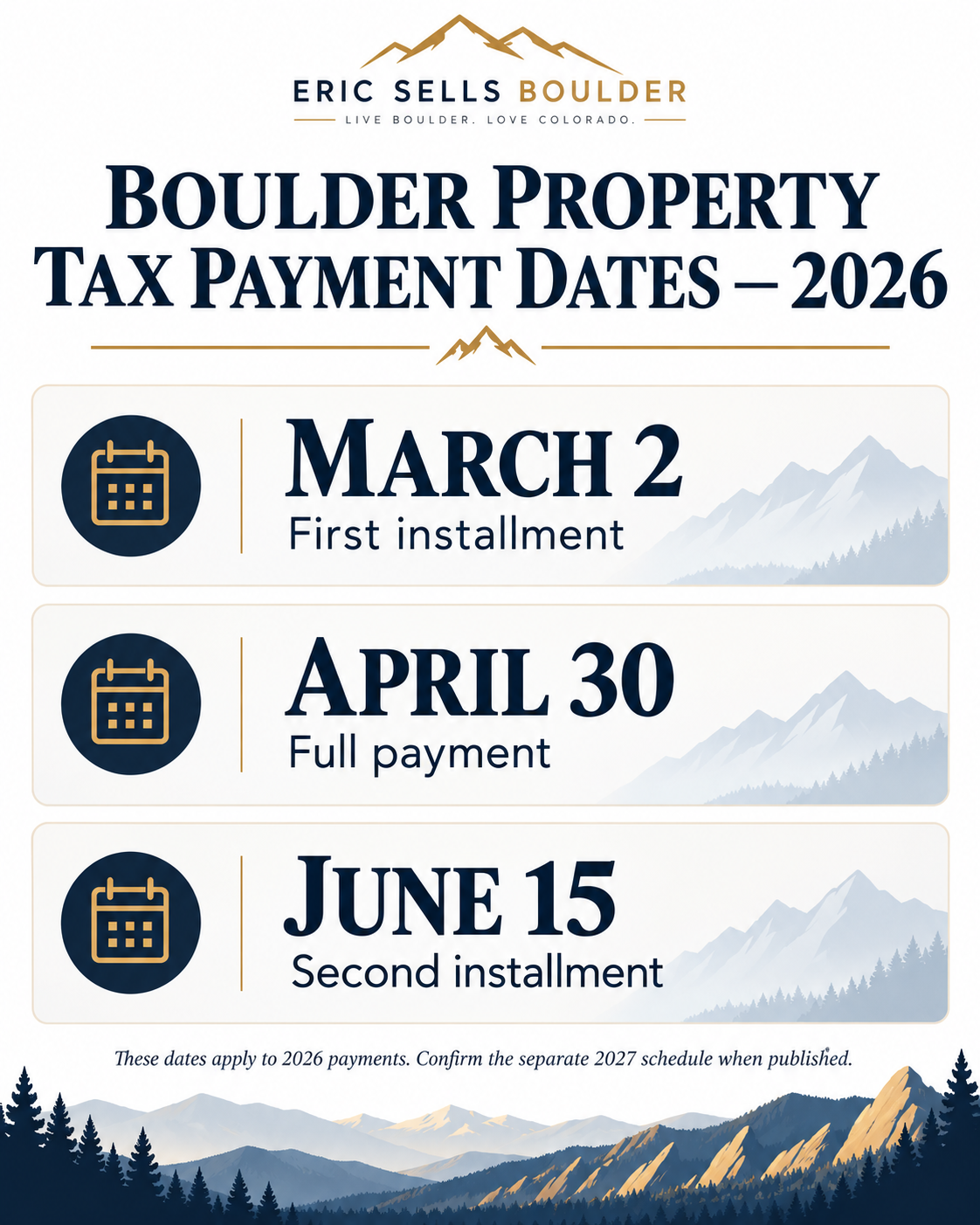
For taxes payable in 2026, Boulder County published the following deadlines:
| Payment option | 2026 deadline |
|---|---|
| First installment | March 2, 2026 |
| Second installment | June 15, 2026 |
| Full annual payment | April 30, 2026 |
These dates applied to taxes paid in 2026 and should not automatically be reused as the official 2027 payment calendar.
Because those 2026 deadlines have passed, owners with an unpaid balance should contact the Treasurer.
Boulder County currently states that online tax payments have been disabled for the remainder of 2026 and that delinquent payments require certified funds.
The County also advises property owners to contact the Treasurer for exact amounts when payments are late. Boulder County
Before making any payment, verify the current instructions directly with the County.
The Bottom Line: Understand the Tax Record Before Making a Real Estate Decision
Boulder property taxes are not determined by a single countywide percentage.
They depend on the property's assessed value, the applicable assessment rates, local mill levies, and any exemptions or adjustments.
For taxes paid in 2026, Boulder County applied separate residential assessment rates of 7.05% for schools and 6.25% for other local governments.
For tax year 2026, payable in 2027, the County publishes a 7.05% school assessment rate and a 6.8% local-government rate, with an applicable reduction to the value used for the local-government calculation.
Those differences are worth understanding, but they do not tell every homeowner exactly what their next bill will be.
The most reliable approach is to review the actual property's County records, confirm applicable exemptions and taxing districts, and use updated information when estimating future ownership costs.
For buyers, that means looking beyond the seller's most recent bill.
For sellers, it means understanding how tax records and prorations may affect the transaction.
And for existing homeowners, it means reviewing County notices and asking questions when a valuation or tax bill does not look right.
If you're considering buying or selling a home in Boulder or Boulder County, I can help you compare properties, examine the costs of ownership, and identify the property-specific information that matters before making a decision.
Eric Farran
Eric Sells Boulder
This article is for general real estate information and reflects publicly available property-tax information reviewed in October 2026. Tax laws, mill levies, exemptions, and payment procedures can change. Confirm property-specific assessments and taxes with Boulder County and consult a qualified tax professional when appropriate.
Boulder Property Tax FAQ
How are property taxes calculated in Boulder County?
Property taxes are based on a property's actual value, applicable assessment rates, and mill levies. Residential taxes are calculated separately for school districts and other local governments, then added together.
Why did my Boulder property tax bill increase in 2026?
Some homeowners experienced higher bills because a temporary $55,000 residential value reduction expired for tax year 2025, payable in 2026. Changes in applicable levies or other property-specific factors can also affect the final bill.
What are the Boulder residential assessment rates for 2026?
For taxes paid in 2026, the residential assessment rates were 7.05% for school districts and 6.25% for other local governments.
For tax year 2026, payable in 2027, Boulder County lists 7.05% for schools and 6.8% for other local governments, with an applicable local-government value reduction.
Will Boulder property taxes decrease in 2027?
Not necessarily. The 2026 tax-year calculation includes a local-government value reduction, but actual taxes payable in 2027 will depend on assessed value, applicable mill levies, exemptions, and other adjustments.
How can I check my Boulder property taxes?
Use the Boulder County Assessor's Property Search to review property information and assessed values. The Treasurer's tax search provides tax account and payment information.
Does a home's purchase price determine its property taxes?
Not automatically. Boulder County determines assessed values under Colorado's statutory valuation process. A recent sale price may be relevant to future assessments, but it does not automatically replace the current official assessed value.
Can seniors receive property-tax relief in Boulder County?
Qualifying homeowners may be eligible for Colorado's Senior Homestead Property Tax Exemption. The standard exemption can exclude up to $100,000 of actual property value from taxation, subject to program requirements.
Can I appeal my Boulder property assessment?
Yes, through the applicable assessment appeal process. Owners must follow the County's filing deadlines and provide relevant evidence supporting their challenge.
FROM OUR BLOG


Boulder Homeowners Insurance 2026: Wildfire, Hail & What Buyers Need to Know
Buying a home in Boulder involves more than finding the right neighborhood, negotiating a purchase price, and qualifying for a mortgage. There is another important consideration that can affect both the monthly cost of ownership and the ability to complete a purchase: homeowners insurance. In Boulde

Boulder Down Payment Assistance 2026: How First-Time Buyers Can Get Up to $100,000
For many Boulder buyers, the challenge is not simply qualifying for a monthly mortgage payment. It is getting enough cash together for the down payment, closing costs, reserves, and everything else that comes with buying a home in one of Colorado's more expensive housing markets. What many buyers do

Boulder ADU Rules 2026: Can You Build, Rent, or Add an ADU to Your Property?
Accessory dwelling units have become one of the most useful—and frequently misunderstood—housing options in Boulder. An ADU can create a separate place for an aging parent, an adult child, a long-term tenant, a home office setup with living space, or even a future downsizing option for the homeowner