
There is something special about walking through an older Boulder home.
Maybe it's a Victorian house in Mapleton Hill with its original woodwork and covered front porch. Maybe it's a cottage near Chautauqua, or a century-old property with tall windows, mature trees, and architectural details that would be difficult to recreate today.
These homes have character. They tell part of Boulder's story.
But buying one also raises a question that doesn't always come up during a showing:
What are you actually allowed to change after you buy it?
Can you replace the windows? Repaint the exterior? Install solar panels? Modernize the kitchen? Build an addition?
The answer depends on the property's historic designation, location, and proposed improvements.
The City of Boulder has specific preservation rules for individually designated landmarks, properties inside local historic districts, and certain older buildings that have never received landmark designation.
Understanding those distinctions before purchasing can help you avoid unexpected delays, renovation costs, and disappointing surprises.
Here's what Boulder homebuyers should know in 2026.
Not Every Old Boulder House Is a Protected Historic Property
One of the biggest misconceptions about historic homes in Boulder is that age alone determines what you can do with a property.
It doesn't.
A home built in 1900 might be individually designated as a local landmark. Another home from the same period might be located inside a historic district. A third property of similar age might have neither designation.
Each situation can involve different preservation requirements.
1. Individually Designated Local Landmarks
An individual landmark is a property that the City of Boulder has formally designated because of its historic, architectural, or aesthetic significance.
These properties receive preservation protection under the city's historic preservation ordinance.
Exterior alterations generally require approval through a Landmark Alteration Certificate, commonly called an LAC.
2. Properties Within Local Historic Districts
Boulder also protects neighborhoods and areas through local historic district designation.
Examples include:
-
Mapleton Hill
-
Chautauqua Park
-
University Place
-
Highland Lawn
-
West Pearl
-
Downtown Boulder
Within a local historic district, the preservation review requirements apply to the properties in the designated area, not just the oldest or most architecturally elaborate houses.
Even a newer building located within a designated historic district can require approval for exterior changes.
That distinction matters when evaluating properties in neighborhoods where historic and more recent construction exist near one another.
3. Older Homes Without Historic Designation
What about a house that is more than 50 years old but is neither a landmark nor inside a historic district?
The owner does not automatically need a Landmark Alteration Certificate for ordinary exterior work.
However, Boulder has a separate historic preservation demolition review process for qualifying work on non-designated buildings older than 50 years.
That process can affect substantial remodeling projects, including certain changes to street-facing walls.
The takeaway: Before purchasing an older Boulder home, confirm its actual designation and applicable review requirements. Do not rely on the home's age, architectural style, or listing description alone.
The City's Historic Preservation resources and Property Information tools are useful starting points.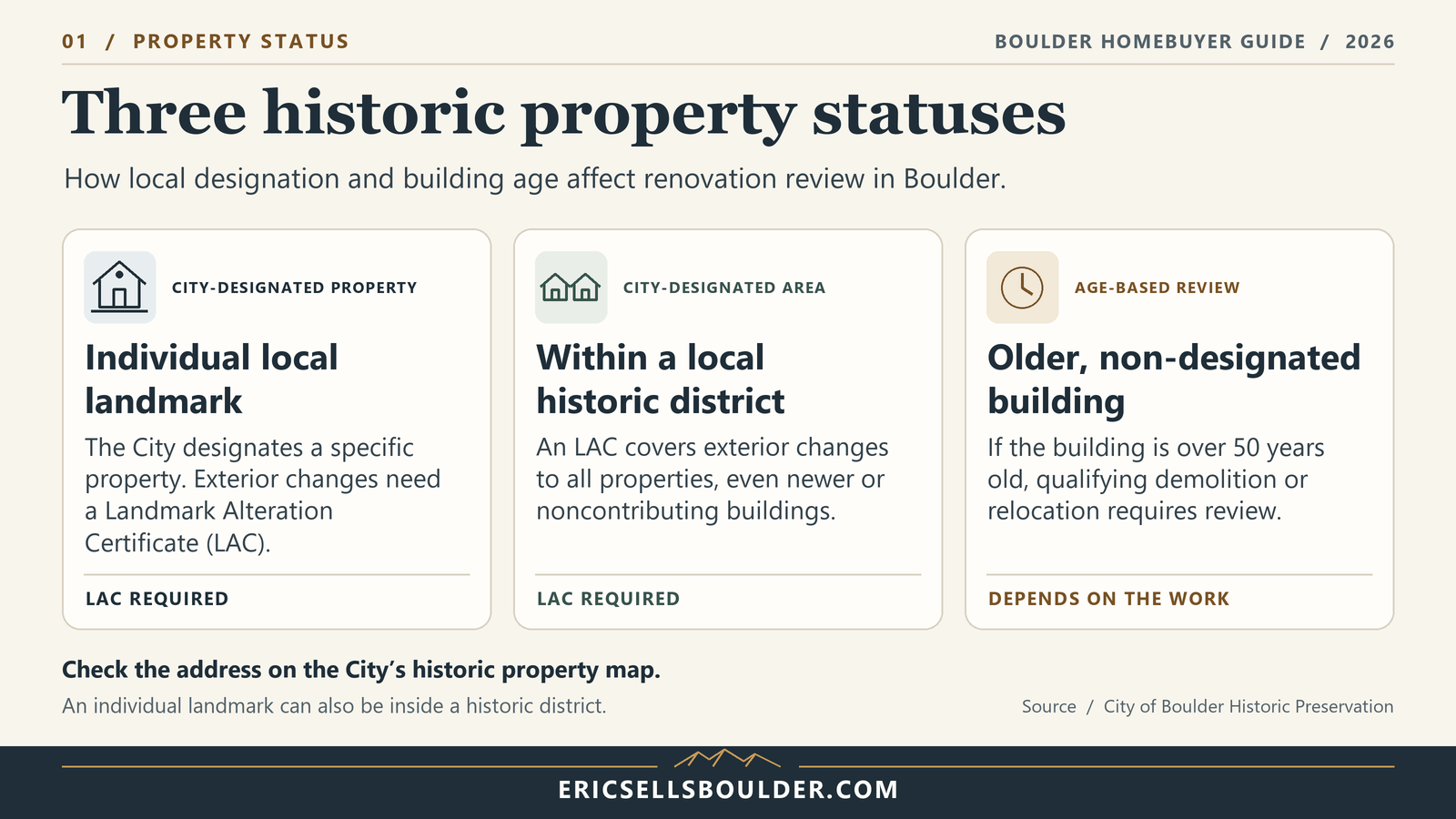
What Renovations Require Approval in Boulder Historic Districts?
For individually designated landmarks and properties within local historic districts, Boulder's Landmark Alteration Certificate process covers exterior changes.
Some of the most common examples include:
-
Repainting the exterior
-
Replacing or modifying windows and exterior doors
-
Replacing roofing materials
-
Constructing an addition
-
Building or modifying a porch or deck
-
Installing exterior mechanical equipment
-
Adding solar panels
-
Constructing or modifying fences
-
Making certain paving or hardscaping changes
-
Removing mature trees
The purpose isn't to prevent every improvement.
It's to ensure changes are compatible with the property's historic character and the surrounding district.
For example, a buyer may want to replace deteriorated original windows with modern products.
The question isn't simply whether new windows would improve energy efficiency.
The city may also consider the original window design, materials, proportions, condition, and whether rehabilitation is a reasonable alternative.
Similarly, a proposed addition could be possible, but its size, placement, materials, and relationship to the existing house may affect approval.
Boulder's Landmark Alteration Certificate guide explains the application requirements for different types of work.
Can You Renovate the Interior of a Historic Boulder Home?
Generally, yes.
Boulder's local Landmark Alteration Certificate process focuses on exterior changes. Ordinary interior remodeling does not require an LAC solely because the property is historically designated.
That can give homeowners meaningful flexibility to improve kitchens, bathrooms, lighting, heating systems, and interior layouts.
However, interior work may still require building, electrical, plumbing, or mechanical permits, depending on the project.
Structural modifications and major rehabilitation projects can introduce additional code and engineering considerations.
A historic designation is not a substitute for reviewing the normal permitting rules.
For buyers, the distinction is important:
A historic home can often be modernized without losing the architectural features that make it distinctive.
The key is determining which improvements require preservation review, which need ordinary building permits, and which need both.
Can You Replace Old Windows, Install Solar Panels, or Improve Energy Efficiency?
Energy efficiency is a common concern when purchasing an older Boulder home.
Historic buildings may have older windows, limited insulation, aging mechanical systems, or other construction features that differ from newer homes.
The challenge is improving comfort and performance while preserving important architectural elements.
Fortunately, historic preservation and energy efficiency are not necessarily competing goals.
Windows and Doors
For designated properties, window and door replacement or alteration generally requires an LAC.
Boulder's application process asks for information about existing conditions and the proposed replacement products.
In some cases, repairing existing windows, improving weatherstripping, or adding compatible storm-window solutions may be worth evaluating before complete replacement.
The appropriate approach depends on the individual building and the city's review.
Solar Panels
Solar installations are not automatically prohibited on historic Boulder homes.
However, exterior renewable-energy systems on designated historic properties require preservation review.
The city requests information about the proposed panel locations, roof layout, mounting systems, and visibility from public areas.
A homeowner interested in solar should investigate those requirements before assuming that a particular roof configuration will be approved.
Heating, Insulation, and Other Improvements
Mechanical upgrades, insulation improvements, and other efficiency measures may be possible, subject to applicable permits and preservation rules.
Exterior equipment placement can be especially relevant if the project involves visible changes to the property.
The City of Boulder provides a dedicated Historic Building Energy Efficiency guide addressing these considerations.
The best approach is to evaluate energy improvements as part of a coordinated renovation plan rather than as unrelated individual projects.
What If the Boulder Home Is More Than 50 Years Old but Not Historic?
This is an important situation for buyers considering significant renovations.
A property can fall outside a designated historic district and still trigger preservation review when a proposed project meets Boulder's definition of historic demolition.
For non-designated buildings older than 50 years, the city identifies several relevant thresholds.
Historic preservation demolition review can be required when proposed work involves:
-
Removing more than 50% of the roof, measured in plan.
-
Removing more than 50% of the exterior walls.
-
Removing any portion of a street-facing wall, including certain changes to exterior finishes or openings.
That last point surprises some homeowners.
A buyer might assume that enlarging a front window or changing a street-facing entry is too minor to involve historic preservation review.
But under Boulder's definition, removing even part of a street-facing wall can trigger the process for an eligible older, non-designated building.
This does not mean every such proposal will be denied.
It means the city must evaluate the work through the applicable review process.
For buyers planning to substantially remodel an older home, this is something to investigate before finalizing renovation plans or making financial commitments.
The city explains the rules in its Historic Preservation Demolition Review guide.
How Long Does Historic Renovation Approval Take in Boulder?
Historic preservation review is a project-planning issue, not just a paperwork issue.
A homeowner may already have an architect, contractor, renovation budget, and preferred construction schedule.
But if the project requires a Landmark Alteration Certificate, that approval may need to be obtained before the relevant building permit can proceed.
The City of Boulder currently describes multiple levels of review.
Some relatively straightforward applications can be reviewed by staff. Other proposals go to the Landmarks Design Review Committee. Larger or more complex proposals may require Landmarks Board review.
For applications approved at the staff or committee level in a single round, the city's published estimate is approximately two to four weeks.
Projects requiring Landmarks Board review may take approximately six weeks to three months.
Revisions can extend those timelines.
The city currently does not charge an application or review fee for the Landmark Alteration Certificate itself.
That doesn't mean the project is free of other expenses. Architects, engineers, permit fees, specialized contractors, construction work, and additional documentation can still affect the overall cost.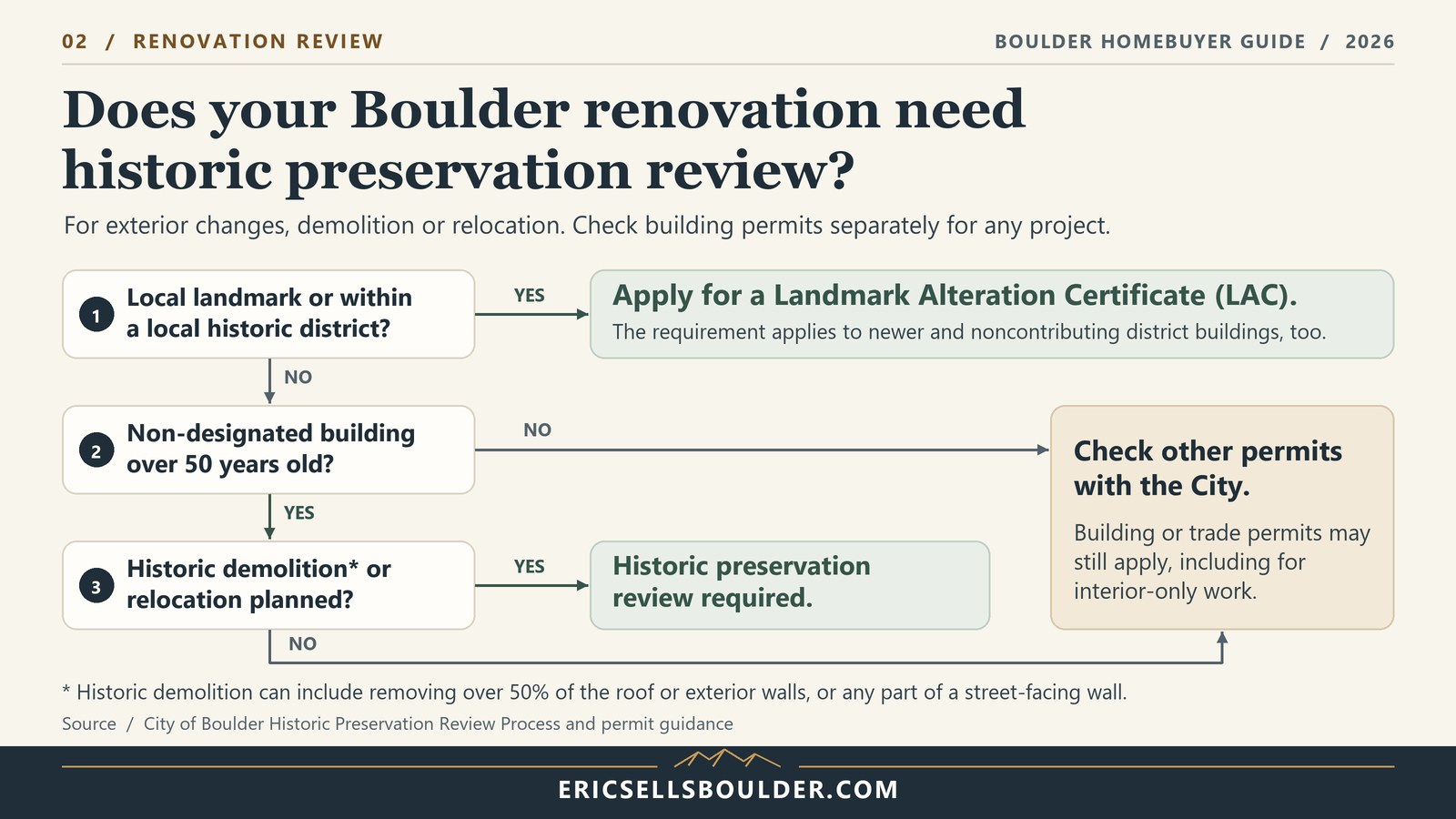
For homebuyers, the best strategy is to research renovation feasibility before the purchase—not after closing.
A New Historic District Is Being Considered Along Grant Place in 2026
Historic preservation in Boulder isn't limited to neighborhoods that received designation decades ago.
The city is also reviewing a proposed historic district along Grant Place, between Chautauqua Park and Columbia Cemetery.
The proposed district covers four blocks, from the 700 block through the 1000 block of Grant Place.
According to the City of Boulder, 64 property owners, representing approximately 74% of the owners within the proposed area, applied for designation in July 2026.
The Landmarks Board voted in September to begin the designation process.
As of November 5, 2026, the proposal is still under review.
The city's published schedule calls for another Landmarks Board review on December 9, 2026, followed by Planning Board consideration and a final City Council decision through the applicable process.
The proposed Grant Place district should not be described as an already-approved historic district.
That distinction is especially relevant to potential buyers.
A property located in a proposed district may present different future renovation considerations if designation is ultimately approved.
Anyone buying or selling in the affected area should verify the latest status directly with the city.
Read the city's Proposed Historic Districts update for the current process.
Are There Tax Credits for Renovating Historic Homes in Boulder?
Potentially, yes.
Historic designation can create responsibilities, but qualifying projects may also be eligible for preservation-related financial incentives.
Colorado offers a state historic preservation income tax credit for qualifying rehabilitation work on eligible designated properties.
According to the City of Boulder's current guidance, the residential credit equals 20% of qualified rehabilitation costs, with a maximum credit of $100,000.
Eligibility depends on the property's designation or contributing status, the nature of the work, applicable program rules, and required approvals.
Not every old house qualifies.
Not every renovation expense qualifies.
And the availability of a credit should not be treated as guaranteed project financing.
Homeowners may need to complete required preservation reviews at the beginning and end of their project.
Before relying on any credit in a renovation budget, buyers should verify the current rules, eligible expenses, and application requirements with the program administrators and their tax professional.
The city's State Historic Preservation Tax Credits page is a useful starting point.
What Should Buyers Check Before Purchasing a Historic Boulder Home?
Historic homes can be rewarding properties to own, but the buying process should include a few additional questions.
Confirm the Property's Actual Historic Status
Start by checking whether the property is an individual landmark, inside a designated historic district, or an older non-designated building.
For a property in a historic district, ask whether the structure is considered a contributing or noncontributing resource when that distinction matters to the proposed project or an incentive program.
Use the city's official mapping and preservation resources rather than relying solely on marketing descriptions.
Review Previous Renovations and Permit History
An older home may have gone through decades of improvements.
Ask about additions, roof replacement, window changes, structural modifications, electrical upgrades, and other significant work.
Compare seller-provided documentation with the city's available permit and approval records.
A renovation that appears visually consistent with the home isn't necessarily evidence that every required approval was obtained.
Investigate the Condition of Original Building Systems
Historic character and mechanical condition are separate issues.
A house can have beautifully preserved architectural details while still requiring work on its sewer lateral, electrical system, roofing, foundation, heating, or drainage.
Depending on the property, buyers may want specialty evaluations from qualified inspectors and contractors.
For a broader explanation of these property concerns, read my Boulder Home Inspection Guide: Radon, Sewer, Roofs, and Drainage.
Evaluate Renovation Feasibility Before Making Assumptions
Suppose you find a historic Boulder house with a smaller kitchen and want to build a larger rear addition.
Before assuming the addition can be approved, consider:
-
Does the historic designation require an LAC?
-
What do the applicable district design guidelines say?
-
Does the property have sufficient room under zoning and setback requirements?
-
Would the addition affect historic architectural features?
-
Would the project need building or other permits?
-
What would the design and construction process realistically cost?
The answers depend on the specific property and the proposed design.
An architect experienced with local preservation projects may be helpful for evaluating a substantial renovation.
Check Insurance and the Full Ownership Budget
Older homes can have distinctive construction materials and replacement considerations.
Insurance companies may evaluate factors such as roof condition, construction characteristics, rebuilding costs, and other property-specific risks.
For buyers, the estimated purchase payment is only one part of affordability.
Review the actual insurance quote, property taxes, utilities, expected maintenance, and renovation needs before establishing your long-term budget.
My Boulder Homeowners Insurance Guide for 2026 explains additional coverage considerations.
Understand the Lifestyle You Are Buying Into
Historic homes offer more than architecture.
Neighborhoods such as Mapleton Hill and Chautauqua have distinct streetscapes, mature landscaping, and connections to Boulder's history.
But individual homes can differ in parking, accessibility, property layout, maintenance responsibilities, and improvement potential.
A historic home's appeal should fit both your current lifestyle and your longer-term plans.
The right property isn't necessarily the one with the most impressive history.
It's the one whose location, condition, ownership costs, and permitted future uses work for you.
Do Historic Preservation Rules Affect a Home's Resale Value?
Historic character can be appealing to buyers who value original craftsmanship, architectural detail, and established neighborhoods.
At the same time, renovation restrictions and maintenance considerations may matter to buyers who want extensive customization.
There is no reliable rule that historic designation automatically increases or decreases the value of every Boulder property.
Two homes with similar architectural styles can perform differently because of their condition, lot size, location, floor plan, improvements, and buyer demand.
For sellers, accurate documentation becomes important.
If you've completed historically appropriate improvements, preserve records of approvals, permits, invoices, warranties, and completed work.
If the property is designated, make its status clear rather than waiting until the buyer discovers the applicable restrictions during due diligence.
A transparent presentation can help the next owner appreciate both the property's character and the responsibilities that come with it.
The Bottom Line: Historic Boulder Homes Can Offer Character and Flexibility—With the Right Planning
Boulder's historic homes are part of what makes the city's residential landscape distinctive.
From the Victorian architecture of Mapleton Hill to the cottages around Chautauqua, these properties connect everyday life with the city's past.
But buying a historic property requires more than admiring the architecture.
You need to understand whether the home is formally designated, whether exterior work requires a Landmark Alteration Certificate, what renovation plans are feasible, and how the property's condition affects ownership costs.
The good news is that historic preservation doesn't mean a house can never change.
Many improvements are possible with the appropriate planning and approvals.
The smartest approach is to understand the property's opportunities and limitations before committing to a purchase.
If you're considering a historic home in Boulder, I can help you compare properties, understand the relevant local real estate considerations, and organize the questions to review with the city's preservation staff, inspectors, architects, and other qualified professionals.
A historic home should be a place where you can enjoy Boulder's past while making informed decisions about your future.
— Eric Farran | Eric Sells Boulder
Frequently Asked Questions About Historic Homes in Boulder
Can you remodel a historic house in Boulder, Colorado?
Yes. Historic homes can generally be renovated, but exterior changes to individually designated landmarks and properties within local historic districts require a Landmark Alteration Certificate. Other permits and development standards may also apply.
Do I need permission to paint a historic Boulder home?
If the property is individually landmarked or located within a local historic district, exterior repainting requires preservation review through the city's Landmark Alteration Certificate process.
Can I replace windows in a Boulder historic district?
Potentially. Window replacement is subject to preservation review, and the city evaluates relevant design, materials, and existing conditions. Buyers should not assume that every replacement-window product will be approved.
Can I build an addition on a historic Boulder house?
An addition may be possible, but it must satisfy applicable historic preservation review criteria as well as zoning, building-code, and other development requirements. Approval depends on the individual design and property.
Does every house more than 50 years old need historic approval?
No. Building age does not automatically create landmark designation. However, qualifying demolition or substantial alterations to non-designated buildings older than 50 years can trigger Boulder's historic preservation demolition review.
Can I install solar panels on a historic Boulder home?
Potentially. Solar installations on designated properties require a Landmark Alteration Certificate. Panel placement, mounting details, and visibility can be part of the review.
Is Grant Place already a designated historic district in Boulder?
As of November 5, 2026, the proposed Grant Place Historic District is still undergoing the city's designation process. The City of Boulder has scheduled further review for December 9, 2026, with additional consideration expected in 2027.
FROM OUR BLOG

Boulder Homeowners' Winter Checklist 2026: 9 Things to Do Before the Next Freeze
Winter in Boulder has a way of catching homeowners off guard. One afternoon, the sun is shining over the Flatirons, and the temperature feels comfortable enough to enjoy a walk outside. A few days later, a cold front can bring freezing temperatures, snow-covered sidewalks, and unexpected maintenance

Boulder Radon Testing 2026: What Homebuyers and Sellers Need to Know
If you're buying a home in Boulder, one of the most important inspections involves something you can't see, smell, or taste. Radon. It's a naturally occurring radioactive gas that can enter homes through foundations and accumulate indoors. Unlike a leaking roof, damaged sewer line, or visibly cracke
How Much Does It Cost to Sell a House in Boulder in 2026? Closing Costs Explained
Selling a home in Boulder can involve a substantial amount of money, but the final sale price isn't necessarily the amount that ends up in your bank account. Between brokerage compensation, title insurance, closing charges, property-tax adjustments, mortgage payoff, and possible buyer concessions, s