
If you've been thinking about upgrading your Boulder home's heating system, improving insulation, or replacing an aging water heater, 2026 has brought some important changes to the financial incentives available.
Some rebate programs are still offering meaningful savings.
Others have changed their eligibility requirements, reduced their incentives, or ended entirely.
And for certain Boulder County homeowners, December 31, 2026, is an important deadline.
The challenge is that home energy incentives don't all follow the same rules.
A rebate available through Boulder County may have different income limits, contractor requirements, and application deadlines than one offered by Xcel Energy or a statewide Colorado program.
Some incentives can be combined. Others cannot.
For homeowners trying to make a smart financial decision, understanding those differences can be just as important as choosing the equipment itself.
Whether you're planning to stay in your home for another decade, preparing to sell, or evaluating the cost of improvements on a property you're considering buying, here's what you should know about Boulder home energy rebates in 2026.
What Changed for Boulder Home Energy Rebates in 2026?
One of the biggest changes came from Boulder County's EnergySmart program.
EnergySmart has supported home energy efficiency and electrification projects for years, helping residents evaluate improvements such as insulation, air sealing, heating equipment, and electric appliances.
But beginning in 2026, EnergySmart discontinued its standard rebate program and shifted its direct rebate funding toward income-qualified households.
That means homeowners who previously qualified for a standard county rebate may no longer be eligible for the same financial assistance.
However, the change doesn't mean energy rebates have disappeared.
Boulder residents may still qualify for incentives through:
-
Boulder County EnergySmart's income-qualified program
-
Power Ahead Colorado's regional heat pump rebate
-
Colorado's Home Electrification and Appliance Rebates (HEAR) program
-
Xcel Energy's residential efficiency programs
-
Colorado's heat pump tax-credit discount program
-
Certain municipal energy and solar incentives
Each program operates independently, and eligibility depends on factors such as location, household income, utility service, equipment specifications, and contractor participation.
The most important lesson for 2026 is simple:
Don't assume a rebate you saw advertised last year is still available under the same rules today.
Before making a purchase or committing to an installation, confirm the current requirements directly with the program administrator.
Source: EnergySmart — Changes to Rebates in 2026
1. Boulder County EnergySmart: Up to $2,000 for Qualifying Households
For eligible Boulder County residents, EnergySmart remains one of the most useful places to start.
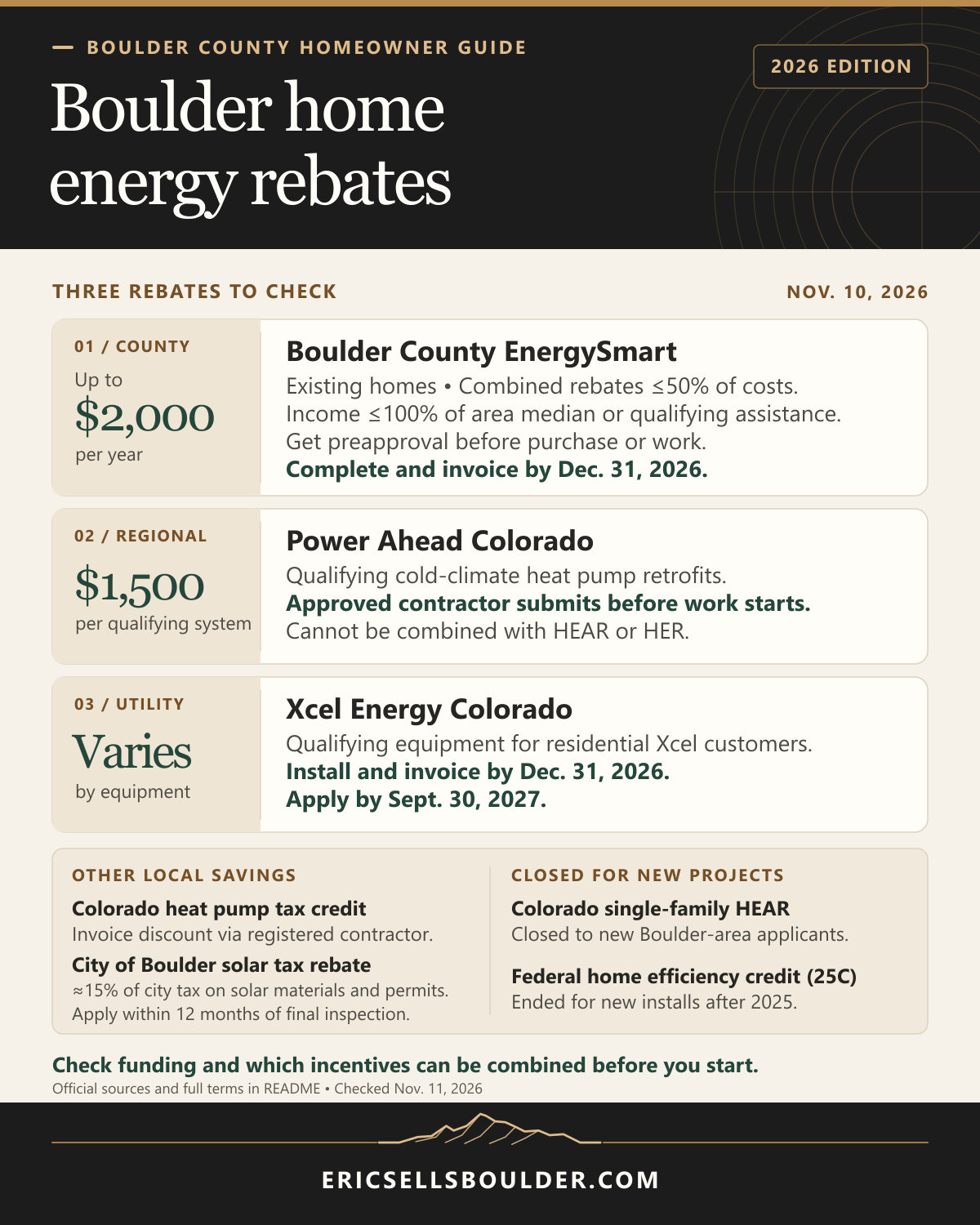
Under its 2026 income-qualified rebate program, eligible households may receive financial assistance covering up to 50% of qualifying project costs, with an annual rebate limit of $2,000.
The program is funded by Boulder County's Sustainability Tax and is available while funding remains.
Eligible projects can include:
-
Cold-climate heat pumps for heating and cooling
-
Heat pump water heaters
-
Attic, wall, and foundation insulation
-
Professional air sealing
-
Induction or qualifying electric cooking equipment
-
Heat pump dryers
-
Certain electrical panel upgrades
-
Qualifying cellular shades
Not every project automatically qualifies.
Each type of improvement has technical specifications, documentation requirements, and potentially different contractor rules.
For example, an electrical panel upgrade must satisfy the program's capacity requirements and be connected to another qualifying improvement.
Who Qualifies for the EnergySmart Rebate?
Eligibility generally requires household income at or below 100% of Boulder County's area median income, commonly called AMI.
For 2026, EnergySmart publishes the following 100% AMI income thresholds:
-
One-person household: $105,000
-
Two-person household: $120,000
-
Three-person household: $135,000
-
Four-person household: $150,000
Higher household sizes have different limits.
Participation in certain public-assistance programs may also help establish eligibility.
Homeowners should verify their household's applicable income limit with EnergySmart rather than assuming qualification based on individual salary.
The program is available for qualifying existing site-built and manufactured homes in Boulder County.
Eligible renters may also apply when they have the required property-owner authorization.
How Much Could You Actually Receive?
Consider a hypothetical homeowner planning a $3,000 eligible insulation project.
At 50% of the project cost, the preliminary rebate calculation would be $1,500.
For a $6,000 qualifying project, 50% would be $3,000, but the standard annual EnergySmart cap would limit the county rebate to $2,000.
These examples assume no other incentives have been applied and that the project meets all program requirements.
Actual reimbursement may be reduced when other incentives are combined with the county program.
EnergySmart's rules restrict the combined rebate amount to no more than 50% of the total project cost.
There is also no guarantee that funds will remain available when a homeowner applies.
The December 31, 2026 Deadline
This is one of the most important details for homeowners considering a project this year.
EnergySmart requires eligible 2026 projects to be completed and invoiced between January 1 and December 31, 2026.
Preapproval is mandatory.
That means submitting an application, signing a contractor agreement, or purchasing equipment is not necessarily enough to qualify.
Homeowners must complete the program's preapproval process before purchasing equipment or beginning the project.
After approval, the installation must meet program requirements, and the homeowner must submit the necessary documentation and final rebate claim.
With the end of the year approaching, homeowners should confirm contractor availability and the current status of funding before proceeding.
Official program: Boulder County EnergySmart Income-Qualified Rebates
2. Power Ahead Colorado: A $1,500 Cold-Climate Heat Pump Rebate
Another significant development in 2026 is the expansion of regional heat pump incentives through Power Ahead Colorado.
In July, the Denver Regional Council of Governments announced a new $1,500 rebate for qualifying cold-climate heat pump installations.
The program serves eligible properties within participating communities in the Denver region, including Boulder.
Unlike Boulder County's income-qualified EnergySmart rebate, Power Ahead Colorado has its own program eligibility rules.
The rebate focuses on qualifying cold-climate air-source heat pumps.
These systems provide heating and cooling using electricity.
Rather than generating heat through combustion, a heat pump transfers heat between indoor and outdoor spaces.
That allows a properly designed system to provide heating during colder months and cooling during warmer weather.
Why Cold-Climate Performance Matters in Boulder
Boulder's weather can change quickly.
A home may experience a mild afternoon followed by overnight temperatures well below freezing.
That makes equipment selection particularly important.
A heat pump intended for cold-weather operation should be evaluated for heating capacity, efficiency, and performance at low outdoor temperatures.
Homeowners should work with a qualified HVAC professional to determine whether the system can meet the property's heating requirements.
The contractor should also consider insulation, air leakage, electrical capacity, and whether a backup heating strategy is appropriate.
How to Qualify for the Power Ahead Rebate
According to Power Ahead Colorado, qualifying projects generally must:
-
Be completed in an eligible participating community
-
Involve an existing building rather than new construction
-
Use qualifying cold-climate heat pump equipment
-
Be installed by an approved Power Ahead Colorado contractor
-
Be submitted to the program by the contractor before work begins
The program allows certain utility and municipal incentives to be combined with its rebate.
However, Power Ahead Colorado specifically prohibits combining its rebate with Colorado's Home Energy Rebate Program incentives, including HEAR and HER.
That distinction matters because a homeowner may need to compare two different incentive pathways rather than assuming every available dollar can be stacked together.
Before selecting a contractor, verify whether the contractor participates in the program and whether the proposed equipment is eligible.
Official program: Power Ahead Colorado — Eligibility Requirements
3. Colorado's HEAR Program: Another Option for Income-Qualified Homeowners
Some households may qualify for substantially larger assistance through Colorado's Home Electrification and Appliance Rebates program.
Known as HEAR, this statewide program supports eligible energy-efficient electric home upgrades.
According to Boulder County EnergySmart, HEAR is available for qualifying single-family homes and may provide up to $14,000 in total rebates, depending on household eligibility, the improvement, and program limits.
Households generally must have income no greater than 150% of the applicable area median income.
Potentially eligible improvements include:
-
Heat pumps for space heating and cooling
-
Heat pump water heaters
-
Electric cooking appliances
-
Electrical wiring
-
Electrical panel improvements
-
Insulation and air sealing
-
Ventilation improvements
Qualifying improvements must be completed through registered program contractors.
Eligible discounts are generally applied at the time of installation through the participating contractor.
This may make HEAR particularly relevant to homeowners concerned about covering the full upfront cost of major electrical or heating upgrades.
However, the $14,000 figure is a program-level maximum, not an automatic payment to every applicant.
Individual equipment limits, income-based rules, funding availability, and other restrictions apply.
One critical caution: HEAR cannot be combined with the Power Ahead Colorado rebate for the same project.
If you're eligible for more than one program, ask an EnergySmart advisor and participating contractors to compare the total financial benefit before deciding which application pathway to pursue.
Official information: EnergySmart — State Incentives and HEAR
4. Xcel Energy Rebates: Why Your Utility Provider Matters
Your utility provider can also influence the incentives available for a home improvement.
Xcel Energy offers residential efficiency programs covering qualifying heating, cooling, and other energy-saving upgrades in Colorado.
For heat pumps, eligible residential customers may qualify for rebates based on the type of equipment installed and program requirements.
Some income-qualified customers may qualify for additional assistance.
The important detail is that rebate amounts are not identical for every project.
For example, a homeowner replacing a gas furnace with an eligible heat pump may face different incentive calculations from someone installing a ductless system in a home that already uses electric heating.
Xcel's residential heat pump program also lists a December 31, 2026 deadline for completing installations and invoices under its current rebate terms, while accepting applications through September 30, 2027.
That later application deadline does not extend the installation deadline.
Another change occurred on October 1, 2026, when Xcel reduced certain heat pump and heat pump water heater bonuses.
For homeowners comparing older contractor estimates or online rebate examples, this is another reason to request a current written calculation.
What to Ask Before Hiring a Contractor
Ask the contractor:
-
Does the specific equipment qualify for an Xcel Energy rebate?
-
Is the contractor registered with the appropriate rebate program?
-
Will the rebate be deducted from the invoice or paid afterward?
-
Who is responsible for submitting the application?
-
What documentation is required?
-
Can the incentive be combined with another applicable program?
Don't base your project budget on a verbal estimate of potential rebates.
Request a written quote showing the project cost, expected incentives, and the amount you will actually need to pay.
Official resource: Xcel Energy — Residential Heat Pumps
5. Colorado's Heat Pump Tax Credit Is Different From the Expired Federal Credit
Homeowners should also understand the difference between Colorado's heat pump tax-credit program and the federal home energy tax credits that ended.
Colorado continues to offer a state-level tax-credit incentive for certain qualifying heat pump installations.
Unlike a conventional tax credit claimed directly by a homeowner, the Colorado program generally allows a registered contractor to claim the credit while providing the required discount to the customer.
The discount must be shown on the invoice when the contractor claims the credit.
The amount and requirements depend on the eligible equipment, the applicable tax year, and current state program rules.
A homeowner should confirm that the contractor is registered for the state program and that any promised discount is documented in writing.
This state incentive should not be confused with the federal Energy Efficient Home Improvement Credit.
Source: Colorado Department of Revenue — Income Tax Credits
What Happened to the Federal Energy Efficient Home Improvement Credit?
Previously, the federal Energy Efficient Home Improvement Credit, commonly associated with Section 25C, allowed eligible taxpayers to claim tax credits for certain energy-saving improvements.
Qualifying projects could include heat pumps, insulation, windows, doors, and other improvements, subject to specific limits.
However, federal legislation enacted in 2025 accelerated the credit's expiration.
According to the Internal Revenue Service, the Section 25C credit is not available for qualifying property placed in service after December 31, 2025.
The federal Residential Clean Energy Credit under Section 25D, which previously covered qualifying solar and other clean-energy expenditures, also ended for eligible expenditures after December 31, 2025.
For homeowners installing new equipment in 2026, these former federal credits should not be included in projected savings.
If you completed a qualifying project in 2025, the tax treatment may be different.
Discuss any potential claim with a qualified tax professional using the applicable tax-year rules.
Official resource: IRS — Energy Efficient Home Improvement Credit
6. What About Solar Incentives in the City of Boulder?
Solar incentives deserve separate consideration.
Although the federal Residential Clean Energy Credit is no longer available for new qualifying expenditures after 2025, Boulder homeowners may still have access to certain local solar-related programs.
The City of Boulder maintains a sales and use tax rebate for eligible solar installations.
According to the city, the rebate may return approximately 15% of the city sales and use tax paid on qualifying solar materials and permits.
This is not a rebate equal to 15% of the entire installation cost.
Eligible applicants generally must file within 12 months of the city's final inspection.
Homeowners considering solar should confirm applicable eligibility requirements and current program details directly with the city.
Official resource: City of Boulder — Energy Rebates & Resources
7. Before December 31: A Practical Checklist for Boulder Homeowners
If you're planning a home energy upgrade before the end of 2026, the smartest approach is to confirm the financial details before beginning the work.
Use this checklist to avoid common mistakes.
Step 1: Identify the Improvement Your Home Actually Needs
Start with the property itself.
Is the furnace approaching the end of its useful life?
Are certain rooms consistently colder than others?
Does the home have inadequate insulation, persistent drafts, or an aging water heater?
The most appropriate improvement depends on the building's condition and the homeowner's goals.
An energy assessment can help prioritize projects before equipment is selected.
Step 2: Check Your Eligibility Before Purchasing Equipment
Visit the appropriate incentive administrator's website.
Confirm whether the program depends on household income, property location, utility service, or qualifying equipment.
For EnergySmart's income-qualified rebates, obtain the required preapproval before purchasing equipment or beginning construction.
Step 3: Verify Contractor Participation
Not every qualified HVAC contractor is necessarily approved for every rebate program.
Ask whether the contractor participates in the specific program you intend to use.
If multiple rebates are being considered, confirm the contractor satisfies each program's requirements.
Step 4: Get an Itemized Written Quote
Your quote should identify the equipment, model numbers, installation scope, estimated completion date, permit requirements, and total cost.
It should separately show any anticipated rebates or contractor-applied discounts.
Ask who is responsible for submitting the paperwork.
Step 5: Confirm Which Incentives Can Be Combined
Never assume that all advertised rebates can be added together.
Some programs restrict total reimbursement.
Others prohibit combining certain incentives entirely.
Ask the relevant administrators to confirm your specific combination before signing a contract based on expected savings.
Step 6: Save Every Document
Maintain copies of:
-
Contractor quotes and final invoices
-
Equipment model numbers and specifications
-
Preapproval confirmations
-
Permits and inspection records, when applicable
-
Installation dates
-
Rebate applications and approval notices
-
Warranty and operating information
These records may be useful not only for rebate applications but also for future maintenance and a potential home sale.
Step 7: Confirm the Actual Deadline
For Boulder County EnergySmart's 2026 income-qualified rebates, qualifying work must be completed and invoiced by December 31.
Xcel's current residential heat pump rebate terms also identify December 31, 2026 as an installation and invoice deadline.
Other programs have their own schedules.
A homeowner should verify the applicable completion and application deadlines separately.
8. What Home Energy Improvements Mean for Boulder Homebuyers
For buyers, energy efficiency is part of understanding a home's real cost of ownership.
Two properties with similar asking prices may have very different heating systems, insulation levels, and future maintenance needs.
One might have recently installed cold-climate heat pumps and upgraded attic insulation.
Another might have an aging furnace, older windows, and limited insulation.
Those differences can affect comfort, the timing of future replacements, and ongoing operating expenses.
However, newer equipment does not automatically guarantee lower utility bills.
Actual costs depend on the home's size, insulation, occupant behavior, energy prices, system design, and other factors.
Questions to Ask When Buying a Boulder Home
When evaluating a property, consider asking:
-
How old are the furnace, air conditioner, and water heater?
-
Has the home undergone an energy assessment?
-
What insulation or air-sealing improvements have been completed?
-
Are there permits or invoices documenting major upgrades?
-
How has the home's energy usage changed after improvements?
-
Does the electrical panel have sufficient capacity for planned upgrades?
Buyers may also want to review recent utility bills and ask a qualified contractor to evaluate systems that are approaching replacement age.
Don't Assume a Rebate Transfers With the House
A rebate advertised for an existing owner is not necessarily available to the next buyer.
Eligibility may depend on the applicant's household income, the date of installation, required preapproval, or the contractor who completed the project.
If you're purchasing a property with plans for future energy improvements, check the programs that will apply to you after closing.
This is particularly important when budgeting for an older Boulder home that may require substantial modernization.
For a broader look at preparing a property for cold weather, see my Boulder Winter Home Maintenance Checklist (2026).
9. Should Boulder Sellers Upgrade Their Homes Before Listing?
For sellers, the decision requires a different calculation.
A major energy improvement might increase comfort, address an aging mechanical system, or make the property more appealing to certain buyers.
But that doesn't automatically mean the homeowner will recover the entire installation cost through a higher sale price.
In some situations, replacing a failing furnace before listing may help reduce uncertainty during inspections.
In others, the property may already be in good condition, and spending thousands of dollars on a new heating system may not be the most effective preparation strategy.
Evaluate the Improvement Against Your Selling Timeline
Before making a major upgrade, consider:
-
The condition and remaining useful life of the existing system
-
The property's likely buyer expectations
-
Whether the improvement addresses a known concern
-
The actual out-of-pocket cost after confirmed incentives
-
How much time remains before the intended listing date
-
Whether permits, inspections, or installation delays could affect the sale
For sellers preparing a home for the market, documentation is particularly useful.
Keep records of energy upgrades, equipment specifications, permits, warranties, and installation dates.
These can help prospective buyers understand the work that has been completed.
However, equipment improvements should be presented accurately, without promising specific utility savings or increases in market value that have not been established.
Energy Efficiency Is One Part of Property Value
A home's value in Boulder depends on much more than its heating equipment.
Location, property condition, square footage, layout, lot characteristics, comparable sales, and prevailing market conditions remain central considerations.
Energy efficiency can contribute to the property's overall appeal, but it should be evaluated alongside these other factors.
A seller planning major improvements should consider the projected cost, timing, and potential buyer response before committing to the work.
The Bottom Line: Verify the Rebate Before You Commit
Boulder homeowners still have access to meaningful home energy incentives in 2026.
But the financial landscape has changed.
Boulder County EnergySmart has shifted its rebate funding toward qualifying households.
Power Ahead Colorado introduced a regional cold-climate heat pump rebate.
Colorado's HEAR program provides another potential source of assistance.
Xcel Energy continues to offer qualifying residential rebates, while Colorado's state heat pump tax-credit program operates separately from the federal credits that expired.
For homeowners considering work before the end of the year, December 31, 2026, is an important deadline for certain EnergySmart and Xcel projects.
But the best decision isn't necessarily to rush into the most expensive improvement simply because a rebate exists.
It's to understand what your home needs, compare qualified contractors, verify incentives, and calculate the real cost after confirmed assistance.
And if you're considering buying or selling a Boulder home, those same principles apply.
A property's heating equipment, insulation, and energy systems are part of understanding its condition and the long-term responsibilities of ownership.
Frequently Asked Questions About Boulder Home Energy Rebates
Are Boulder County EnergySmart rebates still available in 2026?
Yes, but EnergySmart discontinued its standard rebates beginning in 2026. Its income-qualified rebate program remains available to eligible Boulder County households, subject to preapproval, project requirements, and funding availability.
How much can I receive through Boulder County EnergySmart?
Qualifying households may receive up to $2,000 per year, generally covering up to 50% of eligible project costs. Combining other incentives can affect the final county rebate amount.
What is the deadline for Boulder County's 2026 rebates?
For the 2026 EnergySmart income-qualified program, eligible projects must be completed and invoiced by December 31, 2026. Homeowners must obtain preapproval before purchasing equipment or starting the project.
Can I combine Colorado heat pump rebates?
Some programs can be combined, but not all. Power Ahead Colorado allows certain utility and municipal incentives but prohibits combining its rebate with Colorado's HEAR or HER incentives. EnergySmart also has a combined-rebate cost limit. Verify the applicable rules before proceeding.
Is the federal heat pump tax credit still available in 2026?
The federal Section 25C Energy Efficient Home Improvement Credit is not available for qualifying equipment placed in service after December 31, 2025. Colorado's separate state-level heat pump incentive may still apply to qualifying installations.
Can I get a rebate for installing solar panels in Boulder?
Potentially. The City of Boulder maintains a sales and use tax rebate for qualifying solar installations. It may return approximately 15% of eligible city sales and use tax paid on materials and permits, not 15% of the total solar project cost.
Should I replace my heating system before selling my Boulder home?
Not necessarily. The decision depends on the condition of the existing equipment, the property's market position, improvement costs, timing, and buyer expectations. A newer system may be attractive, but it does not guarantee a dollar-for-dollar return on the investment.
Editor's note: Program information was reviewed November 10, 2026. Rebates, funding, income limits, eligibility requirements, and deadlines may change. Confirm details directly with each program administrator before purchasing equipment or beginning work. This article provides general real estate and homeowner information, not individualized tax, financial, engineering, or legal advice.
FROM OUR BLOG


Buying a Historic Home in Boulder? Renovation Rules, Permits & What Buyers Should Know in 2026
There is something special about walking through an older Boulder home. Maybe it's a Victorian house in Mapleton Hill with its original woodwork and covered front porch. Maybe it's a cottage near Chautauqua, or a century-old property with tall windows, mature trees, and architectural details that wo

Boulder Homeowners' Winter Checklist 2026: 9 Things to Do Before the Next Freeze
Winter in Boulder has a way of catching homeowners off guard. One afternoon, the sun is shining over the Flatirons, and the temperature feels comfortable enough to enjoy a walk outside. A few days later, a cold front can bring freezing temperatures, snow-covered sidewalks, and unexpected maintenance
Boulder Radon Testing 2026: What Homebuyers and Sellers Need to Know
If you're buying a home in Boulder, one of the most important inspections involves something you can't see, smell, or taste. Radon. It's a naturally occurring radioactive gas that can enter homes through foundations and accumulate indoors. Unlike a leaking roof, damaged sewer line, or visibly cracke