
Selling a home in Boulder can involve a substantial amount of money, but the final sale price isn't necessarily the amount that ends up in your bank account.
Between brokerage compensation, title insurance, closing charges, property-tax adjustments, mortgage payoff, and possible buyer concessions, several expenses can affect the proceeds from a sale.
For homeowners who have built significant equity, understanding those costs before listing is especially important.
A home that sells for $1 million, for example, does not automatically leave the seller with $1 million—or even with the full difference between the sale price and the remaining mortgage balance.
The actual amount depends on the terms of the transaction.
Colorado also has specific rules for recording real estate documents, allocating certain closing expenses, and handling property taxes. Meanwhile, brokerage compensation is negotiable, and sellers have choices about whether to offer compensation to a buyer's agent or contribute toward a buyer's closing costs.

So how much does it really cost to sell a house in Boulder in 2026?
There is no single percentage that accurately describes every home sale. The most useful approach is to understand each expense, determine which costs apply to your property, and calculate your estimated net proceeds before putting the home on the market.
Here's how to do that.
What Costs Should Boulder Home Sellers Expect?
The costs of selling a home generally fall into several categories.
Some are directly related to completing the real estate transaction. Others involve preparing the property, maintaining it until closing, or paying off obligations already attached to the home.
For a typical Boulder sale, the expense categories may include:
| Expense | What sellers should know |
|---|---|
| Brokerage compensation | Negotiable; determined by the agreements and transaction |
| Title insurance | Amount depends on the policy, coverage, and title company |
| Closing and settlement services | Allocated under the purchase contract |
| Recording and documentary fees | Certain amounts are established by Colorado law |
| Property-tax adjustments | Depend on closing date and contractual proration |
| HOA fees | May include status letters, transfer charges, or outstanding assessments |
| Repairs and preparation | Depend on property condition and marketing strategy |
| Buyer concessions | Negotiated as part of the offer |
| Mortgage payoff | Remaining debt must generally be satisfied at closing |
| Potential tax obligations | Depend on the seller's individual tax circumstances |
A seller may encounter only some of these expenses.
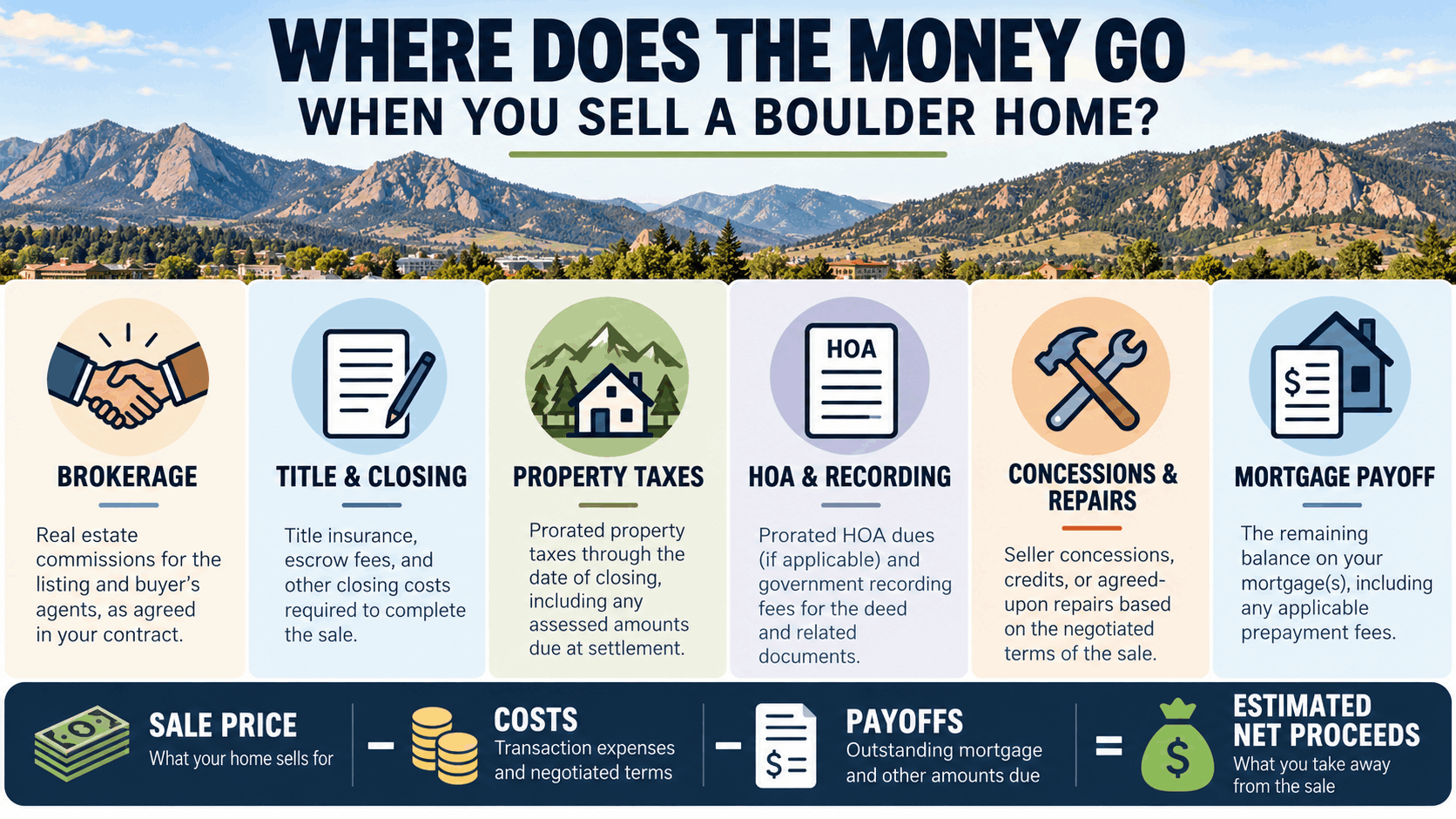
For example, a detached home without an HOA will generally not have association-related charges. A property owned without a mortgage will not require a mortgage payoff.
A home that needs significant repairs may involve preparation expenses that another seller can avoid.
This is why applying one generic closing-cost percentage to every Boulder property can be misleading.
Before listing, sellers should request a property-specific estimate of proceeds that separates selling expenses from mortgage debt and other obligations.
That estimate is commonly called a seller net sheet.
How Much Is the Real Estate Commission in Boulder in 2026?
Brokerage compensation is often one of the largest transaction expenses, but there is an important fact sellers should understand:
There is no legally required real estate commission rate in Boulder or Colorado.
The amount is negotiable.
Sellers should not assume that a particular percentage is mandatory, standard, or automatically divided between the listing brokerage and the buyer's brokerage.
The amount a seller pays for listing services depends on the negotiated agreement.
Any compensation offered to the buyer's brokerage should also be clearly discussed and documented.
How Agent Compensation Works
A seller normally negotiates compensation with the brokerage representing the sale of the property.
Depending on the agreements involved, compensation for a buyer's brokerage may be handled separately.
The seller can choose whether to offer or authorize compensation to a buyer's broker, subject to the applicable agreements and requirements.
That is different from saying the seller is legally required to pay both agents.
The National Association of REALTORS confirms that compensation is negotiable and not set by law.
Source: NAR Consumer Guide to Written Buyer Agreements
Source: NAR Consumer Guide to Offers of Compensation
What Does a Commission Percentage Look Like in Dollars?
Consider a hypothetical $1 million sale.
| Hypothetical negotiated compensation | Dollar amount |
|---|---|
| 1% of sale price | $10,000 |
| 2% of sale price | $20,000 |
| 2.5% of sale price | $25,000 |
| 3% of sale price | $30,000 |
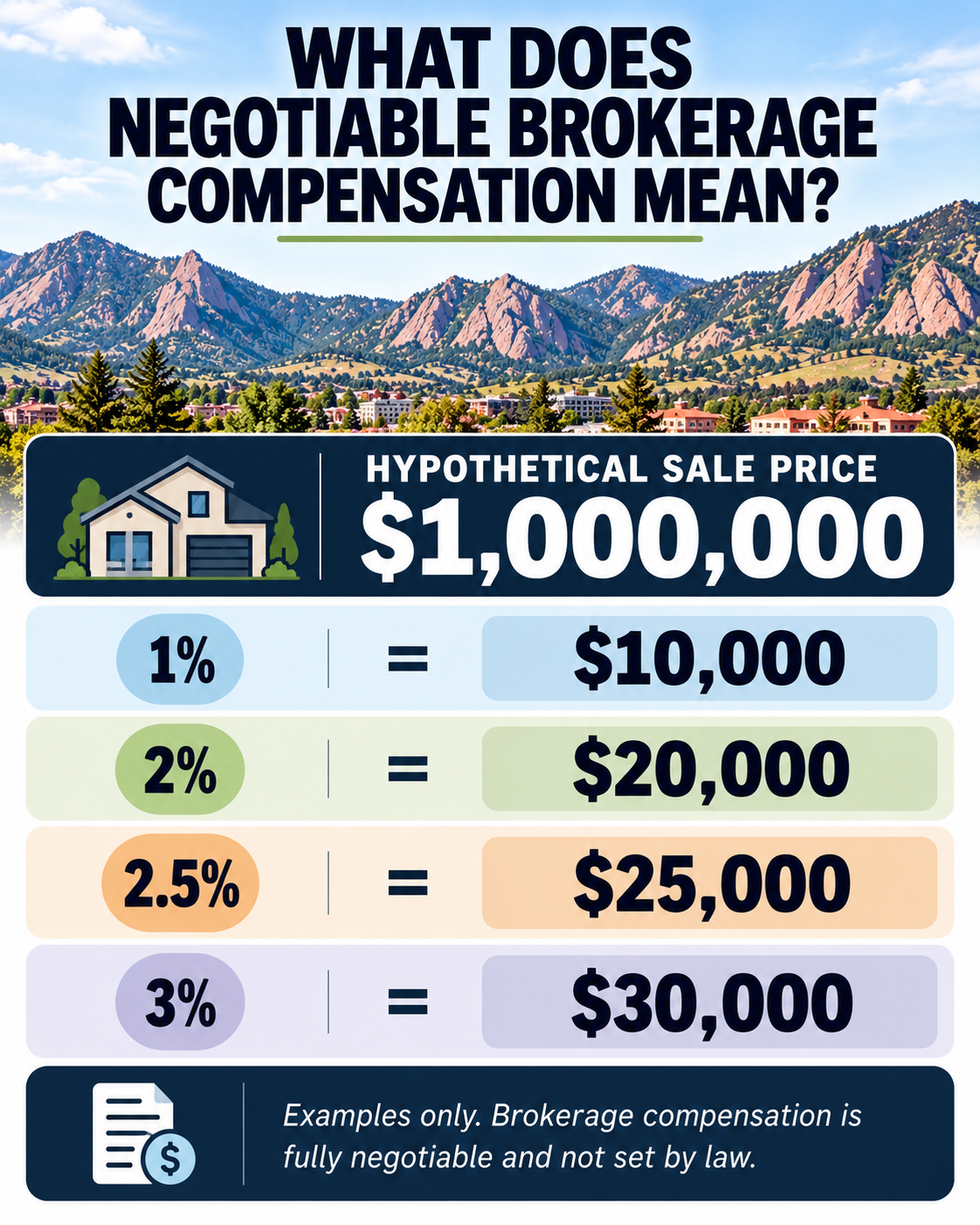
These are mathematical examples, not recommended, typical, or legally prescribed commission rates.
Whether compensation is structured as a percentage, flat fee, or another permissible arrangement, sellers should understand which services are included and how the agreement affects their estimated proceeds.
For a high-value Boulder property, even a relatively small difference in percentage can represent thousands of dollars.
That makes it important to discuss services, marketing strategy, representation, and compensation before signing a listing agreement.
Title Insurance and Closing Fees in Boulder
Title insurance and settlement services are another important part of the transaction.
Title insurance generally protects against certain covered title-related problems, subject to the policy's terms.
A seller's ownership history, recorded liens, easements, and other title matters can affect what must be resolved before a transaction closes.
Who Pays for Title Insurance?
In Colorado transactions, sellers commonly pay for the owner's title insurance policy, but the allocation can be negotiated.
The actual purchase contract controls which party is responsible for the applicable expenses.
A buyer obtaining financing may also need a lender's title insurance policy.
The premium and any endorsements depend on the transaction, insurer, and coverage.
What Are Closing and Settlement Fees?
A closing or settlement company coordinates the transfer of funds and documents necessary to complete a real estate transaction.
Services may include preparing closing statements, coordinating signatures, disbursing funds, and handling the recording process.
The settlement fee may be paid by the buyer, seller, divided between them, or handled through another agreed arrangement.
The amount is not necessarily identical across title companies.
What About Existing Liens?
If a seller has an outstanding mortgage or other lien that must be cleared, the title and closing process will normally address the necessary payoff and release documentation.
Unresolved title issues can sometimes delay closing.
For sellers, requesting title information early can help identify potential problems before they become urgent.
The best way to estimate these expenses is to obtain a preliminary title and settlement quote for the actual property rather than relying on a generic statewide estimate.
Colorado Documentary Fees and Boulder County Recording Costs
Not every fee involved in a Boulder home sale is negotiable.
Colorado establishes certain statutory charges for recording real estate documents.
Boulder County currently publishes the following fees, effective July 1, 2025:
| Recording-related fee | Published amount |
|---|---|
| Standard recording fee | $43 per document |
| Colorado documentary fee | $0.01 per $100 of applicable consideration |
The documentary fee generally applies when a deed transfers real property for consideration greater than $500 and no exemption applies.
Official source: Boulder County Recording Fees
Example: Documentary Fee on a $1 Million Sale
For a hypothetical property transfer with $1 million in applicable consideration:
$1,000,000 ÷ $100 × $0.01 = $100
That is the Colorado documentary fee under the published formula.
The standard fee to record one applicable document would be $43.
These are separate charges.
The final allocation of recording-related expenses between buyer and seller depends on the transaction and contract.

Buyers and sellers should also confirm whether any separate location-specific transfer charges apply to the property, rather than confusing the Colorado documentary fee with a municipal transfer tax.
Property Taxes, HOA Charges, and Other Closing Adjustments
Property taxes can create confusion because Colorado generally collects them in arrears.
That means taxes associated with one year are normally paid during the following year.
When a property sells, the purchase contract and closing calculations establish how the relevant taxes are allocated between the buyer and seller.
How Property-Tax Prorations Work
Consider a homeowner who sells a property partway through the year.
The seller may be responsible for the property's tax obligation associated with the portion of the year they owned the home.
Because the final tax bill for the current year may not yet be available, the closing calculation may use a contractually specified estimate.
The amount credited or charged at closing depends on the applicable tax information, contract provisions, and closing date.
This adjustment is known as a property-tax proration.
A proration is not necessarily a fee charged by a service provider. It is an allocation of a property-related obligation between the parties.
For Boulder sellers, the distinction matters because changes to Colorado's property-tax assessment system can make the most recent tax bill an imperfect estimate of future obligations.
What If the Property Has an HOA?
Condo, townhome, and other association-governed properties may involve additional charges.
Depending on the association and the purchase contract, these can include:
-
HOA status-letter fees
-
Document preparation charges
-
Record-change or transfer fees
-
Unpaid regular assessments
-
Special assessments
-
Working-capital or reserve contributions
-
Prorated HOA dues

The allocation of these costs is not identical for every transaction.
Sellers should request current association information and ask the closing company which charges will appear on the settlement statement.
A condo with an upcoming special assessment may also present issues that deserve attention well before closing.
Repairs, Staging, and Buyer Concessions Can Change the Bottom Line
Not every selling expense appears as a standard charge on the closing statement.
Some of the most important financial decisions occur before the property goes on the market or during negotiations with the buyer.
Preparing the Property for Sale
Depending on the home's condition, preparation expenses may include cleaning, landscaping, minor repairs, painting, staging, photography, or other improvements.
However, spending more on preparation does not guarantee a higher sales price.
The right strategy depends on how the property compares with competing listings and what buyers in that segment are likely to value.
A carefully maintained Boulder home might need only cleaning, photographs, and modest presentation work.
A property with deferred maintenance may need a more detailed approach.
The objective should be to identify improvements that support the selling strategy—not to complete every possible renovation.
What Are Seller Concessions?
A seller concession is a negotiated benefit provided to a buyer as part of a purchase agreement.
Depending on financing rules and contract terms, it might help with allowable closing costs, a mortgage-rate buydown, or an agreed credit related to inspection negotiations.
For example, a buyer might offer $950,000 for a property while requesting a $5,000 closing-cost credit.
A seller evaluating that offer should consider both the purchase price and the requested credit.
A $955,000 offer with a $10,000 credit does not automatically produce more net proceeds than a $950,000 offer without a credit.
The financing, appraisal, inspection, and probability of closing also matter.
Why Net Proceeds Matter More Than the Highest Offer
Two offers with different prices can produce similar—or even reversed—financial outcomes after negotiated terms are accounted for.
A stronger offer may be the one that creates the better combination of proceeds, contractual certainty, and timing.
That is why sellers should compare offers using an estimated net sheet rather than focusing only on the headline price.
Example: How Much Would You Keep After Selling a $1 Million Boulder Home?
The easiest way to understand selling costs is to walk through an example.
Suppose a Boulder homeowner sells a property for $1 million.
The owner has an outstanding mortgage payoff of $450,000.
For illustration, assume the transaction includes separately negotiated brokerage compensation, title and closing expenses, a property-tax credit, and a buyer concession.
The assumptions below are fictional. They are not an estimate of prevailing Boulder brokerage rates or actual closing costs for a particular address.
Illustrative $1 Million Boulder Home Sale
| Item | Amount |
|---|---|
| Sale price | $1,000,000 |
| Negotiated listing brokerage compensation (illustrative 2%) | −$20,000 |
| Negotiated buyer brokerage compensation paid by seller (illustrative 2%) | −$20,000 |
| Title and settlement expenses (assumption) | −$2,000 |
| Documentary fee ($0.01 per $100) | −$100 |
| One recording charge (assumed seller-paid) | −$43 |
| Property-tax credit to buyer (assumption) | −$4,000 |
| HOA-related expenses (assumption) | −$500 |
| Negotiated buyer concession | −$5,000 |
| Estimated proceeds before mortgage payoff | $948,357 |
| Outstanding mortgage payoff | −$450,000 |
| Estimated cash received at closing | $498,357 |
Now suppose the seller also spent $3,000 on property preparation before closing.
That would reduce the seller's overall cash outcome, producing approximately:
$495,357
This figure is a simplified illustration of cash remaining from the transaction after the listed expenses and earlier preparation spending.
It is not an estimate of tax-free profit, home equity before expenses, or what every Boulder seller would receive.
The calculation does not include every potential charge, tax obligation, mortgage payoff adjustment, lien, or individual circumstance.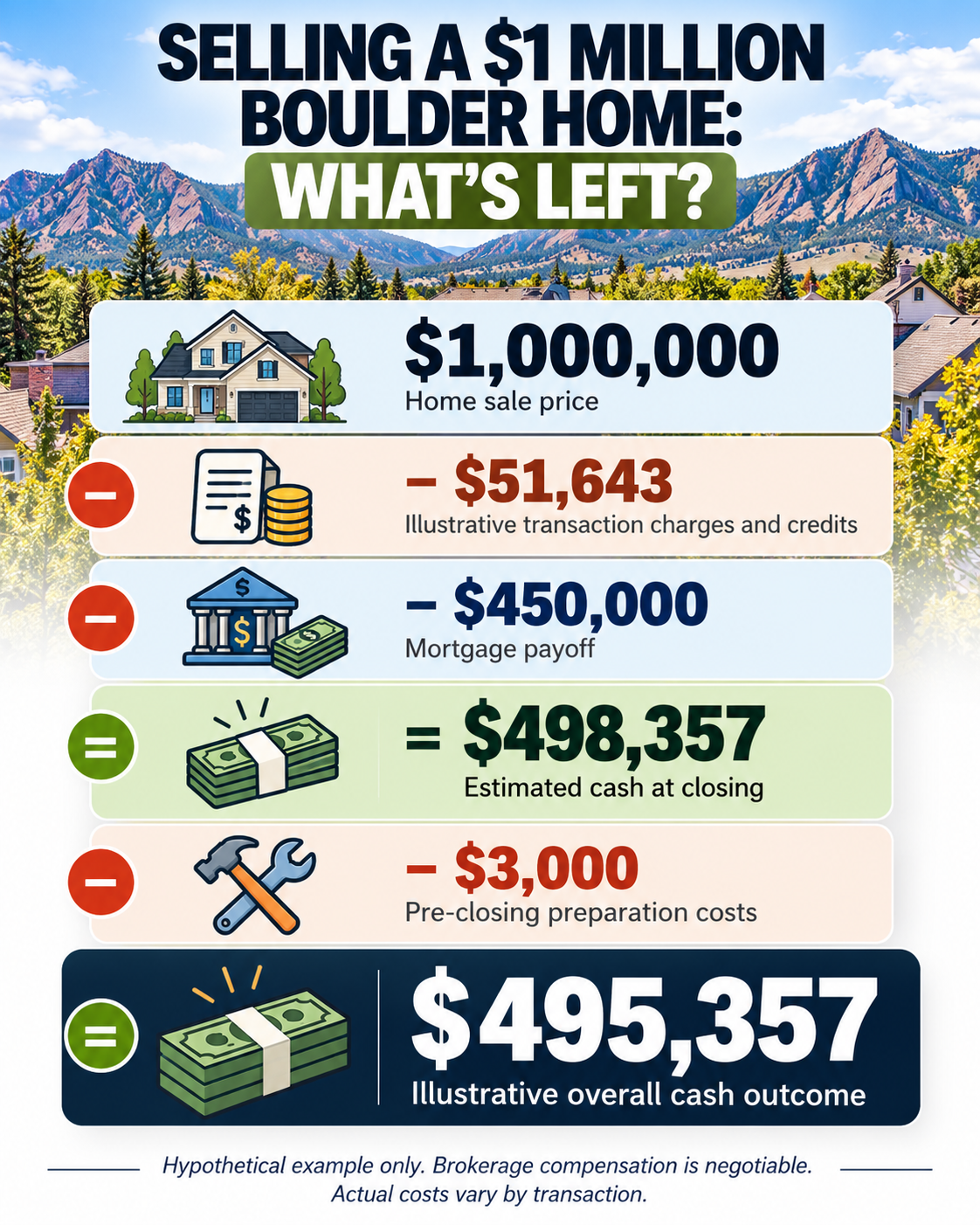
What This Example Shows
The seller received a $1 million offer, but the final cash outcome was substantially different.
Part of that difference was the outstanding mortgage balance.
Another part was the collection of transaction costs and negotiated expenses.
Those are two separate categories.
Mortgage payoff is not a brokerage or closing-service fee. It is the satisfaction of debt already owed against the property.
This distinction is especially important when sellers compare their estimated equity with the money they expect to receive at closing.
Do You Pay Capital Gains Tax When Selling a Boulder Home?
Selling a home may create a capital gain, but the amount received at closing is not automatically the amount subject to income tax.
Under federal tax rules, qualifying homeowners may be able to exclude some or all of the gain from selling their primary residence.
The IRS currently describes a potential exclusion of:
-
Up to $250,000 for qualifying individual taxpayers.
-
Up to $500,000 for qualifying married couples filing jointly.
These limits apply to qualifying gains, not to the sale price itself.
How Does the Home-Sale Exclusion Work?
In general, the IRS requires the seller to meet ownership and residence requirements.
Typically, the homeowner must have owned and used the property as a principal residence for at least two of the five years preceding the sale.
Additional conditions and exceptions apply.
Sellers who used part of the property for business, rented it, claimed depreciation, inherited it, or experienced other special circumstances should seek tax guidance before relying on the full exclusion.
Official IRS guidance: Sale of Your Home
What About Colorado Income Tax?
Colorado tax treatment can also matter.
For some nonresident sellers, Colorado's real estate withholding requirements may apply unless an exemption is established.
The Department of Revenue explains that certain transfers involving nonresidents may require withholding handled through the closing process.
That withholding is not necessarily the seller's final tax liability.
Colorado Department of Revenue — Nonresident Tax Guidance
For Boulder homeowners, especially those who have moved out of state or converted a former residence into a rental property, this is worth discussing with a qualified tax professional before the sale.
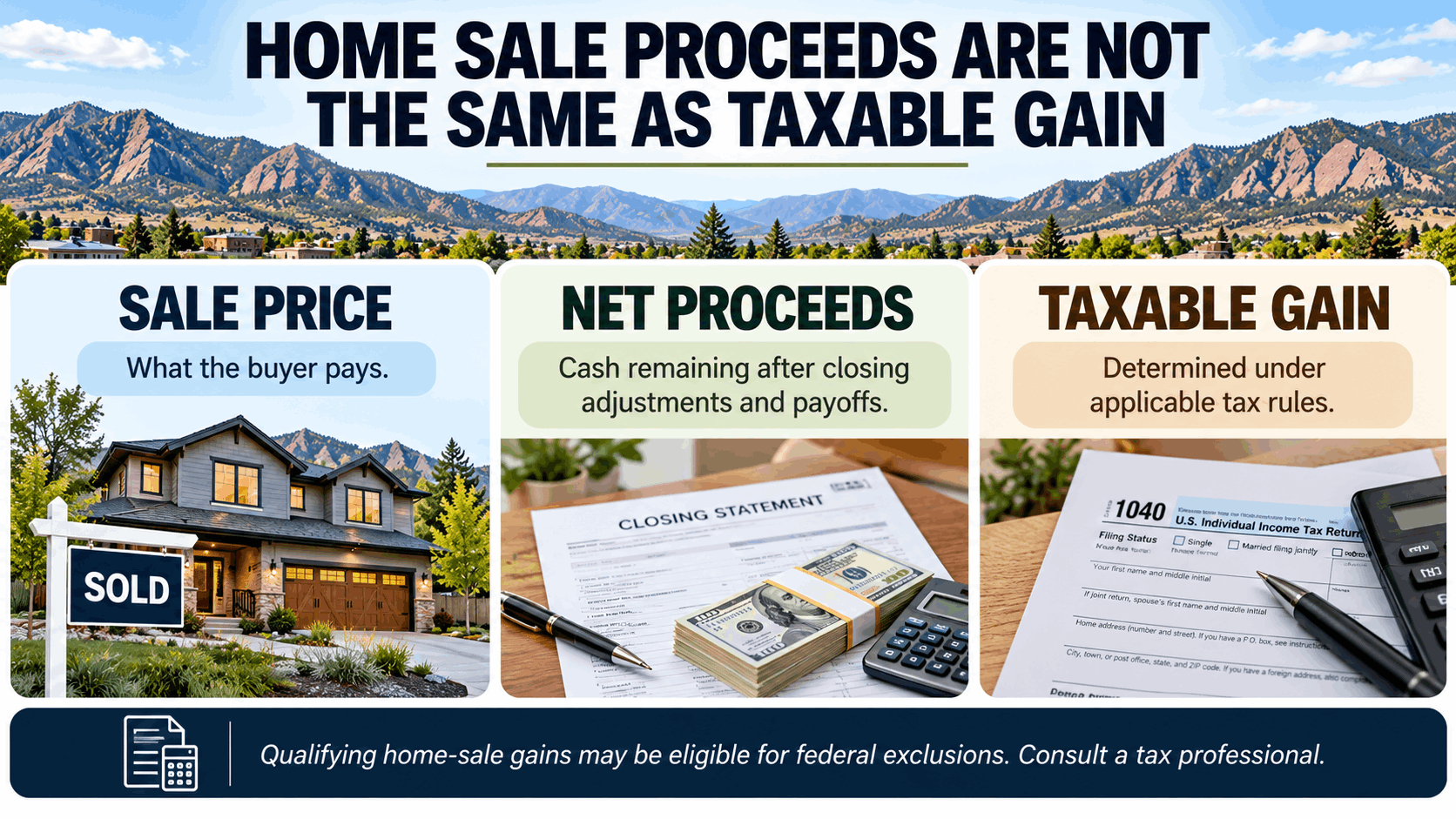
The seller net sheet estimates cash proceeds. A tax professional determines potential taxable gain and related reporting requirements.
How Can Boulder Sellers Estimate Their Net Proceeds Before Listing?
A seller net sheet is one of the most useful documents to prepare before putting a home on the market.
It provides a preliminary breakdown of the expected selling price, transaction costs, mortgage payoff, and cash proceeds.
The estimate should be updated as new information becomes available.
A useful seller net sheet starts with the property's likely selling-price range rather than an arbitrary asking price.
For example, a seller might compare estimated proceeds under three scenarios:
-
A lower price that reflects a more conservative sale outcome.
-
A target price supported by comparable properties.
-
A higher price scenario that requires stronger buyer demand.
Those scenarios should incorporate realistic assumptions about the property's condition, competing inventory, brokerage arrangements, and potential concessions.
Information to Gather
Before preparing the estimate, a seller should collect the most recent mortgage statement, a lender payoff estimate, current property-tax information, HOA details if applicable, and records of known property-related obligations.
The seller should also discuss expected preparation costs and any transaction-specific circumstances that could affect the settlement.
A useful net sheet can then help answer several important questions:
How much equity is available to fund the next home purchase?
What happens if the home sells below the initial asking price?
How would a buyer concession change the outcome?
What difference does the closing date make?
Are there repairs or financial obligations that should be addressed before listing?
The more clearly these questions are answered, the easier it becomes to evaluate offers without relying on the sale price alone.
What Makes Selling Costs Different in Boulder?
Boulder sellers should consider several local property characteristics that can affect the cost and complexity of a sale.
A downtown condo may require HOA documents, association assessments, and an insurance review.
An older home may need additional inspection preparation or documentation of previous improvements.
A property near the foothills may raise questions about wildfire mitigation, private access, or insurance.
A larger parcel in unincorporated Boulder County may involve well, septic, utility, access, or land-use considerations that do not apply to an ordinary in-town property.
Historic properties and homes with extensive renovations may also require closer attention to permit history and existing approvals.
These factors do not automatically make a home more expensive to sell.
But they can influence preparation costs, documentation requirements, negotiations, and closing timelines.
For sellers of distinctive properties, my Luxury Home Selling Guide for Boulder explains why pricing and property-specific preparation matter.
The same principle applies across price ranges:
The better a seller understands the property before listing, the easier it becomes to plan for expenses and reduce avoidable surprises.
The Bottom Line: What Does It Really Cost to Sell a House in Boulder?
Selling a Boulder home involves more than paying a real estate agent and completing closing paperwork.
The financial outcome depends on negotiated brokerage compensation, title and settlement charges, recording expenses, property-tax adjustments, HOA obligations, concessions, preparation costs, and any outstanding mortgage payoff.
Some expenses are determined by law.
Others are established through service-provider pricing or negotiated agreements.
And some are specific to the property itself.
That is why a generic estimate such as “selling costs are always a certain percentage” does not tell a homeowner enough.
A more useful starting point is a realistic estimate of the property's likely selling price, followed by a detailed seller net sheet.
For homeowners planning to buy another property, downsize, relocate, or sell an investment home, understanding the expected proceeds can make a significant difference in the next decision.
If you're considering selling a home in Boulder or Boulder County, I can help you evaluate comparable properties, develop a pricing and preparation strategy, and review the real-estate costs that may affect your expected proceeds.
The goal is to understand not only what your home could sell for, but also what the transaction may leave you with after closing.
Eric Farran
Eric Sells Boulder
This article provides general real estate information based on publicly available guidance reviewed in October 2026. Actual transaction expenses, compensation arrangements, tax obligations, and closing procedures vary. Confirm property-specific costs with your brokerage, title company, lender, and qualified tax or legal professionals.
Boulder Home Selling Costs FAQ
How much does it cost to sell a house in Boulder, Colorado?
The total depends on negotiated brokerage compensation, title and closing charges, recording fees, property-tax adjustments, preparation costs, HOA expenses, and any buyer concessions. There is no fixed percentage that accurately describes every Boulder home sale.
What is the real estate commission in Boulder in 2026?
Real estate brokerage compensation is negotiable and is not set by law. Sellers should review their listing agreement and any separate compensation arrangements instead of assuming a mandatory commission rate.
Does the seller have to pay the buyer's agent in Colorado?
No. Sellers are not automatically required to pay the buyer's brokerage. They may choose to negotiate or authorize compensation to a buyer's broker, subject to the applicable agreements and requirements.
Who pays closing costs when selling a home in Colorado?
Both buyers and sellers can be responsible for different closing expenses. The signed purchase contract determines the allocation of many charges, including title services, settlement fees, and association-related expenses.
What is Colorado's documentary fee on a $1 million home sale?
Boulder County lists a Colorado documentary fee of $0.01 per $100 of applicable consideration. On a qualifying $1 million transfer, the calculated documentary fee would be $100.
How much does it cost to record a deed in Boulder County?
Boulder County currently lists a standard recording fee of $43 per document, effective July 1, 2025. The documentary fee may apply separately when the transfer meets the relevant conditions.
Do sellers pay property taxes at closing in Boulder?
Property taxes are commonly prorated under the terms of the purchase contract. Since Colorado generally collects taxes in arrears, the closing statement may include a seller-to-buyer credit for the seller's portion of accrued taxes.
Is the mortgage payoff considered a closing cost?
A mortgage payoff reduces the cash a seller receives at closing, but it is repayment of existing debt rather than a fee for selling the property.
Do I owe capital gains tax when selling my Boulder home?
Not necessarily. Qualifying sellers may be eligible for a federal exclusion of up to $250,000 in gain, or $500,000 for eligible married couples filing jointly. Ownership, residence, and other IRS requirements apply.
How can I find out what I'll make from selling my Boulder house?
Request a property-specific seller net sheet that estimates the selling price, brokerage compensation, title and closing expenses, tax adjustments, concessions, mortgage payoff, and remaining proceeds. Update the estimate as the transaction develops.
FROM OUR BLOG


Boulder Rental License Requirements 2026: Fees, Inspections & How to Apply
Renting out a home in Boulder involves more than finding a tenant, setting a monthly rent, and signing a lease. Before most residential properties inside Boulder city limits can legally be advertised or rented, the owner must obtain a rental housing license from the City of Boulder. That requirement

Boulder Homeowners Insurance 2026: Wildfire, Hail & What Buyers Need to Know
Buying a home in Boulder involves more than finding the right neighborhood, negotiating a purchase price, and qualifying for a mortgage. There is another important consideration that can affect both the monthly cost of ownership and the ability to complete a purchase: homeowners insurance. In Boulde

Boulder Down Payment Assistance 2026: How First-Time Buyers Can Get Up to $100,000
For many Boulder buyers, the challenge is not simply qualifying for a monthly mortgage payment. It is getting enough cash together for the down payment, closing costs, reserves, and everything else that comes with buying a home in one of Colorado's more expensive housing markets. What many buyers do