
What this license really is - and why it matters
As Sundance prepares to land in Boulder, one of the biggest real estate questions is not about movie tickets. It is about lodging. Specifically, how homeowners and property owners can legally participate when demand for short stays spikes.
Boulder's Festival Lodging Rental License was created for that exact moment. It allows eligible homes in the City of Boulder to be rented for 29 days or less per year during a city-approved special festival event. In practical terms, it gives local owners a legal framework to host visitors during major events like Sundance without turning the whole city into a year-round short-term rental market.
For homeowners, that can mean flexible seasonal income. For investors, it opens a very specific opportunity set. And for anyone selling a home in Boulder, it adds another lifestyle-and-income angle buyers may want to understand.
How the Festival Lodging Rental License works
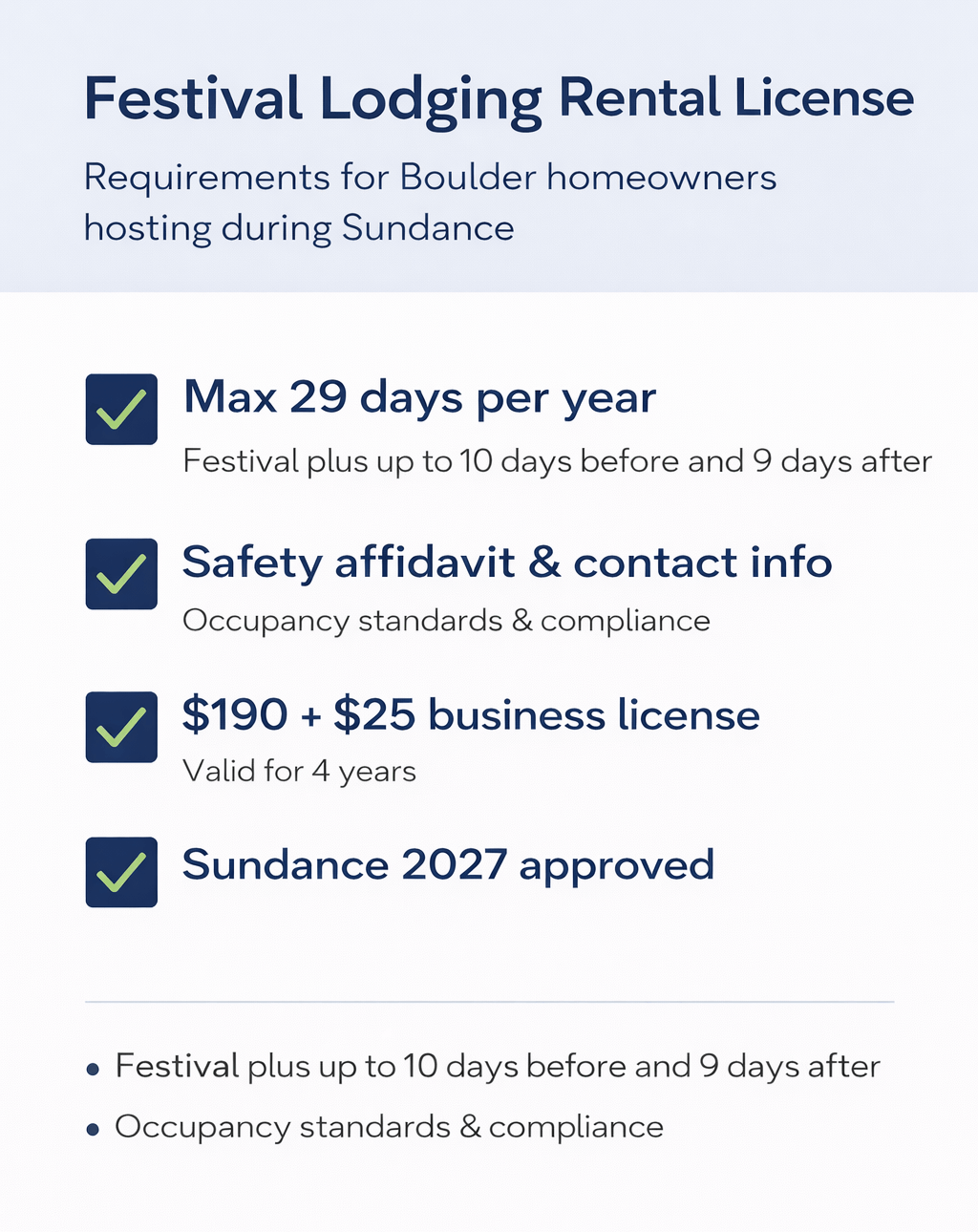
The license is designed for city-approved Special Festival Events. Under the current rules, rentals are capped at 29 days per year, and use is limited to the festival window plus up to 10 days before and 9 days after. The city also requires a safety affidavit, contact information, and compliance with occupancy standards.
A few details matter here. First, applications are open year-round. Second, the license is for properties within the City of Boulder, not unincorporated Boulder County. Third, the current approved festival under the program is Sundance in 2027. That makes this less of a generic short-term rental play and more of an event-specific strategy tied to Boulder real estate and festival demand.
The application fee is straightforward: $190 plus a $25 business license fee, and the license is valid for four years. That is a relatively modest entry point for owners who want flexibility without committing to a traditional short-term rental model.
Who can use it - and who needs to slow down and read the fine print
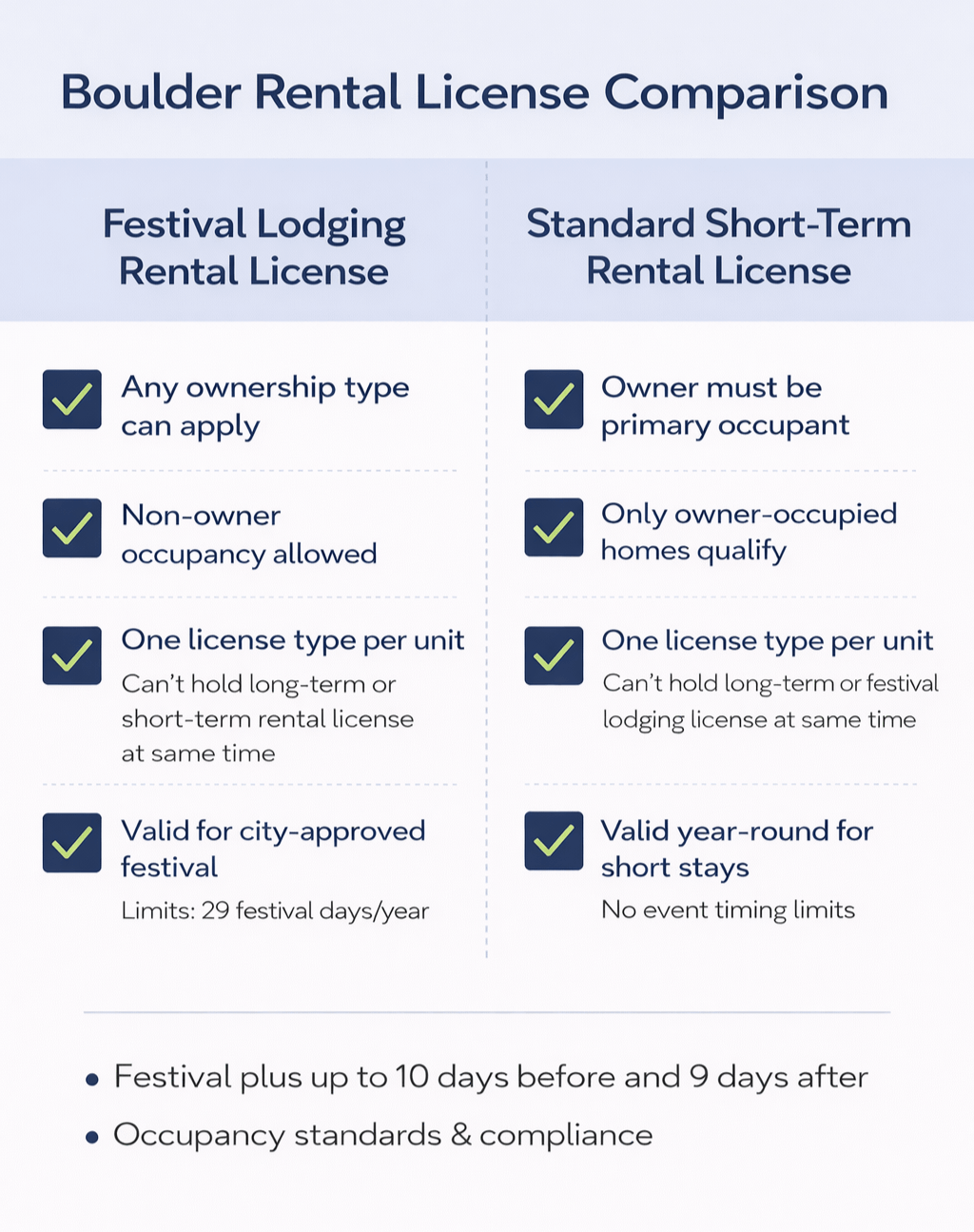
This is where a lot of people get tripped up. The Festival Lodging Rental License is more flexible than Boulder's regular short-term rental license. The city says any ownership type can apply, and the property does not have to be owner-occupied. That is a meaningful difference from the standard short-term rental rules, which are tied to principal residence requirements.
But flexibility does not mean a free-for-all. The city only allows one rental license type per unit at a time. So if a unit already has a long-term rental license or a short-term rental license, it generally is not eligible for a Festival Lodging Rental License under the current rules. If you already have a short-term rental license, you do not need this extra license to rent during a special festival event. You would simply operate under your existing short-term rental authorization.
There is also the HOA and lease issue. Even if the city allows a property to participate, private restrictions may not. Owners and tenants need to review HOA rules, lease terms, and building policies early. City approval does not override those private agreements.
Festival lodging license vs. short-term rental license
If you want the simplest way to think about it, the Festival Lodging Rental License is narrower in timing but broader in who may qualify. A regular short-term rental license is built for ongoing short stays in an owner-occupied home. The festival license is built for short, high-demand event windows, with fewer ongoing obligations and more ownership flexibility.
That difference matters for real estate strategy. If you are buying a home in Boulder as your primary residence and want year-round hosting flexibility, the regular short-term rental path may be more relevant. If you own a second home, a non-primary residence, or a property you only want to use during a major event window, the festival license may be the more practical fit.
The key is not assuming one license replaces the other. They solve different problems, and choosing the wrong path can create compliance issues fast.
What homeowners should do now

If you think your property could be a fit, this is the time to get organized. Start with eligibility. Confirm that the property sits inside City of Boulder limits, review whether there is an existing rental license on the unit, and check your HOA or lease documents. Then make sure the home can meet basic safety and occupancy standards.
After that, decide whether you want to self-manage or work with a property management company. Visit Boulder says hosts can choose either route, and it has partnered with vetted management companies to help with licensing support, guest communication, and logistics. That can be especially helpful for owners who want the income opportunity without the operational headache.
Finally, think like a marketer, not just a landlord. Festival guests will not just be booking a bed. They will be booking proximity to Boulder Theater, the Dairy Arts Center, CU Boulder, Pearl Street, Chautauqua, and the overall Boulder lifestyle. A well-positioned, well-presented home can stand out quickly.
What it means for investing in Boulder real estate

The smartest takeaway for investors is not that every property suddenly becomes a short-term rental goldmine. It is that Boulder is creating a targeted, regulated way to absorb major-event demand while preserving neighborhood character. That matters because it signals the city understands the value of hospitality, compliance, and real estate flexibility all at once.
For some buyers, the opportunity is direct income during a high-demand window. For others, the bigger play is owning in a market that keeps adding reasons people want to be here. Sundance, CU Boulder, Pearl Street, the outdoor lifestyle, and a nationally visible arts scene all reinforce Boulder's long-term desirability.
If you are considering investing in Boulder real estate, the festival license should be viewed as one tool in the toolbox, not the whole strategy. The best investments still start with location, livability, neighborhood quality, and long-term resale appeal.
The bottom line for Boulder property owners
Boulder's Festival Lodging Rental License is practical because it is specific. It gives eligible owners a legal, limited way to participate in Sundance-driven demand while keeping the rules clear around timing, safety, occupancy, and taxes.
For homeowners, that can mean extra flexibility. For investors, it can add another layer of value analysis. And for sellers, it can become part of the conversation when marketing a home to buyers who care about both lifestyle and optionality.
In other words, this is not just a festival story. It is another example of how Boulder real estate keeps intersecting with the things people already love about living here.
FROM OUR BLOG


Boulder Rental License Requirements 2026: Fees, Inspections & How to Apply
Renting out a home in Boulder involves more than finding a tenant, setting a monthly rent, and signing a lease. Before most residential properties inside Boulder city limits can legally be advertised or rented, the owner must obtain a rental housing license from the City of Boulder. That requirement

Boulder Homeowners Insurance 2026: Wildfire, Hail & What Buyers Need to Know
Buying a home in Boulder involves more than finding the right neighborhood, negotiating a purchase price, and qualifying for a mortgage. There is another important consideration that can affect both the monthly cost of ownership and the ability to complete a purchase: homeowners insurance. In Boulde

Boulder Down Payment Assistance 2026: How First-Time Buyers Can Get Up to $100,000
For many Boulder buyers, the challenge is not simply qualifying for a monthly mortgage payment. It is getting enough cash together for the down payment, closing costs, reserves, and everything else that comes with buying a home in one of Colorado's more expensive housing markets. What many buyers do