
Boulder is one of the easiest and most rewarding day trips from Denver. You can leave the city after breakfast, see the Flatirons up close, walk through one of Colorado’s best-known downtown districts, eat near Boulder Creek and finish the afternoon with a panoramic view over town.
The challenge is not finding things to do. It is deciding what to leave out.
A good Denver-to-Boulder day trip should give you a real sense of the city without turning the entire day into a race between attractions. This itinerary combines Boulder’s mountain setting, walkable downtown, local food and residential character while keeping the route geographically efficient.
Visit Boulder lists the trip from downtown Denver at approximately 28.4 miles and 37 minutes in normal conditions. Traffic on US 36 can add time, especially during weekday commuting hours, university events and busy summer weekends, so an early departure is worthwhile.
As a Boulder real estate professional, I also think a day trip is one of the best ways to begin understanding whether Boulder’s lifestyle fits you. Walking the neighborhoods, noticing how residents move between trails and downtown, and comparing different parts of the city can tell you more than simply driving past a few listings.
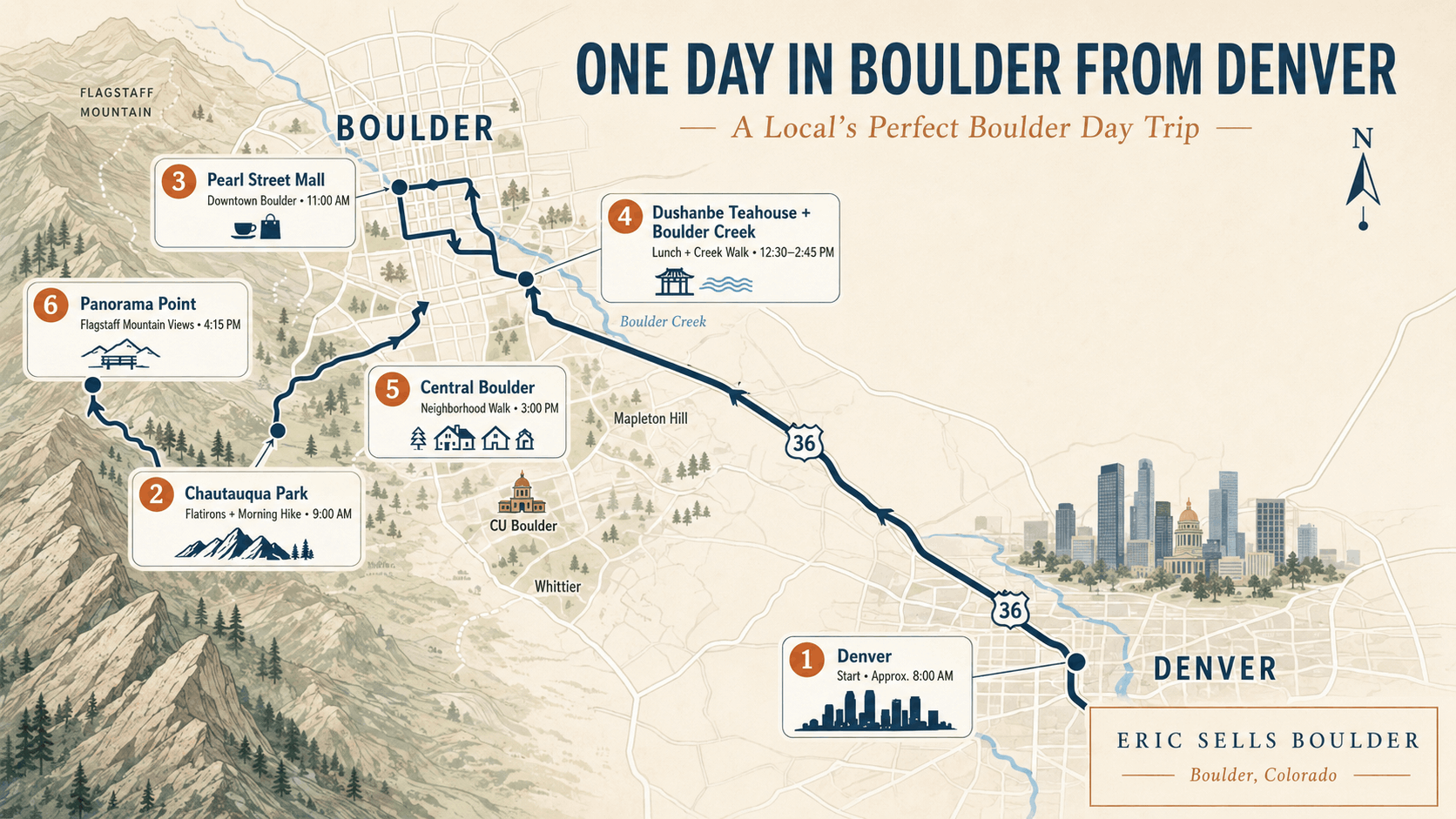
One-Day Boulder Itinerary at a Glance
| Time | Activity |
|---|---|
| 8:00 AM | Leave Denver |
| 8:45 AM – 9:00 AM | Arrive at Chautauqua Park |
| 9:00 AM – 10:45 AM | Flatirons views and a short hike |
| 11:00 AM – 12:30 PM | Explore Pearl Street Mall |
| 12:30 PM – 1:45 PM | Lunch downtown or at the Dushanbe Teahouse |
| 1:45 PM – 2:45 PM | Walk part of the Boulder Creek Path |
| 3:00 PM – 4:00 PM | Explore CU Boulder or a historic central neighborhood |
| 4:15 PM – 5:15 PM | Panorama Point or another foothills view |
| 5:30 PM – 7:00 PM | Dinner, a brewery or both |
| 7:00 PM – 8:00 PM | Return to Denver |
This schedule is intentionally flexible. Hikers can spend more time at Chautauqua, food-focused visitors can linger downtown, and prospective residents can replace an attraction with a guided neighborhood tour.
Getting from Denver to Boulder
Driving from Denver
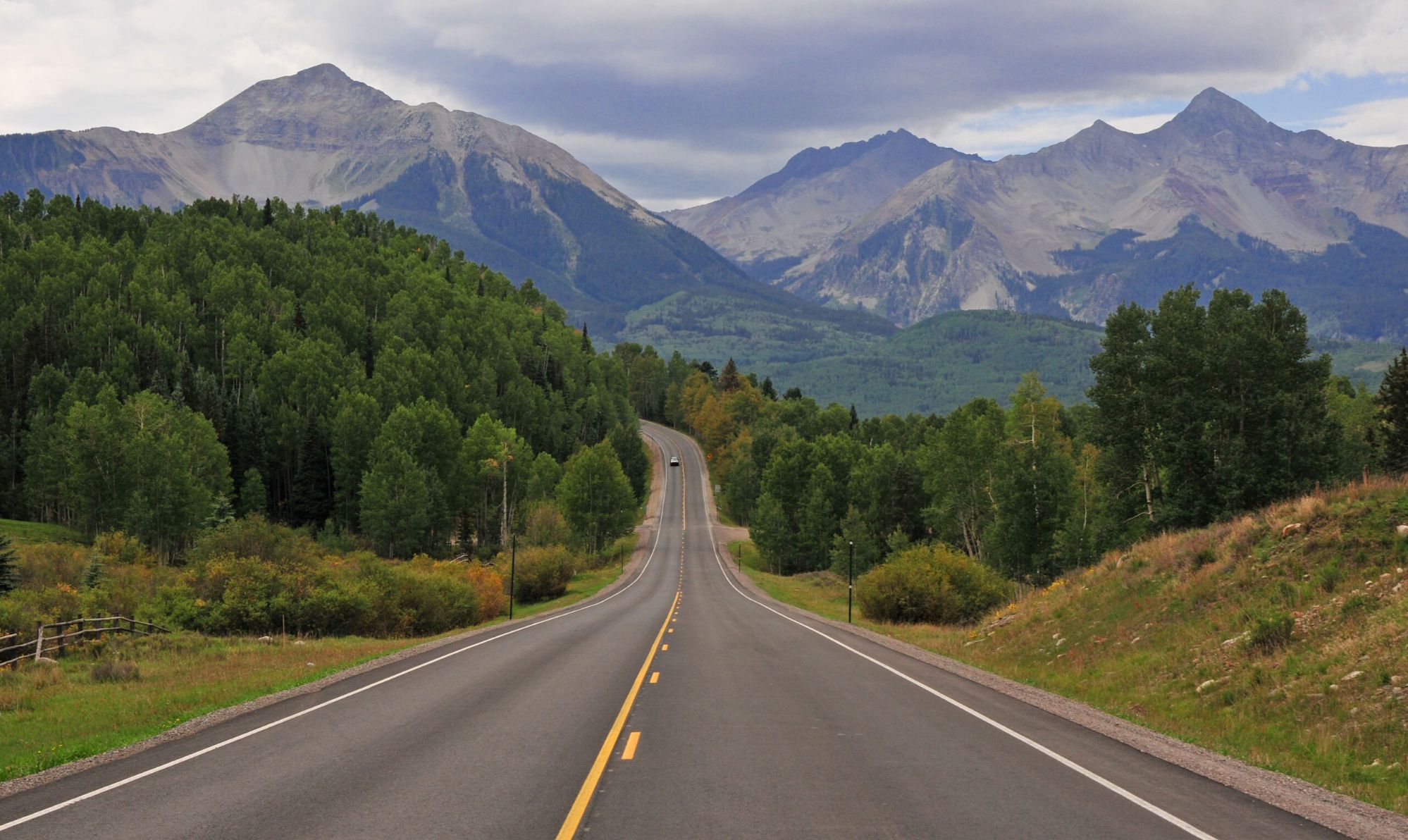
For most visitors, driving is the simplest option. From downtown Denver, the usual route follows US 36 northwest into Boulder. The road becomes 28th Street as you enter the city, placing you near CU Boulder, Baseline Road and the route to Chautauqua.
Leave Denver by about 8:00 a.m. A morning departure gives you a better chance of finding convenient trail access and lets you complete the outdoor portion of the itinerary before the strongest afternoon sun.
Do not rely on one parking location for the entire day. Chautauqua and downtown operate as separate parking environments, and moving your vehicle after the morning hike will usually save time.
Traveling from Denver to Boulder without a car
A car is helpful, but it is not essential for a Boulder day trip.
RTD’s Flatiron Flyer FF1 connects Denver Union Station with Downtown Boulder Station. From the Boulder station, Pearl Street, downtown restaurants and Boulder Creek are within the central city area. Use RTD’s current Trip Planner before departure because service times and alerts can change.
Reaching Chautauqua without a car requires an additional local bus, seasonal shuttle, rideshare, bicycle trip or longer walk. On summer weekends and holidays, Boulder’s free Park-to-Park shuttle serves Chautauqua from designated downtown locations.
A transit-based itinerary works best when you visit Chautauqua first and spend the rest of the day in the walkable downtown and Boulder Creek area.
9:00 a.m.: Begin at Chautauqua Park and the Flatirons
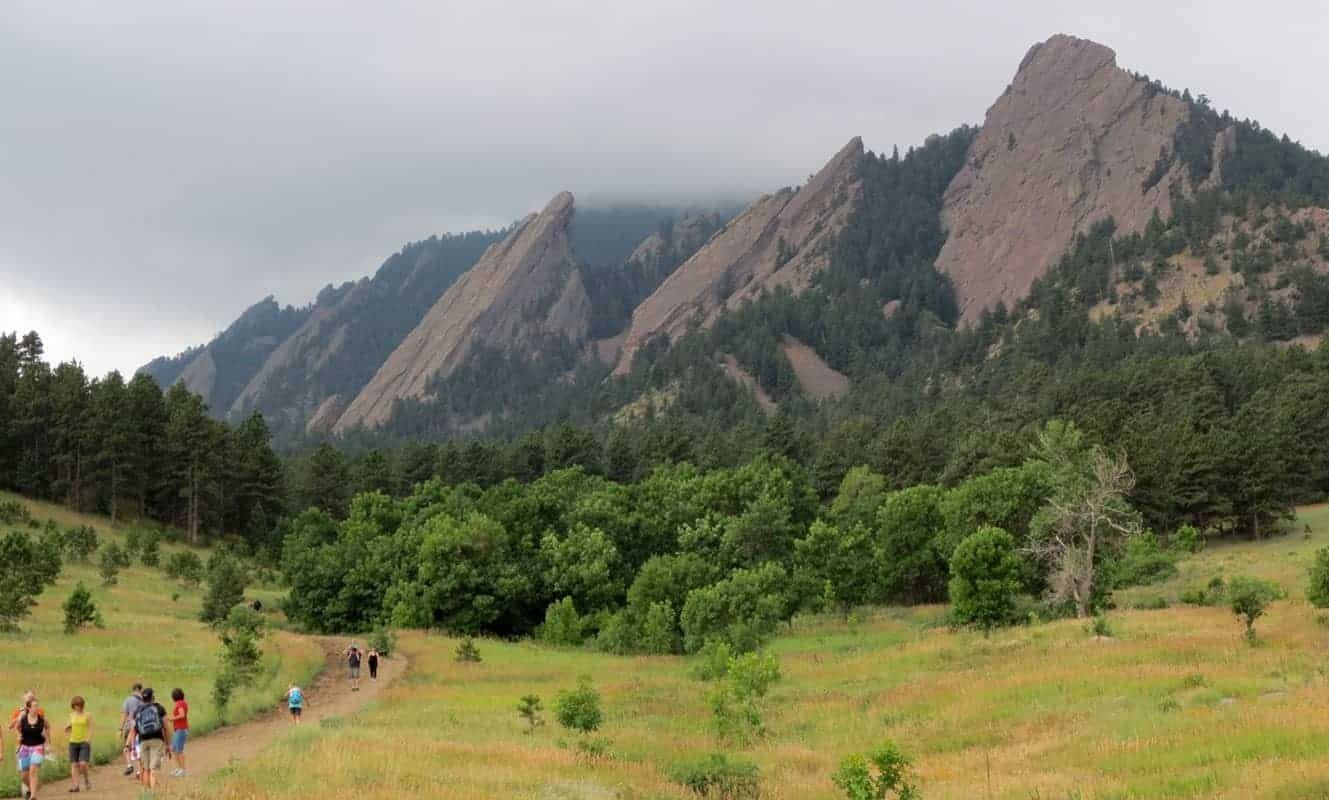
Start your day at Chautauqua Park. This puts Boulder’s most recognizable landscape first, while the light is often better for photography and the temperature is usually more comfortable for walking.
You do not need to complete a difficult hike to appreciate the setting. The lawn and meadow offer clear Flatirons views, and several trails begin nearby.
Best short Chautauqua options for a one-day itinerary
Chautauqua Trail: This 1.2-mile out-and-back route crosses the historic meadow and provides direct views of the Flatirons. The trail is exposed to the sun and receives heavy use, so bring water and begin early.
Bluebell Road: An easy, nearly one-mile route leading toward several trail intersections and Bluebell Shelter. It is a practical choice for visitors who want scenery without committing to a strenuous climb.
Flatirons Loop: A short, moderately graded route through open space and ponderosa forest at the base of the formations. It provides more of a trail experience while remaining more manageable than Boulder’s harder summit routes.
Royal Arch is a Boulder classic, but it is steep, rocky and more demanding than its distance can suggest. The city specifically advises hikers to expect loose rock, tight switchbacks and large steps. For a first visit with only one day available, save Royal Arch for another trip unless hiking is your main objective.
Chautauqua parking in summer
Parking near Chautauqua becomes especially competitive on summer weekends and holidays. For the 2026 season, paid parking is in effect from 8:00 a.m. to 8:00 p.m. on applicable weekends and holidays, while the free Park-to-Park shuttle runs every 30 minutes through Labor Day. The current paid-parking rate is $2.50 per hour.
Arriving early remains the simplest strategy. Before leaving Denver, check the city’s trail status and closure page because maintenance work, weather and natural-resource protections can affect access.
11:00 a.m.: Explore Pearl Street Mall
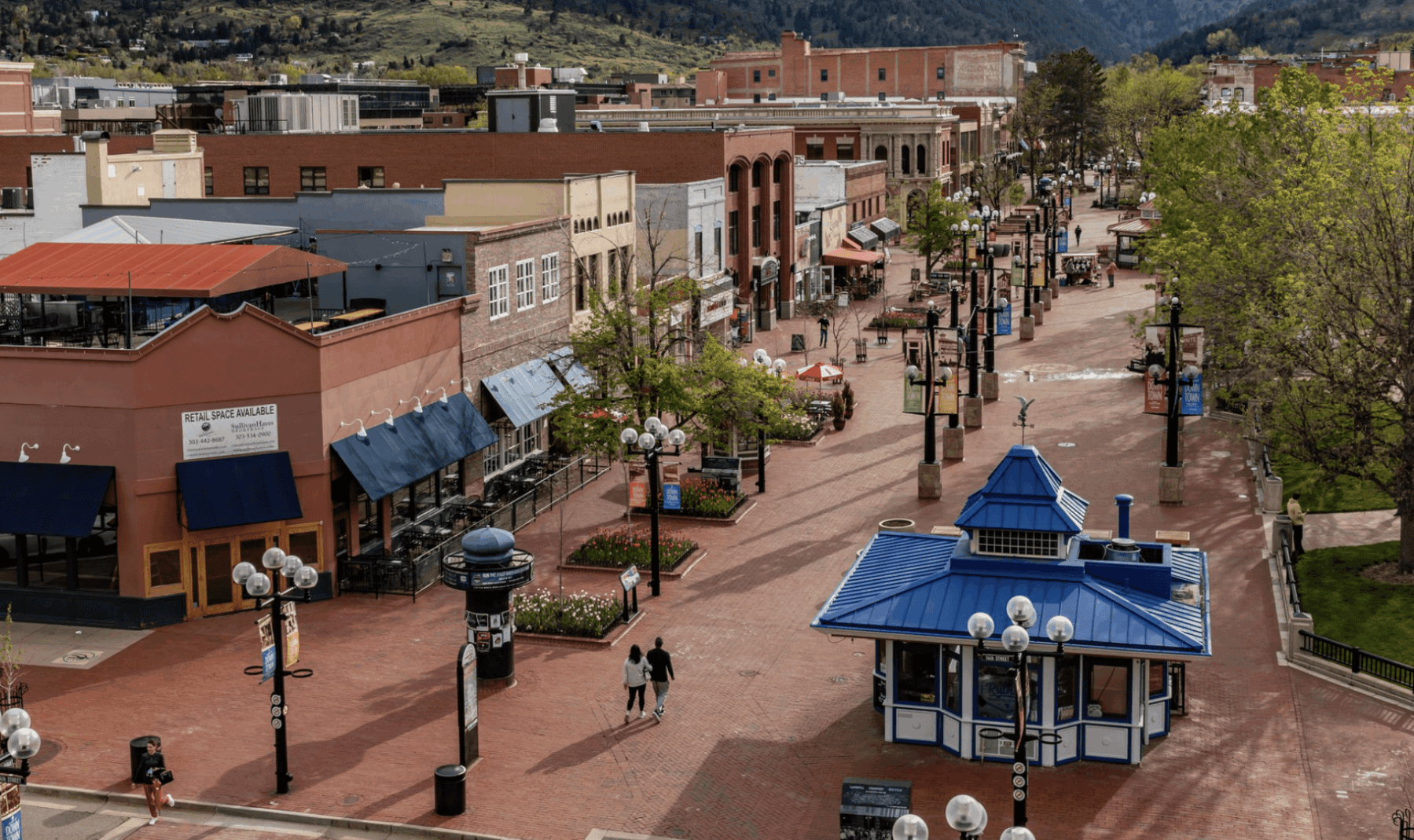
After your hike, drive approximately ten minutes toward downtown and park in a city garage near Pearl Street.
Pearl Street Mall is the center of Boulder’s downtown visitor experience. Four pedestrian blocks are closed to vehicle traffic, with restaurants, cafés, boutiques, galleries, bookstores, public art and street performers extending into the surrounding blocks.
Start around 11th or 12th Street and walk east. Do not limit yourself to the pedestrian-only section. East Pearl contains additional restaurants and storefronts, while the blocks west of the mall connect toward historic residential streets and the foothills.
A productive Pearl Street visit does not require a shopping agenda. Order a coffee, browse Boulder Book Store, watch a street performance and pay attention to how quickly the downtown commercial district transitions into residential neighborhoods.
That transition is an important part of Boulder’s character. Condominiums, historic houses, apartments and newer infill properties all sit within a relatively short distance of the downtown core. The convenience comes with tradeoffs such as event activity, delivery traffic, pedestrian volume and limited private parking.
Downtown parking tip
City-owned downtown garages generally offer free parking on Saturdays, Sundays and city-observed holidays. Depot Square at 3183 Pearl Street is an exception and charges seven days a week. Weekday parking and on-street rates should be checked before arrival.
12:30 p.m.: Have Lunch Downtown or at the Boulder Dushanbe Teahouse
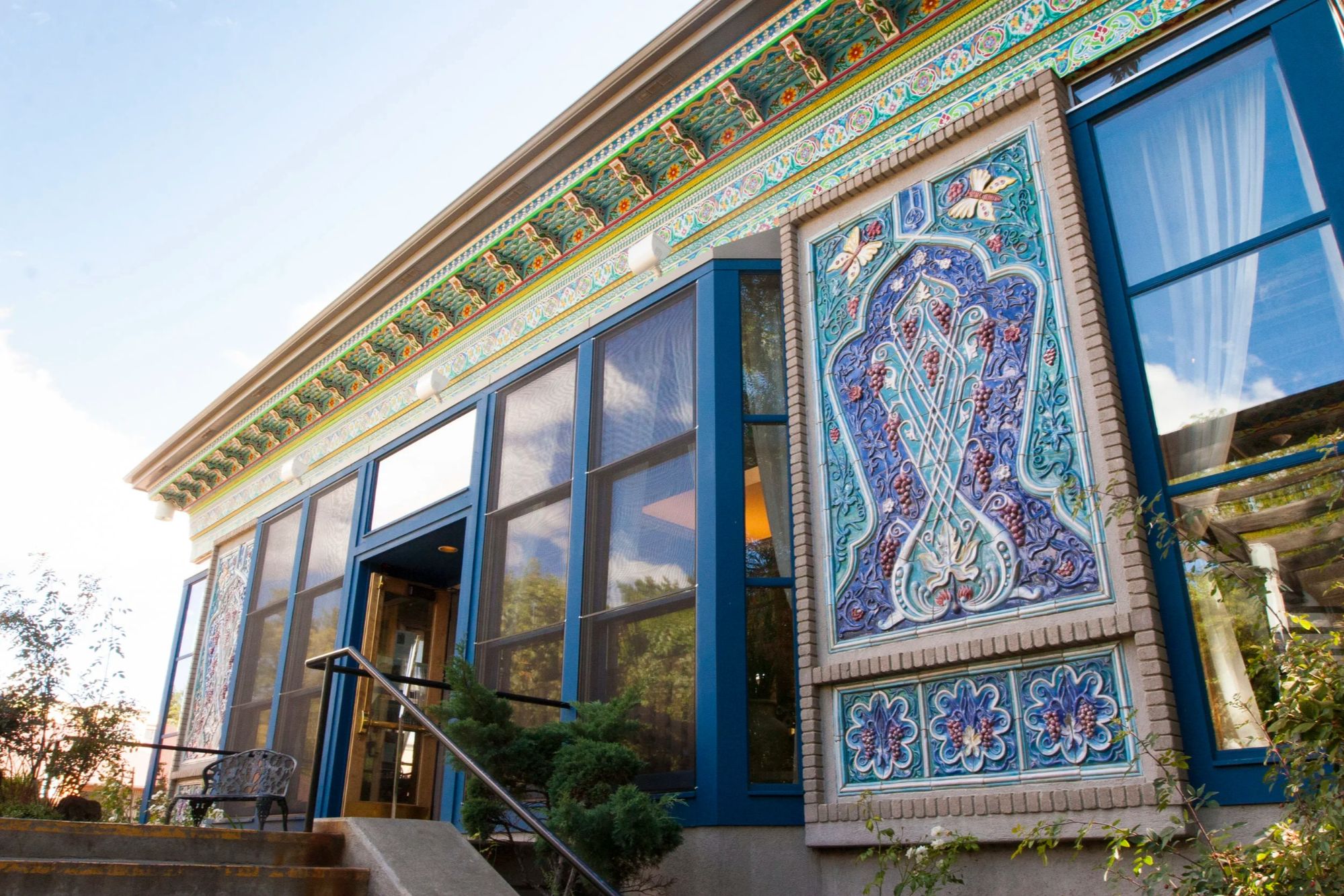
For the most efficient itinerary, eat downtown rather than driving across Boulder for a destination restaurant.
Pearl Street and the neighboring Walnut and Spruce corridors contain the city’s broadest concentration of dining choices. You can choose a quick counter-service meal, a brewery lunch, a patio restaurant or a longer chef-driven experience.
For a distinctly Boulder stop, consider the Boulder Dushanbe Teahouse near 13th Street and Boulder Creek. The ornate Persian-style building serves an international menu and a large tea selection. Its location also sets up the next part of the itinerary without additional driving.
Reserve in advance when possible, especially for weekend brunch or afternoon tea. Restaurant schedules, menus and reservation policies can change, so check directly before making the drive from Denver.
Other practical lunch strategies include:
- Choosing a Pearl Street restaurant so everyone can explore independently afterward
- Picking a food hall when a group wants several cuisines
- Buying prepared food near the farmers market area and eating beside Boulder Creek
- Saving the longer restaurant meal for dinner and keeping lunch quick
The goal is not to visit the most famous restaurant in Boulder. It is to enjoy a good meal without losing the afternoon to parking, waiting or driving.
1:45 p.m.: Walk Along the Boulder Creek Path
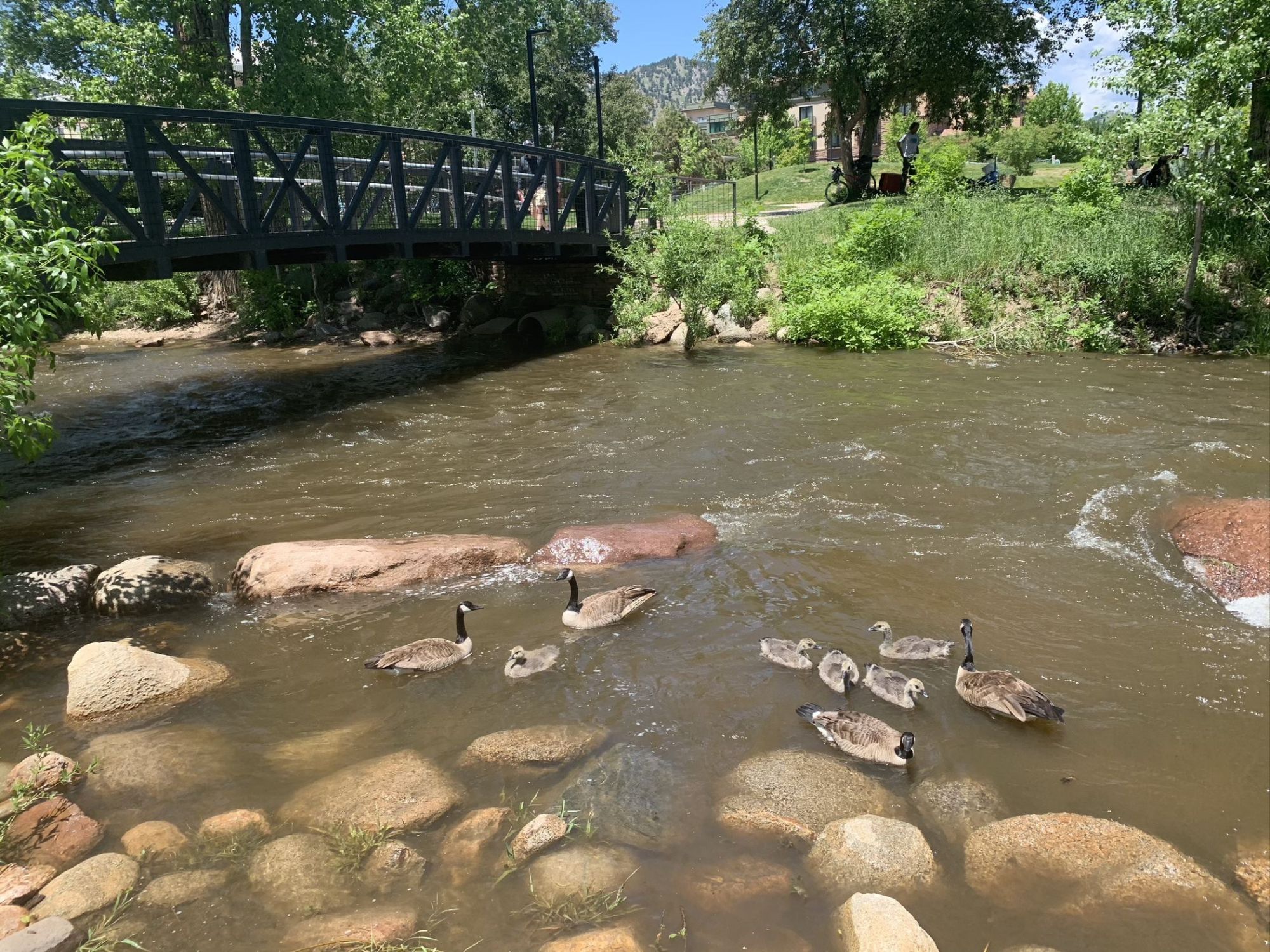
From the Dushanbe Teahouse or Civic Area, step directly onto the Boulder Creek Path.
The full multi-use path extends approximately 5.5 miles from Boulder Canyon on the west to the Stazio Ballfields area east of 55th Street. It passes downtown attractions including the Main Library, the Civic Area and the Dushanbe Teahouse.
You do not need to cover the whole route. For a one-day visit, walk for 20 to 30 minutes in one direction and return.
Heading west brings you closer to Eben G. Fine Park and the mouth of Boulder Canyon. Heading east keeps you near downtown and passes through a greener urban corridor.
The path is shared by walkers, runners, cyclists, families and commuters. Stay to the right, remain aware at bridge crossings and avoid stopping in the middle of the route for photographs.
This portion of the day is deliberately slower. It shows how Boulder’s recreation network functions as part of daily transportation rather than as a separate attraction. Residents use the path to reach work, school, parks, shops and neighborhoods.
3:00 p.m.: Choose CU Boulder or a Historic Neighborhood Walk
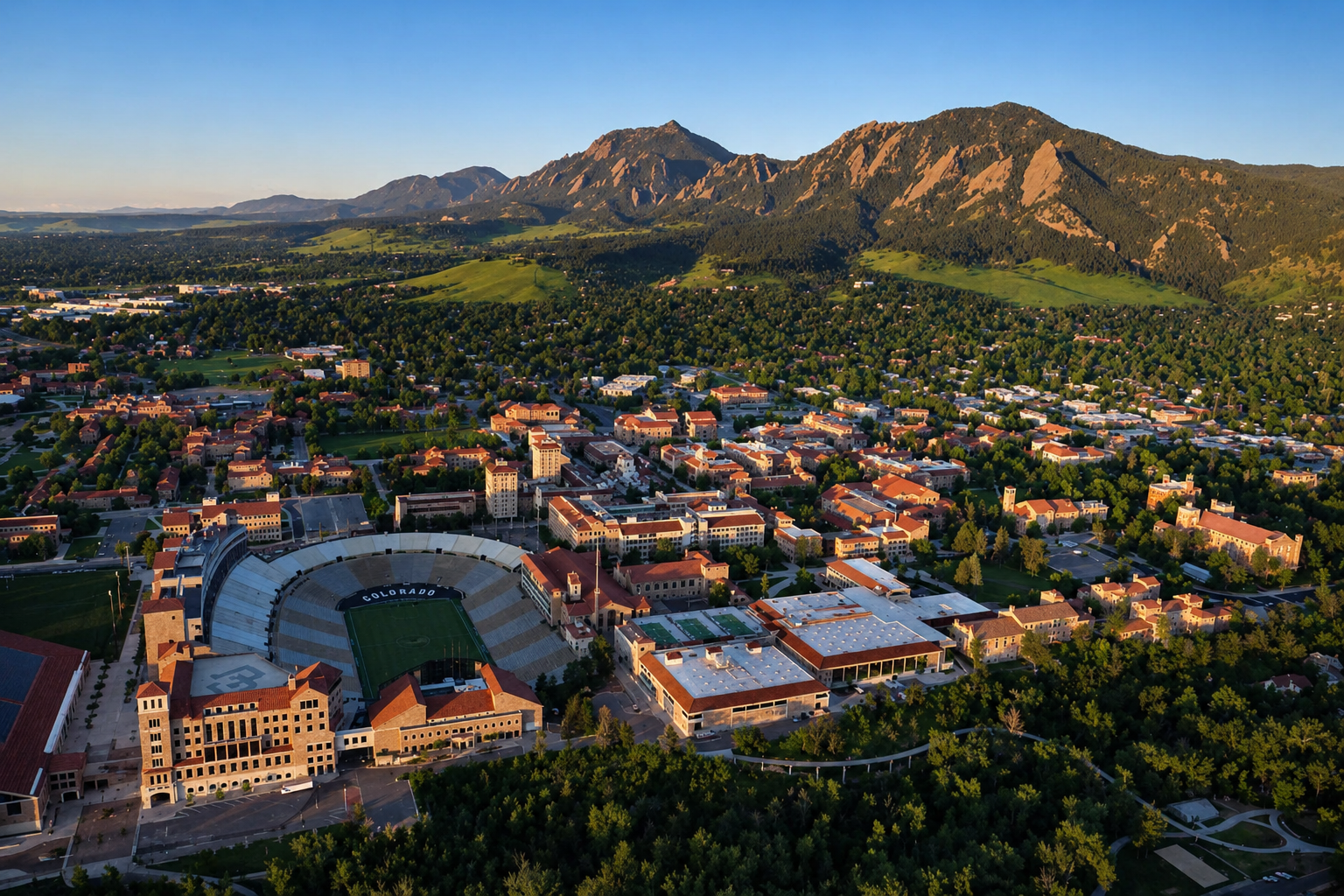
At this point, choose one of two options based on what you want to learn about Boulder.
Option 1: Walk through the CU Boulder campus
The University of Colorado Boulder campus gives the city much of its college-town energy. A short walk offers mountain views, mature landscaping and the university’s recognizable red-tile-roof architecture.
This option makes sense for families with prospective students, alumni, architecture enthusiasts or visitors interested in how the university connects to nearby residential areas.
You can also briefly explore University Hill, but remember that its atmosphere changes substantially during the academic year, football weekends and school breaks.
Option 2: Explore Mapleton Hill, Whittier or west downtown
Visitors who are considering a future move may learn more from a central-neighborhood walk.
Mapleton Hill contains historic homes on tree-lined streets near downtown and the foothills. Whittier sits east of the downtown core, with a mixture of older houses, multifamily buildings and convenient access to central Boulder. West downtown offers condos, townhomes and houses close to both Pearl Street and the mountain edge.
Walk rather than merely driving through. Notice sidewalk continuity, street grades, parking restrictions, traffic, shade, housing density and the actual route between homes and commercial areas.
A neighborhood that looks close to Pearl Street on a map may feel very different after accounting for hills, busy crossings, event traffic or winter conditions.
4:15 p.m.: See Boulder from Panorama Point
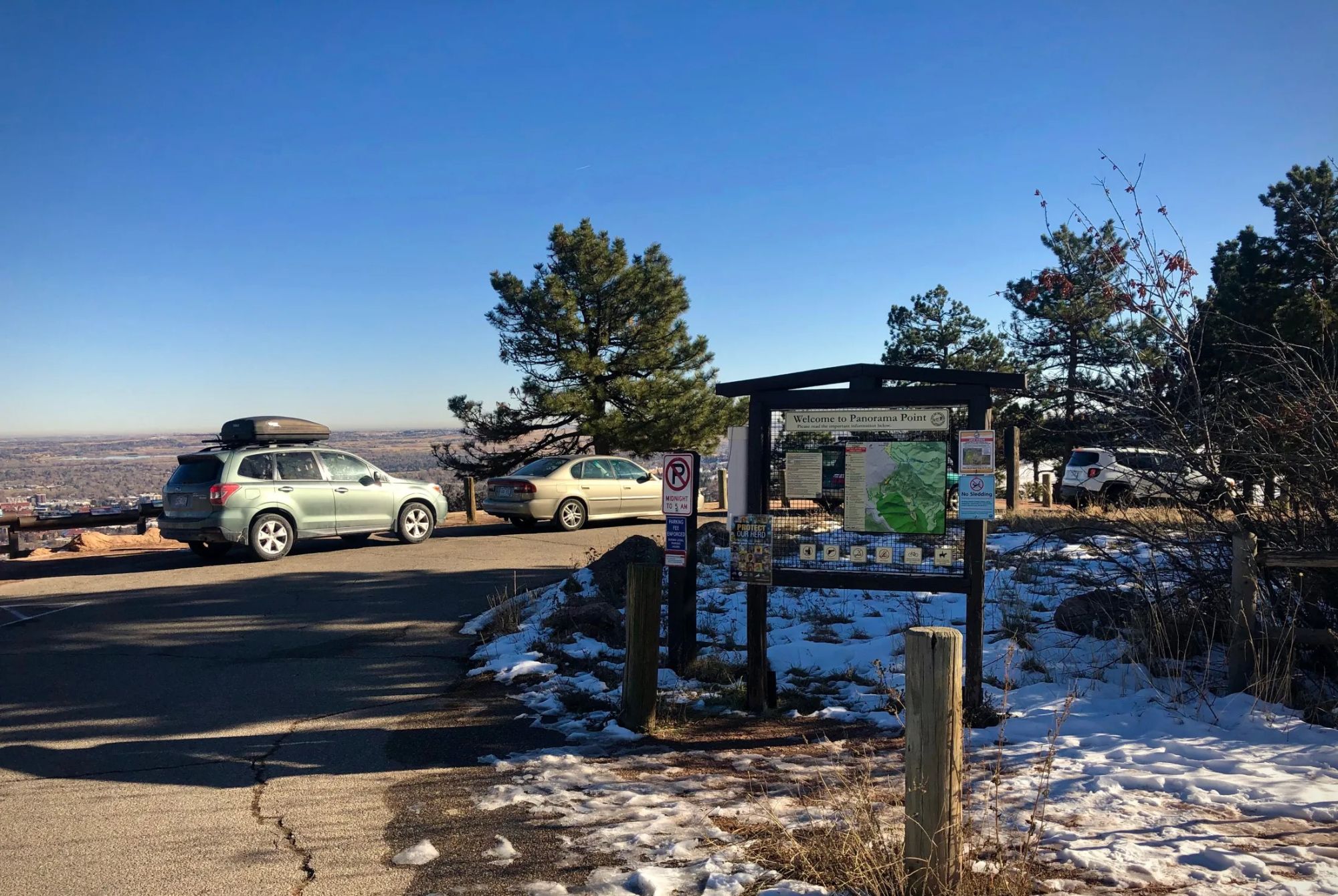
If the weather is clear and you are comfortable driving a winding mountain road, finish the sightseeing portion of the day at Panorama Point.
The overlook sits about one mile up Flagstaff Road and provides a broad view across Boulder and the plains. The trailhead is currently open from 5:00 a.m. to 9:00 p.m. and has no restrooms.
The drive is short, but Flagstaff Road is steep and curving. Watch for cyclists, wildlife, pedestrians and vehicles entering small parking areas.
Parking at designated Flagstaff Mountain locations may require an Open Space and Mountain Parks daily permit for vehicles not registered in Boulder County. A permit purchased for the applicable Flagstaff zone can be used at other listed Flagstaff parking areas on the same date, subject to current rules and space availability.
Keep the stop brief unless you are staying for sunset. Panorama Point is best used as a visual conclusion to the day: Chautauqua showed you Boulder from below the Flatirons, while Panorama Point shows how the city sits between the foothills and the plains.
All Flagstaff Mountain trailhead and parking areas close to vehicles from 9:00 p.m. to 5:00 a.m.
5:30 p.m.: Finish with Dinner or a Boulder Brewery
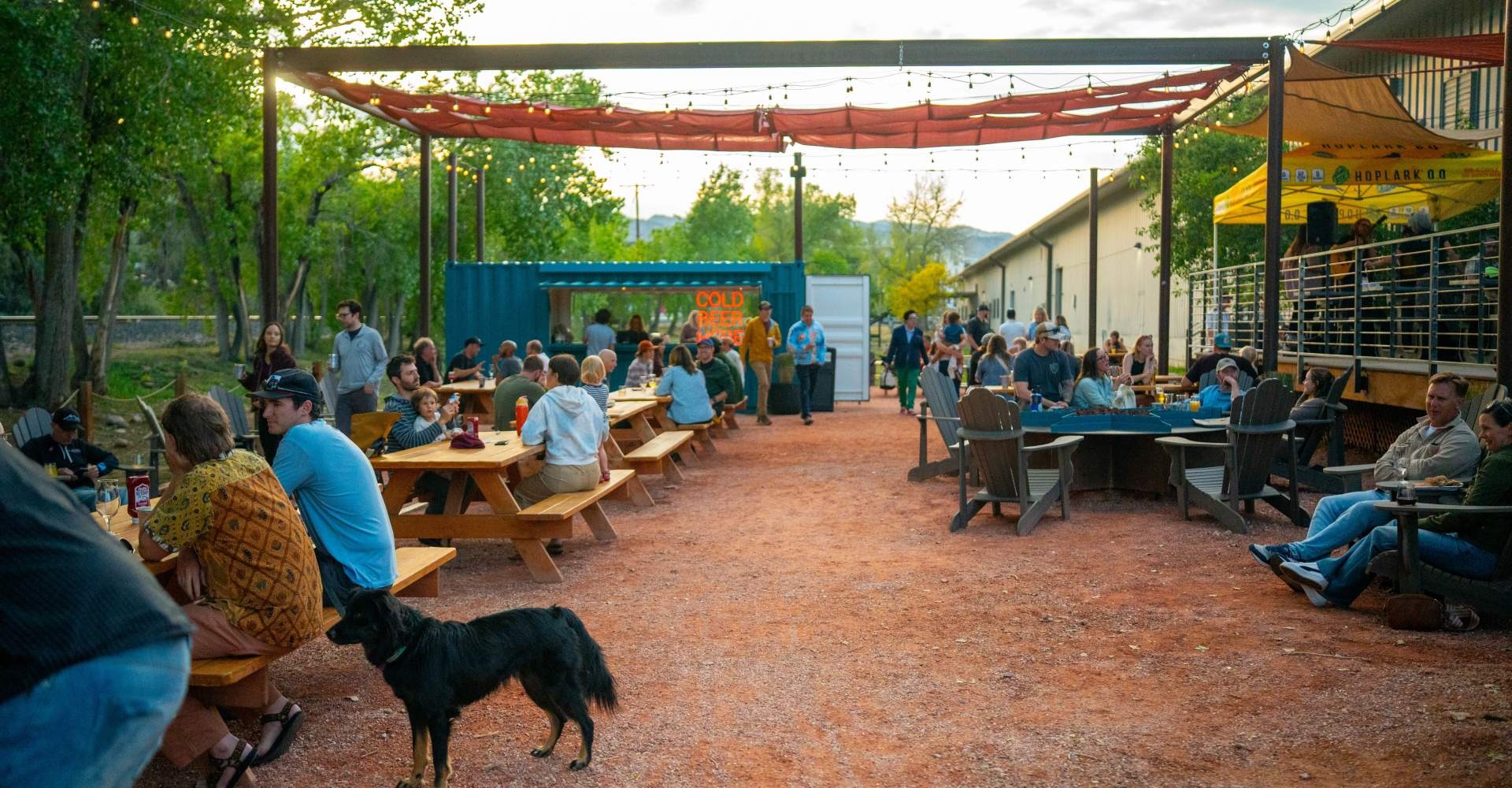
Return to downtown for dinner or choose a brewery elsewhere in the city before driving back to Denver.
Downtown is the most efficient choice because it allows you to combine dinner with one final Pearl Street walk. It also offers the widest range of options, from casual pubs to special-occasion restaurants.
For beer, choose one brewery rather than attempting a multi-stop crawl before driving. Boulder’s taprooms vary considerably by neighborhood:
- Downtown provides walkable brewpubs near Pearl Street.
- North Boulder offers a more neighborhood-oriented, post-trail atmosphere.
- East Boulder contains breweries and food businesses in former or active light-industrial districts.
- Gunbarrel has larger destination taprooms but adds driving time before the return to Denver.
Anyone consuming alcohol should use a designated driver, rideshare or transit rather than driving.
Visitors more interested in coffee or dessert can remain downtown, take another short Pearl Street walk and begin the trip back before evening traffic or event departures.
What This Day Trip Shows You About Living in Boulder
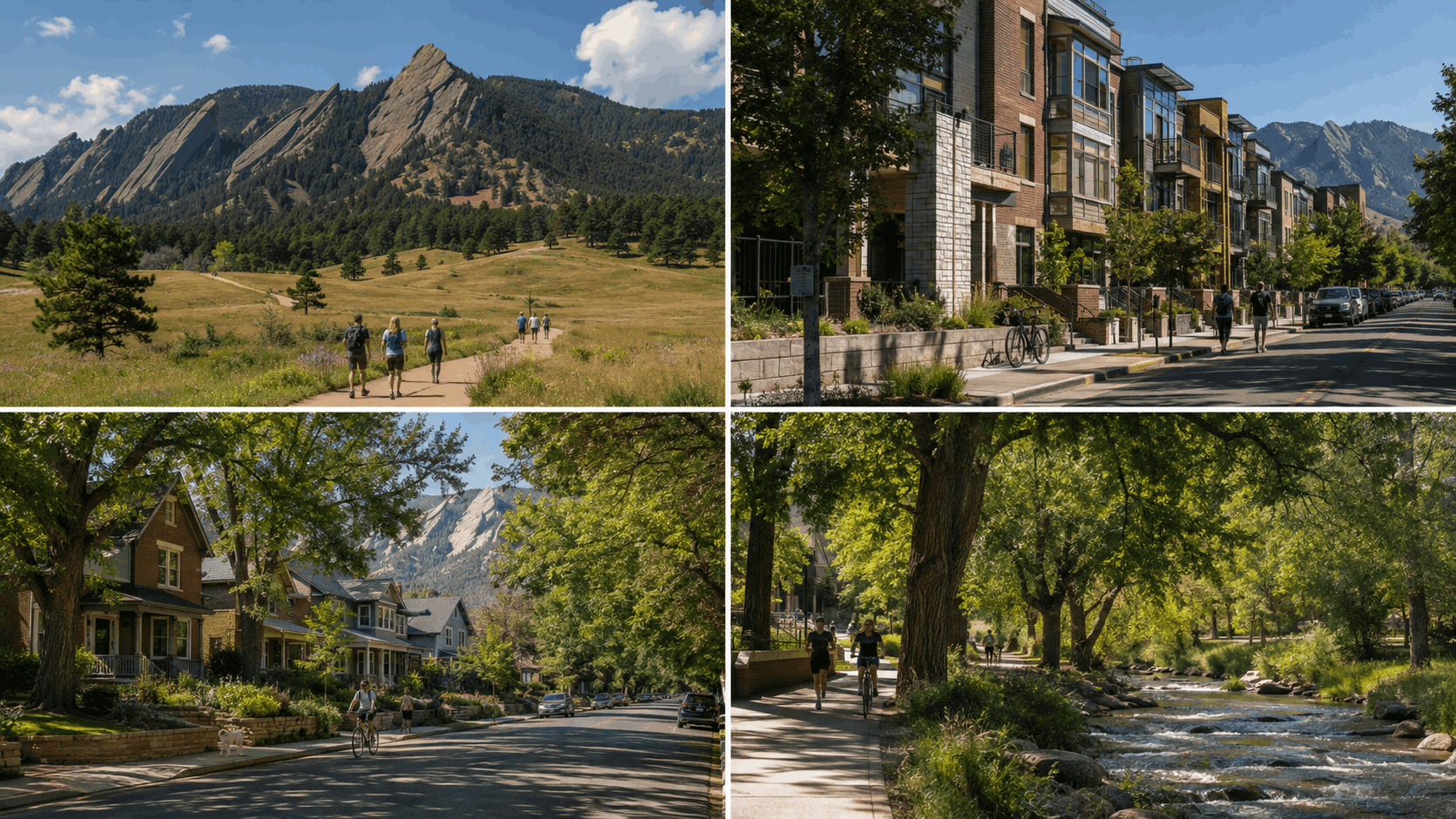
A one-day Boulder itinerary is useful for more than sightseeing. Each stop provides a different window into daily life.
Chautauqua and west Boulder
This part of town offers exceptional foothills access, but visitors should also notice parking pressure, grades, wildfire considerations and the difference between living near open space and living directly beside a heavily used trailhead.
Downtown, Pearl Street and central Boulder
Central Boulder provides the strongest concentration of walkable restaurants, shops and cultural activity. Housing near downtown can offer convenience, but individual properties vary in parking, street noise, age, maintenance obligations and proximity to commercial operations.
Boulder Creek and the multi-use path network
The path shows how cycling and walking can influence a resident’s actual routine. When evaluating a home, test the real route to work, school, downtown or recreation rather than relying solely on a walk-score number.
CU Boulder and University Hill
The university adds employment, lectures, sports, performances and youthful energy. It can also produce event traffic, seasonal noise, student rental demand and a calendar-dependent atmosphere.
Flagstaff and foothills properties
Mountain views and trail proximity are compelling, but buyers should investigate access, road conditions, insurance, fire mitigation, drainage, utilities and emergency-response considerations for each property.
A short visit cannot tell you everything, but it can help identify the questions you should ask before choosing a Boulder neighborhood.
How to Adjust This Boulder Day Trip
For families with young children
Keep the Chautauqua visit to the meadow and lawn, spend more time around Pearl Street’s public spaces and shorten the Boulder Creek walk. Replace Panorama Point if winding roads are likely to be uncomfortable.
For serious hikers
Leave Denver earlier and dedicate most of the morning to a longer Chautauqua-area trail. Reduce downtown shopping and skip the neighborhood walk. Check official trail conditions before departure.
For visitors who do not hike
Enjoy the Flatirons from the Chautauqua lawn, then prioritize Pearl Street, the Dushanbe Teahouse, Boulder Creek, CU Boulder and Panorama Point.
For a rainy or snowy day
Replace the trail with a short Chautauqua view, then consider the Museum of Boulder, Boulder Museum of Contemporary Art, the Dushanbe Teahouse, bookstores, galleries and an extended meal.
For a car-free trip
Take the FF1 to Downtown Boulder Station. Concentrate on Pearl Street, Boulder Creek, the Dushanbe Teahouse and nearby neighborhoods. Add Chautauqua only after confirming a practical local bus or seasonal shuttle connection.
For prospective homebuyers
Spend less time shopping and more time walking through two or three neighborhoods. Visit at least one area outside downtown so you can compare central Boulder with North, South or East Boulder.
Practical Tips for Spending One Day in Boulder
Start early
An early start reduces parking stress at Chautauqua and protects your afternoon schedule if US 36 traffic is slower than expected.
Bring water and sun protection
Boulder sits at approximately 5,430 feet above sea level. Sun exposure and dry air may affect visitors more quickly than expected, particularly during an exposed hike.
Wear layers
Morning foothills temperatures, afternoon sun and evening wind can feel like three different weather conditions in one day.
Check trail conditions
Consult the City of Boulder’s Open Space and Mountain Parks closure information on the morning of your trip. Do not assume a route is open because it appeared in an older itinerary.
Respect the trail system
Stay on designated trails, pack out trash and follow posted dog, bicycle and wildlife rules.
Do not add Rocky Mountain National Park
Rocky Mountain National Park deserves a separate day. Trying to combine Denver, Boulder and the national park usually produces more driving than exploring.
Confirm operating details
Restaurants, museums, shuttles and seasonal attractions may change their hours. Verify important stops directly before leaving Denver.
Is Boulder Worth a Day Trip from Denver?
Yes. Boulder is close enough to Denver to visit without an overnight stay, yet different enough to feel like a separate destination.
In one well-planned day, you can see the Flatirons, complete a short hike, explore Pearl Street, walk beside Boulder Creek, experience a historic neighborhood and enjoy a local meal. The key is to keep the itinerary compact and avoid adding distant attractions.
Boulder also works especially well as a scouting trip for people thinking about relocating from Denver. The day gives you an initial feel for the commute, trail access, downtown walkability, neighborhood density and the relationship between outdoor recreation and residential life.
Frequently Asked Questions
How far is Boulder from Denver?
Downtown Boulder is approximately 28 miles from downtown Denver. Visit Boulder estimates the drive at about 37 minutes under normal conditions, but traffic, weather, construction and events can increase travel time.
Can you visit Boulder without a car?
Yes. RTD’s FF1 Flatiron Flyer connects Denver Union Station with Downtown Boulder Station. Downtown, Pearl Street and Boulder Creek are practical to explore without a car, while Chautauqua may require an additional bus, seasonal shuttle, bicycle trip or rideshare.
What should I do first on a Boulder day trip?
Start at Chautauqua Park. Morning usually provides more comfortable hiking conditions, better light on the Flatirons and a better chance of managing the area’s limited parking.
Is one day enough for Boulder?
One day is enough to experience Boulder’s essential combination of mountain scenery, downtown activity, food and creekside recreation. A second day allows for a longer hike, more neighborhood exploration or a slower dining itinerary.
Where should I park in downtown Boulder?
Use a City of Boulder garage near Pearl Street. City garages generally provide free weekend and city-holiday parking, although the Depot Square garage charges seven days a week. Always review posted rates and restrictions.
Can I combine Boulder and Rocky Mountain National Park in one day?
It is physically possible, but it is not the best way to experience either destination. Give Boulder its own day and plan Rocky Mountain National Park separately.
What is the best time to leave Denver for Boulder?
Leaving downtown Denver around 8:00 a.m. works well for this itinerary. Hikers or summer-weekend visitors may benefit from leaving between 7:00 and 7:30 a.m.
Is Boulder a realistic place to live while working in Denver?
It can be, depending on your work location, schedule and tolerance for commuting. Before moving, test the route during the hours you would actually travel and compare driving with RTD service. Housing type, parking and access to US 36 also vary significantly by neighborhood.
Final Thoughts: The Best Way to Experience Boulder in One Day
The best way to spend one day in Boulder from Denver is not to collect as many attractions as possible. It is to experience the transitions that define the city.
Start beneath the Flatirons. Move from open space into downtown. Follow Boulder Creek through the center of town. Walk a residential street. Look down from the foothills and finish with a local meal.
That sequence gives you more than a set of photographs. It shows you how Boulder’s outdoor access, commercial districts, neighborhoods and transportation network fit together.
For a casual visitor, it is a memorable Colorado day trip. For someone considering a move, it is an excellent first step toward understanding which part of Boulder may fit your lifestyle.
Thinking About Moving from Denver to Boulder?
I help buyers, sellers and relocation clients compare Boulder neighborhoods based on practical factors such as housing type, budget, commute patterns, trail access, walkability, parking and proximity to everyday amenities.
A personalized neighborhood tour can go beyond the visitor highlights and focus on the parts of Boulder that match the way you actually want to live.
FROM OUR BLOG

Pearl Street Mall Guide: Where to Eat, Shop, and People-Watch
Pearl Street Mall is one of the easiest places to start understanding Boulder, but there is an important distinction first-time visitors often miss: the pedestrian mall itself is only four blocks, from 11th Street to 15th Street. Downtown shopping and dining continue east and west well beyond those

Boulder Without a Car: Walkable, Bikeable, and Transit-Friendly Things to Do
If you are considering Boulder without a car, the useful question is not simply, “Is Boulder walkable?” It is whether the places you actually use can be connected comfortably by walking, biking, and transit from a specific address. Boulder gives car-free and car-light residents more infrastructure t

Best Places to Stay in Boulder by Travel Style
Choosing where to stay in Boulder is less about finding one universally “best” hotel and more about matching your lodging to what you actually plan to do. A downtown stay makes it easier to walk to Pearl Street restaurants and shops. A cottage at Chautauqua puts hiking outside your door. A suite wit