
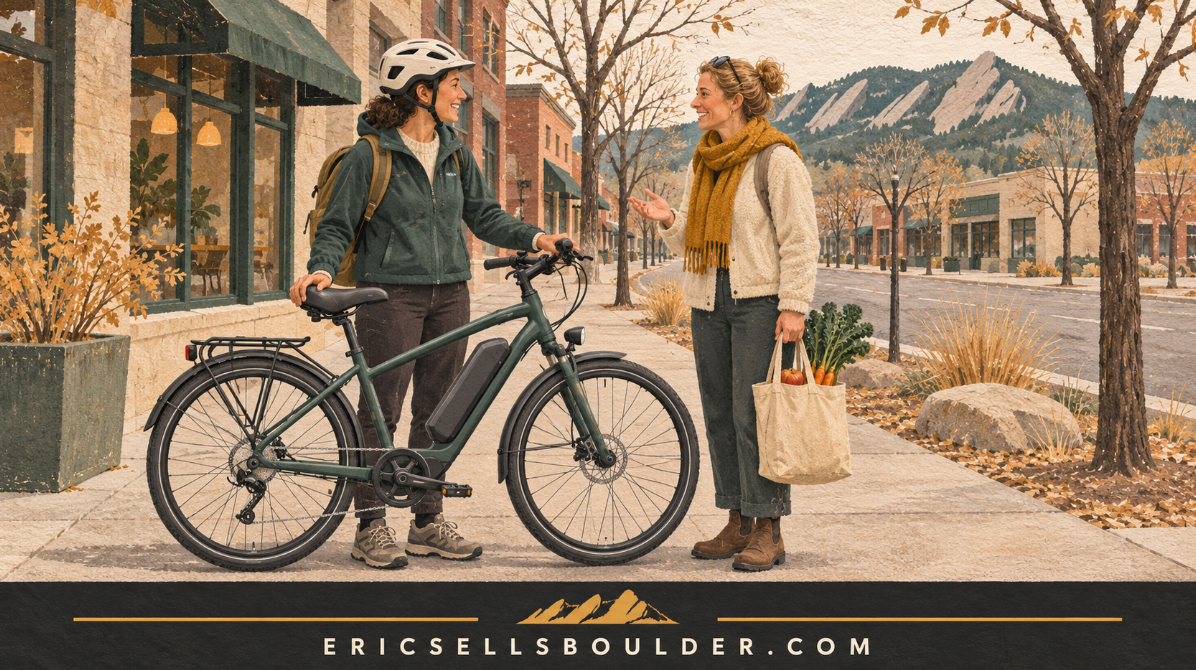
An e-bike can be appealing for the everyday Boulder trips you’d like to make without a car: groceries, a coffee stop, a commute, or a visit across town. Before comparing range, accessories, or holiday discounts, though, there’s a more basic question to answer: can this particular bike go where you want to ride?
On November 23, 2026, the City of Boulder released an e-bike buying guide for holiday shoppers. Its central point is useful well beyond gift season: electric two-wheelers aren’t all the same kind of vehicle.
For a Boulder buyer, the right starting point is the route and the rider. A faster or more powerful device may have fewer places it can legally be used.
Start with the class, not the sales description
Colorado recognizes three classes of electric-assisted bicycles. Here’s a short comparison based on CDOT’s e-bike guidance:
| Class | How it works | Assist ends at |
|---|---|---|
| Class 1 | Pedaling required | 20 mph |
| Class 2 | Can assist without pedaling, using a throttle | 20 mph |
| Class 3 | Pedaling required | 28 mph |
These are motor-assistance cutoffs, not permission to ride at that speed everywhere. A path’s limit and the conditions around you still matter.
Boulder’s detailed electric-mobility guidance also specifies fully operable pedals and a motor power rating of no more than 750 watts for an electric-assisted bicycle. Ask the seller to identify the classification, rated motor power, and assisted-speed limit for the exact model you’re considering.
Treat unclear specifications as an unanswered question. A product description that says “e-bike,” or a device that happens to have pedals, is not enough to establish the applicable rules. Also ask about any mode that changes the device’s capabilities; don’t assume selecting a slower setting gives it a different legal classification.
Match the bike to Boulder’s access rules
For ordinary transportation and recreational riding, the city’s current guide distinguishes these locations:
| Location in the City of Boulder | Classes 1 and 2 | Class 3 |
|---|---|---|
| Streets and bike lanes | Allowed, subject to applicable rules | Allowed, subject to applicable rules |
| City multi-use paths | Allowed | Prohibited |
| OSMP trails | Only specifically designated trails | Prohibited |
Sidewalk use has additional restrictions, and designated dismount zones require walking the bike, subject to accessibility exceptions. A sidewalk should not be treated as an automatic substitute for a prohibited path.
That makes route planning part of shopping. If your intended trip relies on city multi-use paths, check that access before choosing a Class 3 model. If you expect to ride primarily on streets, test how comfortable you feel with the specific streets and crossings involved.
My Boulder Without a Car guide explains how to evaluate everyday trips from a particular address. An e-bike can change how a distance feels, but it doesn’t remove a difficult crossing or create a connection that isn’t there.
Open-space access requires a closer look
“Bikes allowed” and “e-bikes allowed” are not interchangeable trail descriptions.
The city’s OSMP e-bike guide identifies particular trails for Classes 1 and 2. Examples on its current list include Cottonwood, Cottontail, Chapman Drive, and designated portions of other routes. The same guide prohibits e-bikes on trails including Doudy Draw and Flatirons Vista North and South.
Use the linked map to check the whole route, including connectors and land-manager boundaries. A permitted segment is not permission for every trail reached from it. For county-managed land, follow Boulder County’s separate guidance linked from the city guide.
Then check current OSMP closures. Permission to use an e-bike on a trail does not mean that trail is open during mud closures, maintenance, or other restrictions.
This article summarizes ordinary transportation and recreational use. OSMP also publishes separate guidance for people using powered mobility devices because of a mobility disability; those accessibility provisions need to be considered separately.
Be especially careful with an e-moto listing
The city’s new buying guide warns that the devices it describes as e-motos are not allowed on Boulder’s public streets, bike lanes, or multi-use paths.
If a seller is offering a high-powered, motorcycle-style electric device, don’t assume it gets bicycle access. Ask what the vehicle actually is and what requirements apply to it. CDOT notes that “e-moto” is a commonly used term rather than a defined category in state code, and that motor-vehicle requirements can apply.
This is not a blanket statement about every road-legal electric motorcycle. It’s a reason to verify the exact device before buying one for a bicycle route. A seller’s reassurance that it “looks like a bike” should not replace that verification.
Ask questions a test ride can answer

Once you have a suitable classification and route in mind, focus on the practical parts of ownership. Ask to try the bike in a setting appropriate for your ability and the shop’s test-ride rules.
Can you get on and off comfortably? How does the bike feel when starting, stopping, turning slowly, or walking it? Can you manage its weight when the motor isn’t helping? If you plan to carry groceries, discuss the intended load and compatible equipment with the shop rather than assuming any rack or bag will work.
Service matters, too. Before paying, ask who handles maintenance, warranty work, and replacement batteries for that exact model. Request the manufacturer’s written documentation. Those answers can be more useful for everyday ownership than a long list of features you may rarely use.
For a younger rider, confirm the age rules before shopping. CDOT identifies a minimum operating age of 16 for Class 3 and a helmet requirement for Class 3 riders under 18. It recommends helmets regardless of class. Classification alone also doesn’t tell you whether a child has the skills to handle a particular route.
Give the bike a workable place at home
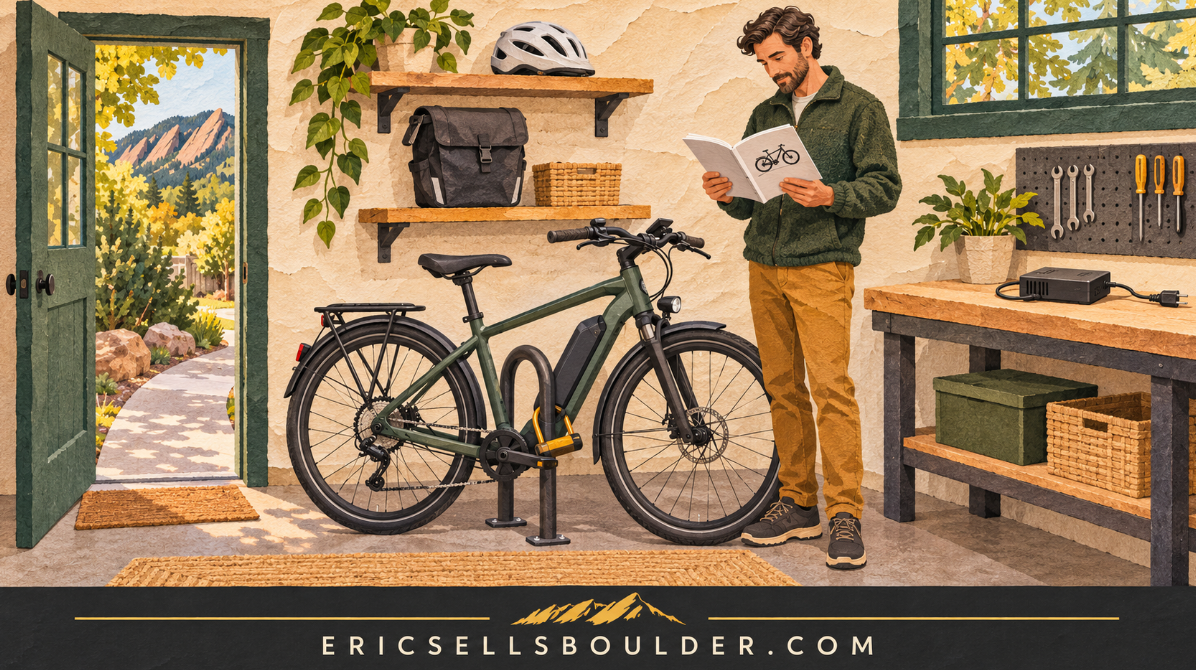
Before bringing a bike home, work through the last part of each trip: getting it inside and putting it away.
Measure the doorway, storage space, and any stairs you would need to use. Check whether you can lift or maneuver the actual bike. If you live in a condo, townhome, or rental, ask about the rules for the storage area and intended charging location instead of assuming a shared bike room includes charging permission.
The U.S. Consumer Product Safety Commission’s battery guidance advises using the supplied charger, being present while charging, never charging while sleeping, following manufacturer instructions, and using only approved replacement batteries. Ask for information about testing and certification to the applicable safety standards.
For homebuyers, those practical questions belong in the property search. A convenient route loses some of its appeal if daily storage is difficult. My Boulder condo and townhome buyer guide covers the broader importance of reviewing association documents and responsibilities.
Keep the first trips simple
Start with a familiar, manageable route and leave time to learn the bike. Route access is only one part of using it considerately.
Boulder lists a 15 mph limit on multi-use paths. Yield to pedestrians and slower traffic, give an audible warning before passing, and slow down when conditions require it. Those are everyday responsibilities, not targets to ride up to regardless of what’s happening around you.
If a trip ends near Pearl Street, confirm where you need to dismount and where you’ll secure the bike. The Pearl Street Mall guide can help you understand the downtown layout; follow posted signs and the city’s current rules for the actual approach.
Frequently asked questions
Can I ride a Class 3 e-bike on Boulder’s multi-use paths?
No. Boulder’s published rules prohibit Class 3 e-bikes on city multi-use paths. Slowing down does not remove that class restriction.
Can I ride an e-bike on every Boulder open-space trail that allows bikes?
No. OSMP allows Classes 1 and 2 only on specifically designated trails. Check its e-bike map, the whole route, posted signs, and current closures.
Is a higher assistance cutoff the speed I can ride on a path?
No. A motor-assistance cutoff describes the bike’s assistance, not the speed permitted at every location. Local limits and conditions still control how you ride.
What should I check before buying an e-bike for a Boulder condo?
Confirm the bike’s access class, your intended routes, how you’ll move it into storage, and the association’s rules for storage and charging. Review the manufacturer’s charging instructions before choosing a charging location.
Choose the bike for the life you want to use it in
For some households, an e-bike may make an ordinary errand or commute more appealing. The useful purchase is the one that fits the rider, the route, and the home where it will be kept.
If easier access to everyday destinations is part of your Boulder home search, I can help you compare specific properties and the connections around them.
Contact Eric Farran or call/text 303-668-5747.
Information checked November 24, 2026. This article is general consumer information, not a legal determination for a particular device. Verify current city, state, land-manager, manufacturer, and property-specific requirements before buying or riding. Rules elsewhere in Boulder County may differ.
FROM OUR BLOG


Boulder Holiday Events 2026: Your Local Guide to Lights, Shopping, Parades & Family Fun
Which day should you bring the kids to Pearl Street? That depends on whether they’ve been talking about Santa or the train. Santa has the Friday after Thanksgiving and three Saturdays. The little electric train gets the Sundays. And if you want to hear the names of the school groups as their floats

Boulder’s Vacancy Tax Passed: What Homeowners Need to Know Before 2028
Say you keep a Boulder condo so you can spend summers here and visit family over the holidays. When you draw up your 2028 budget, one question will matter more than what the condo is worth: How many days of the year does someone live there? On November 3, 2026, Boulder voters approved Ballot Issue 2

There's Something Special About Boulder During the Holidays — Here's Why
There’s a point on a winter evening in Boulder when the foothills are still visible but the streets below have already gone dark. Look west and you might catch the Boulder Star above town. Walk a few blocks downtown and you’ll find a different kind of light in the trees and storefronts along Pearl S